Clear Sky Science · en
Rapid modulation of choice behavior by ultrasound on the human frontal eye fields
Why this research matters for everyday choices
Many of our split-second choices, like where we look when something flickers in our peripheral vision, feel automatic. Yet they are driven by precise activity in tiny brain regions deep beneath the skull. This study shows that gentle pulses of ultrasound, delivered from outside the head, can nudge these rapid eye-movement choices in humans within a few hundredths of a second. The work opens the door to using sound waves to probe how brain circuits support decision-making, and hints at future, highly targeted therapies that do not require surgery or implanted devices.
A new way to nudge brain activity
Scientists have long sought tools that can alter brain activity with both pinpoint accuracy in space and millisecond timing. Existing methods such as magnetic or electrical stimulation can affect broad areas and sometimes cause strong, disruptive responses. By contrast, transcranial ultrasonic stimulation (TUS) uses focused sound waves at frequencies far above hearing to gently influence brain tissue without surgery. Animal studies suggested that TUS can bias choices by acting on specific brain circuits, but it was unclear whether the same precise, immediate effects could be achieved safely in humans, or whether the outcome would be to excite, inhibit, or simply disturb ongoing activity. 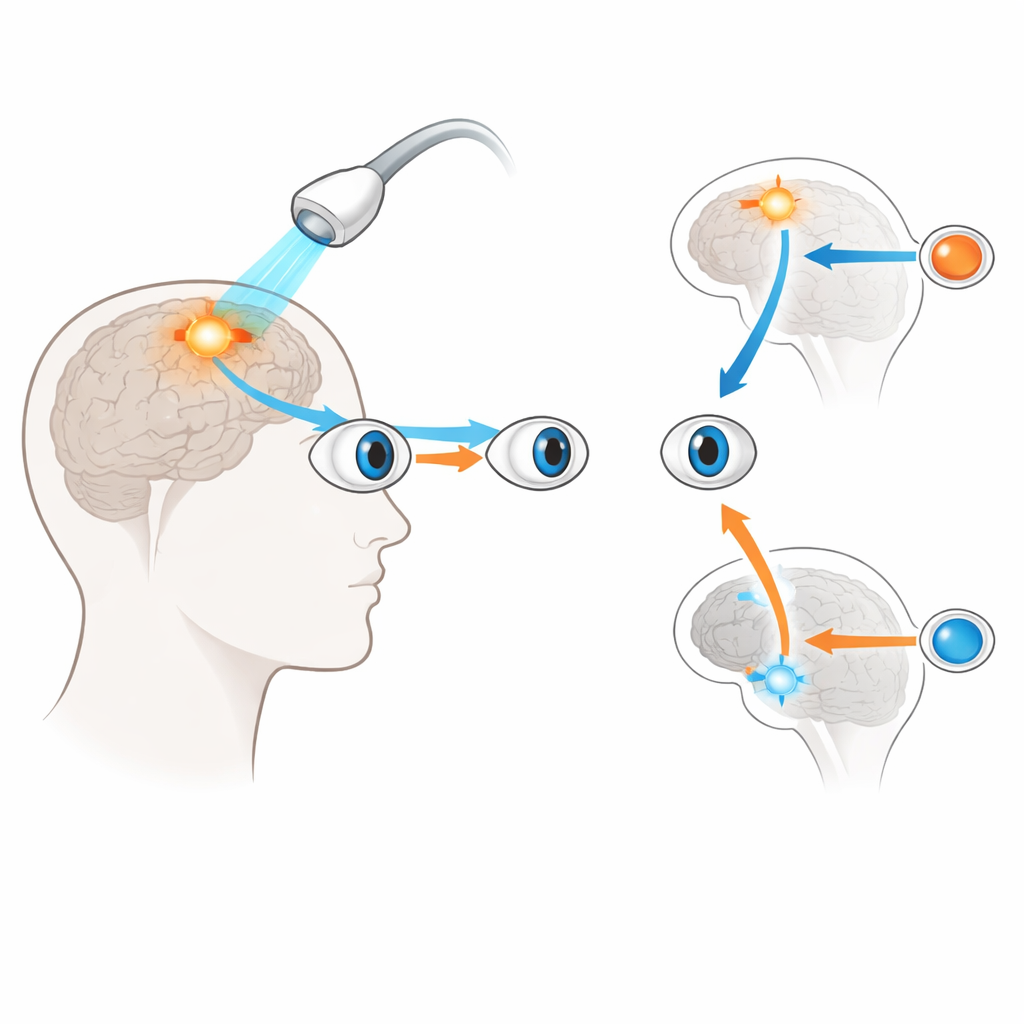
Targeting the brain’s eye-movement control center
The researchers focused on the frontal eye fields (FEFs), small regions on each side of the brain that help decide where we look next. Each FEF mainly controls rapid eye movements, or saccades, toward the opposite side of space. This makes the FEF an ideal testing ground: if stimulation changes its output, eye-movement choices should shift in a clear, measurable way. In the study, 35 volunteers performed a simple game. On each trial, two brief "planet" targets appeared one after the other on the left and right of a central fixation point, separated by only a few thousandths of a second. Participants had to look as quickly as possible at whichever target appeared first, earning or losing points based on accuracy.
Sound pulses that subtly tip the balance
During critical trials, the team delivered 500-millisecond trains of focused ultrasound to either the left or right FEF just as the first target appeared. On other trials, they stimulated a control region in the hand area of the motor cortex, or played only a masking sound without ultrasound. The task was designed so that many trials had very small timing differences between the two targets, making the “correct” answer uncertain and thus more easily influenced by even a tiny bias in brain activity. The key result was that TUS to an FEF reliably increased saccades toward the opposite side of space: stimulating the left FEF led to more rightward choices, and stimulating the right FEF led to more leftward choices, especially when the visual evidence was ambiguous. Importantly, similar ultrasound to the hand motor area did not shift eye choices, showing that the effect was specific to the eye-movement control circuit rather than to general sensations or sounds from the device.
Brain chemistry helps explain who is most affected
Not everyone’s choices shifted to the same extent. To understand why, the researchers measured levels of GABA+, a marker of inhibitory brain chemistry, in the left FEF and left motor cortex using magnetic resonance spectroscopy. Participants with lower baseline GABA+ in the FEF—meaning a lower inhibitory tone—showed the largest ultrasound-induced change in eye-movement bias, while those with higher inhibitory tone changed less. This relationship was specific to the FEF: GABA+ levels in the motor cortex did not predict any effect of TUS on eye choices. The findings suggest that ultrasound does not simply turn brain activity up or down in a fixed way; instead, it interacts with the existing balance of excitation and inhibition in each person’s brain. 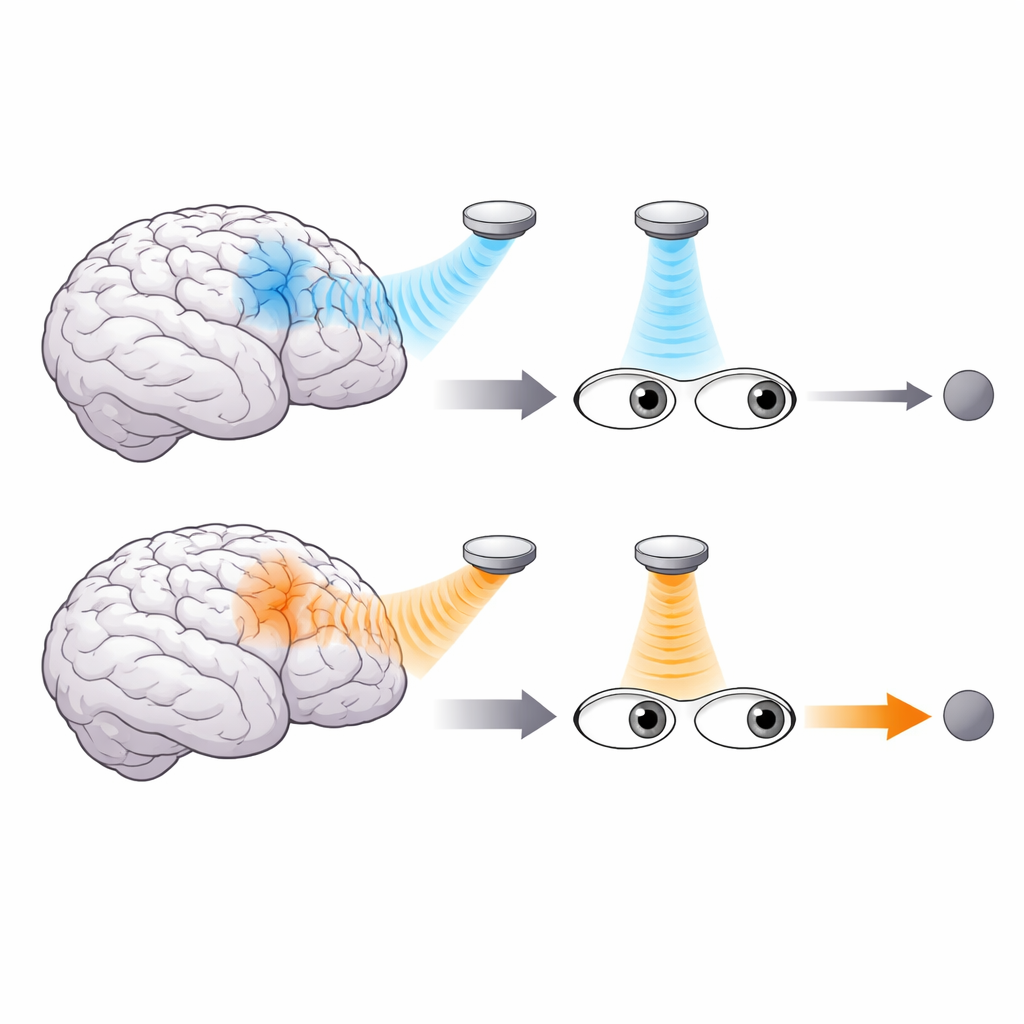
Fast, precise, and promising for future applications
The timing of the effects is crucial. The shift in eye movements appeared even on the fastest trials, when participants had less than about 265 milliseconds of stimulation before moving their eyes. At the same time, there was no drop in overall accuracy and little evidence that the bias carried over to the next trial. Together, this implies that TUS can act as a moment-to-moment "nudge" on ongoing brain computations rather than as a blunt, long-lasting disruption. For a lay observer, the takeaway is that carefully tuned ultrasound can steer our tiny eye-movement decisions in real time, and that how strongly it works depends on each brain’s underlying chemistry. This positions focused ultrasound as a powerful, noninvasive tool for mapping cause-and-effect links in the human brain, and as a potential stepping stone toward future personalized treatments for disorders of attention, movement, and decision-making.
Citation: Farboud, S., Kop, B.R., Koolschijn, R.S. et al. Rapid modulation of choice behavior by ultrasound on the human frontal eye fields. Nat Commun 17, 2966 (2026). https://doi.org/10.1038/s41467-026-69854-7
Keywords: transcranial ultrasound, eye movements, brain stimulation, decision making, GABA inhibition