Clear Sky Science · en
Dolutegravir restores gut microbiota in late-stage HIV-1 unlike darunavir: an open-label, randomized clinical trial
Why your gut matters in HIV treatment
HIV is best known for attacking the immune system, but it also disrupts the trillions of microbes living in our intestines. This "gut community" helps protect us from infections and keeps inflammation in check. For people diagnosed with HIV very late, doctors have long wondered whether standard drug treatments can ever truly repair this hidden ecosystem. This study asks a practical question with big health implications: do different HIV drug combinations have very different effects on the gut, even when they control the virus equally well?
Two treatment paths, same virus control
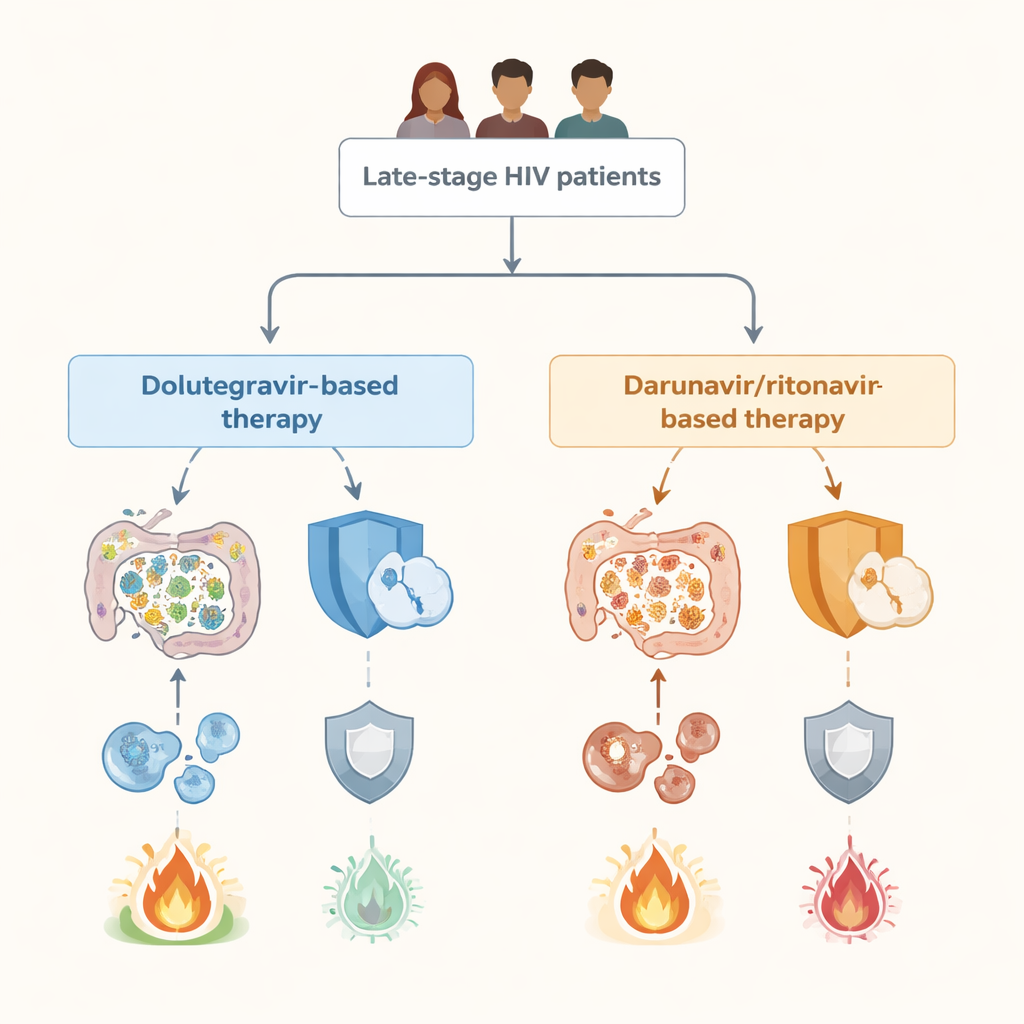
Researchers in Spain followed 88 adults newly starting HIV therapy, all with very advanced infection and extremely low CD4 T-cell counts (the key immune cells that HIV destroys). Everyone received the same backbone of two drugs, but they were randomly assigned to one of two main regimens: one built around dolutegravir, an integrase inhibitor, and the other around darunavir boosted with ritonavir, a protease inhibitor. Both combinations are modern, highly effective treatments. Over two years, both groups suppressed the virus and gained CD4 cells at similar rates, meaning the core HIV control and basic immune recovery were comparable.
The gut’s recovery is not the same
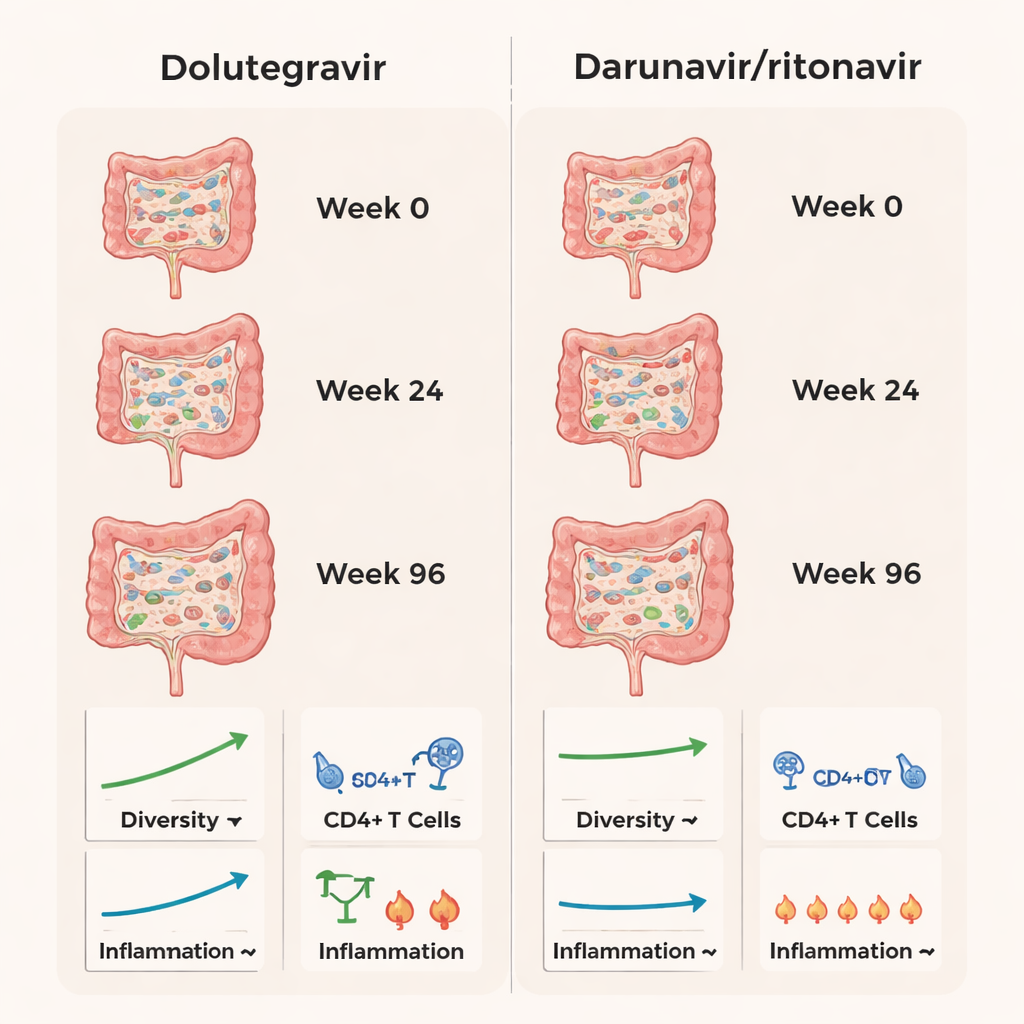
Where the two regimens parted ways was in the gut. The team regularly collected stool samples and used DNA sequencing to map which microbes were present and what they were capable of doing. People on dolutegravir gradually developed richer and more diverse gut communities: more species overall, a better balance between them, and a more consistent pattern of change across individuals. In contrast, participants on darunavir/ritonavir showed little meaningful improvement in these measures. By the end of the study, the gut microbiota of those taking dolutegravir looked noticeably more like that of people without HIV, although it did not fully “normalize.”
Less inflammation, calmer immune system
The researchers also tracked signs of inflammation and immune activation in the blood. High levels of markers such as C-reactive protein (CRP) and soluble CD14 (sCD14) are linked to heart disease, cancers, and earlier death in people living with HIV. Both treatment groups improved, but the dolutegravir group showed greater and more consistent drops, especially in sCD14. Within this group, individuals whose gut communities became richer and more “settled” tended to have higher CD4 counts, better body weight, and lower inflammation. These patterns were largely absent in the darunavir/ritonavir arm, suggesting that the way the microbiome rebounds under dolutegravir may help quiet long-term immune over-activity.
Healthier microbial teamwork
Looking more closely, the authors saw that dolutegravir encouraged not just different individual species, but different ways microbes interacted. Species that cooperate to ferment food into short-chain fatty acids—molecules that nourish gut cells and strengthen the intestinal barrier—became more prominent and more tightly connected in people taking dolutegravir. These included methane-producing archaea and bacteria involved in lactate and other fermentative pathways. Under darunavir/ritonavir, the network remained more fragmented and dominated by hardy, generalist microbes often linked with chronic inflammation and disturbed metabolism. Functionally, the gut communities in the dolutegravir group shifted toward more “building up” chemistry—biosynthesis and energy cycles—rather than the more “breaking down” or stress-related processes seen with darunavir/ritonavir.
What this means for people living with HIV
For patients diagnosed late, HIV therapy is not just about controlling the virus—it is about rebuilding the body’s internal environment to lower long-term risks. This trial suggests that starting treatment with a dolutegravir-based regimen can better restore a healthier, more stable gut microbiome and reduce chronic inflammation than a darunavir/ritonavir-based regimen, even when both control HIV equally well. While larger and longer studies are needed to confirm whether these differences translate into fewer heart attacks, cancers, or other complications, the findings reinforce the idea that the gut is a key target in HIV care, and that the choice of first-line therapy can influence how well this hidden organ system recovers.
Citation: Català-Moll, F., Blázquez-Bondia, C., Farré-Badia, J. et al. Dolutegravir restores gut microbiota in late-stage HIV-1 unlike darunavir: an open-label, randomized clinical trial. Nat Commun 17, 2022 (2026). https://doi.org/10.1038/s41467-026-69846-7
Keywords: HIV treatment, gut microbiome, dolutegravir, inflammation, antiretroviral therapy