Clear Sky Science · en
Polar chromosomes are rescued from missegregation by spindle elongation-driven microtubule pivoting
When Cell Division Goes Wrong
Every time a human cell divides, it must share its DNA equally between two daughter cells. If even one chromosome goes astray, the result can be genetic chaos that fuels cancer. This study tackles a subtle but important problem: what happens to chromosomes that start cell division in the “wrong place” and risk being left behind. The researchers uncover an elegant mechanical rescue system that swings these stray chromosomes into safety before it is too late.
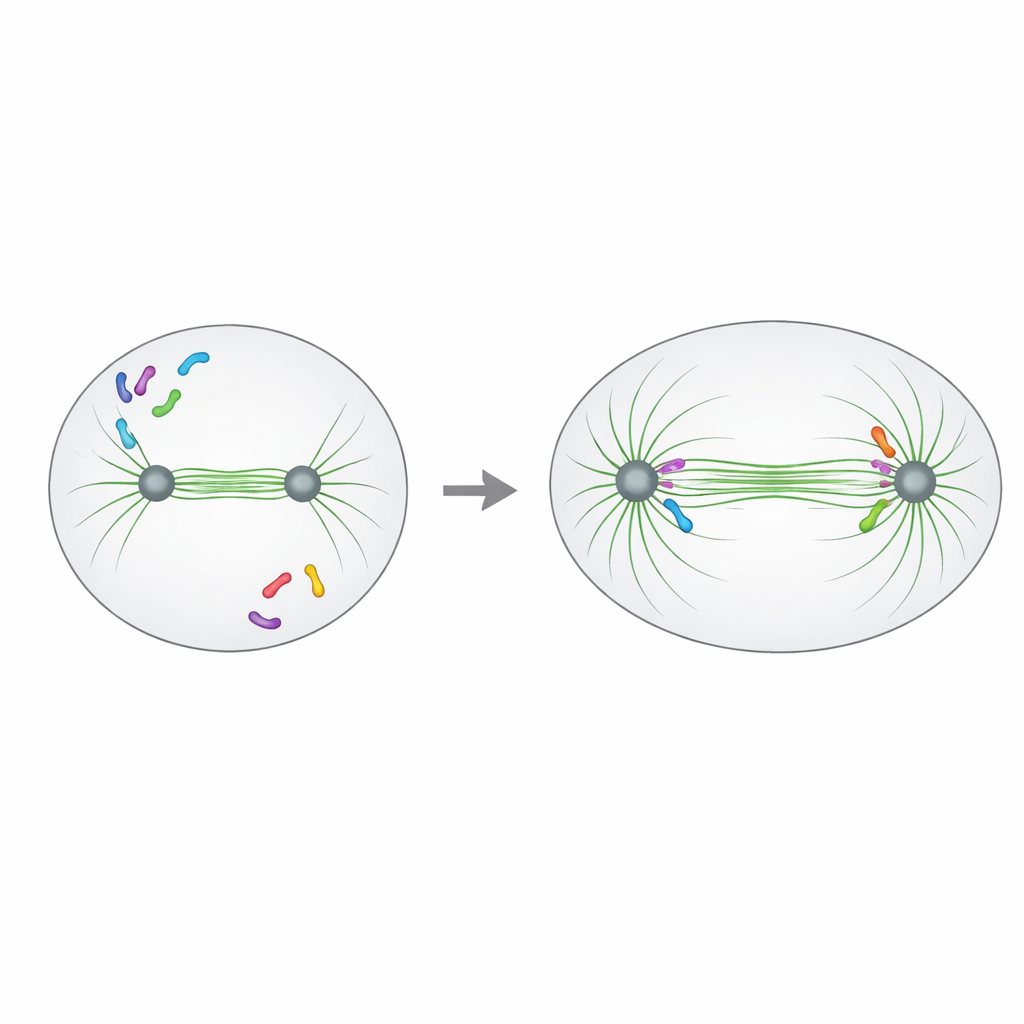
A Risky Neighborhood Inside Dividing Cells
As a cell prepares to divide, its chromosomes line up on a tiny football-shaped machine called the spindle. Where a chromosome sits at the moment the nuclear envelope breaks down strongly shapes its fate. Those that happen to lie behind one of the spindle’s poles, called polar chromosomes, are hidden from the main spindle fibers and are especially prone to missegregation and ending up in extra “micronuclei.” These micronuclei are not just oddities: they are strongly linked to chromosomal instability and aggressive cancers. Previous work had shown that polar chromosomes take longer routes to the middle of the spindle and fail more often, but the crucial step that lets them escape from behind the pole was a mystery.
A Hidden Time Gap and a Mechanical Clue
Using fast three-dimensional live-cell imaging and super-resolution microscopy, the authors tracked polar chromosomes in human cells with nanometer and second-scale precision. They discovered that after an initial pull toward the back of the spindle pole, polar chromosomes pause for about four minutes in a “danger zone” behind the pole. During this pause, other chromosomes already begin aligning at the cell’s equator. Careful timing comparisons showed that this delay is specific to the polar location, not simply to distance. Intriguingly, throughout this waiting period, polar chromosomes remain attached to thin fibers called astral microtubules, which radiate from the spindle poles into the surrounding cytoplasm.
Spindle Stretching Makes Microtubules Swing
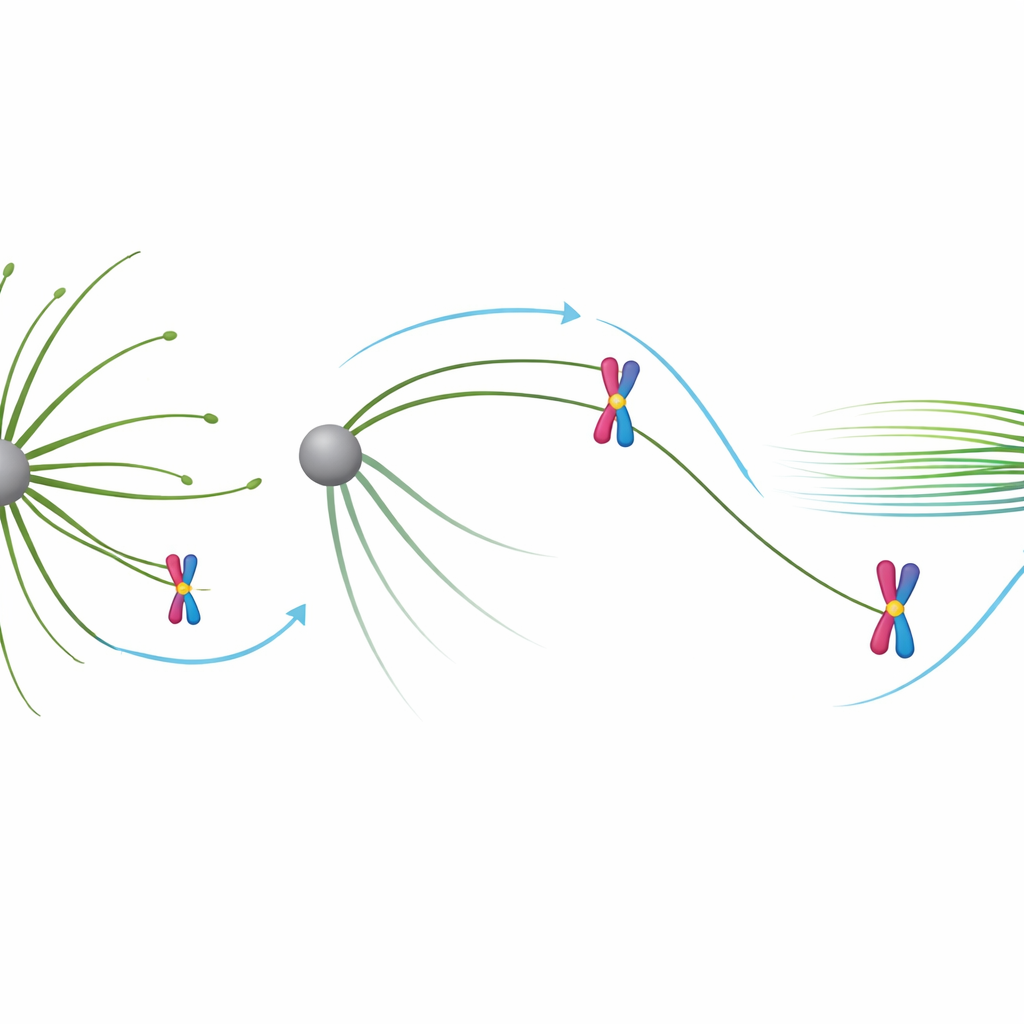
To understand how polar chromosomes finally escape, the team proposed several possibilities and systematically ruled out the usual suspects—well-known motor proteins that pull chromosomes along fibers. Even when these motors were disabled, polar chromosomes still managed to cross in front of the pole, suggesting another force at work. By watching individual fibers in three dimensions, the researchers saw that as the spindle elongates—its poles moving farther apart—the astral microtubules that carry polar chromosomes pivot around the centrosome like swinging arms. The chromosomes themselves move only slightly; instead, the angle of the attached microtubule changes, rotating the chromosome from behind the pole to the spindle surface. When drugs were used to shorten the spindle or block its elongation, the pivoting reversed or stopped, and when elongation resumed, the microtubules swung back toward the spindle again. This showed that spindle elongation is both necessary and sufficient to drive the pivoting motion.
Complex Grips and a Final Assist
Closer inspection revealed that polar chromosomes often maintain surprisingly complex grips on their fibers while pivoting. Instead of simple side-on contacts, their kinetochores—the protein structures that attach chromosomes to microtubules—frequently combine side-on and immature end-on attachments to the same or nearby astral microtubules. Molecular markers showed that these connections are stable enough to keep the chromosome tethered but still “unfinished,” keeping the cell’s safety checks partly active. As the pivot brings the chromosome near the main spindle surface, microtubules growing from the opposite spindle half can then catch the other sister kinetochore. This final tug helps complete proper attachments and pulls the chromosome fully into the spindle body.
Consequences for Cancer and Chromosome-Specific Risk
Because polar chromosomes are such a potent source of errors, the team asked what happens when the pivoting mechanism is disrupted. By weakening a key checkpoint enzyme, they forced some cells into anaphase before the spindle had finished elongating. In these cells, polar chromosomes were much more likely to remain unaligned and missegregate, often producing daughter cells with abnormal chromosome numbers. The researchers also mapped where specific chromosomes sit in the interphase nucleus and found that chromosome 1 often occupies “caps” at the ends of the nucleus that are most likely to become the danger zone behind the poles. This positional bias may help explain why chromosome 1 is so frequently gained in cancers. Importantly, in several cancer cell lines, slowing spindle elongation increased the number and persistence of polar chromosomes, while enhancing elongation reduced them and sped up mitosis.
How Cells Swing Stray Chromosomes Back to Safety
Put simply, this work shows that dividing cells rescue at-risk polar chromosomes not by pulling them along like cargo, but by swinging the fibers they cling to. As the spindle stretches, astral microtubules pivot around the spindle poles, rotating attached chromosomes out of the danger zone and onto the main highway of the spindle, where they can join the central lineup. If this pivoting is too weak or too slow—as can happen in cancer cells—polar chromosomes may never make it to the middle, fueling ongoing genomic instability. By revealing this mechanical safeguard, the study suggests that tuning how much the spindle elongates could one day help either stabilize or deliberately destabilize cancer cell divisions.
Citation: Koprivec, I., Štimac, V., Đura, M. et al. Polar chromosomes are rescued from missegregation by spindle elongation-driven microtubule pivoting. Nat Commun 17, 2049 (2026). https://doi.org/10.1038/s41467-026-69830-1
Keywords: chromosome segregation, mitotic spindle, cancer cell division, microtubule dynamics, chromosomal instability