Clear Sky Science · en
Modulated metal-support interactions for efficient nitrate electroreduction at positive potentials
Turning Polluted Water into a Useful Resource
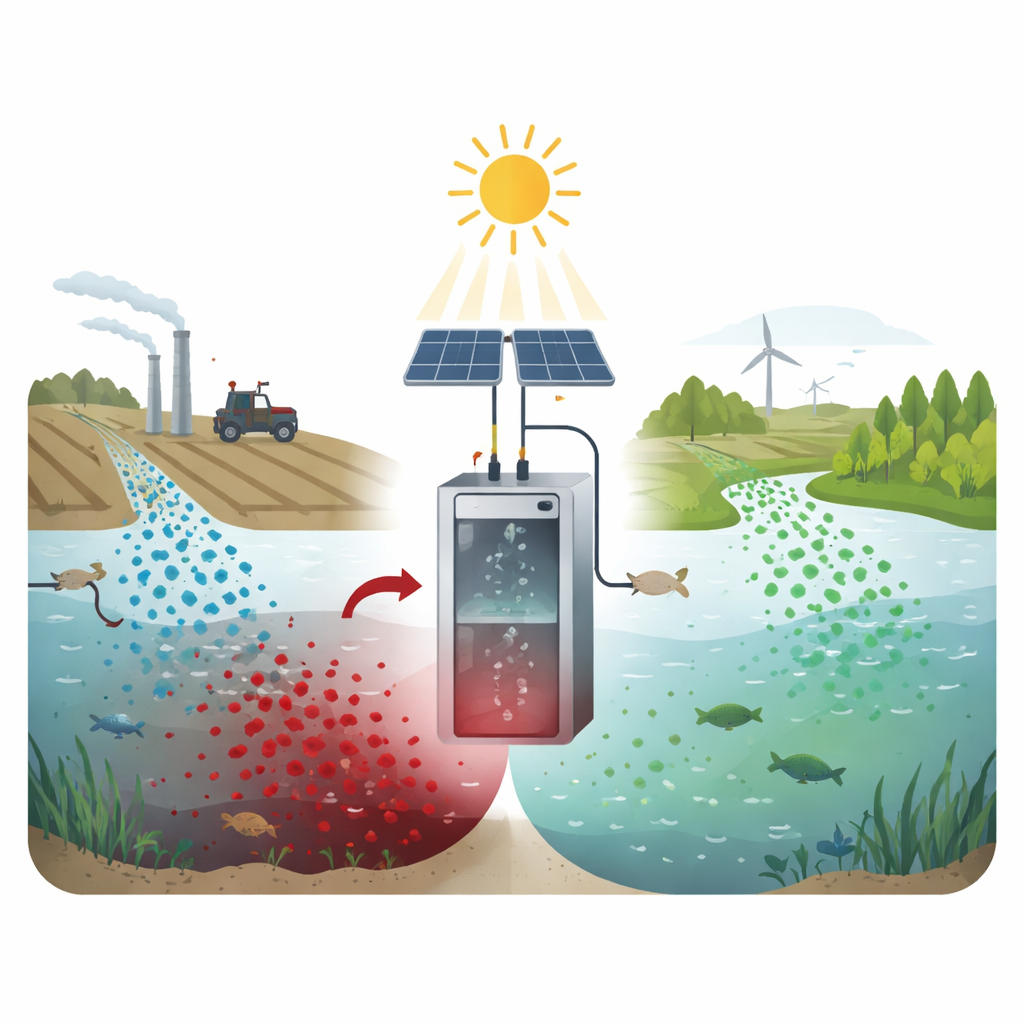
Nitrate pollution in rivers, lakes, and industrial wastewater is a growing concern for ecosystems and human health, but it also represents a wasted resource. The same nitrogen that harms waterways can be turned back into ammonia, a cornerstone of fertilizers, fuels, and chemicals. This study explores a new way to clean nitrate-contaminated water while recovering ammonia using electricity more efficiently than before, pointing toward cleaner agriculture, smarter waste treatment, and new forms of energy storage.
Why Excess Nitrogen Is a Problem
Modern farming and industry rely heavily on ammonia, produced mainly by the energy-hungry Haber–Bosch process. During use and disposal, much of this ammonia ends up as nitrate in wastewater, upsetting the natural nitrogen cycle and contributing to environmental problems such as algal blooms and drinking-water contamination. Existing methods to remove nitrate can be costly and may simply bury or dilute the problem. Electrically driven conversion of nitrate back to ammonia offers a way to clean water while recycling nitrogen, but most current systems demand high energy input because they must run at strongly negative voltages.
Designing a Smarter Catalyst Surface
To tackle this challenge, the researchers designed a new catalyst made of tiny clusters of the metal ruthenium anchored on thin sheets of cobalt hydroxide. They used a simple “self-corrosion” method: a metal foam slowly dissolves in the presence of a ruthenium salt and oxygen, forming a fresh hydroxide layer while ruthenium clusters deposit directly onto it. This process can be applied to different metals, but the team focused on cobalt, nickel, and iron supports to see how each one affects performance. Microscopy and spectroscopy confirmed that the ruthenium clusters are ultra-fine and evenly spread across the hydroxide sheets, and that electrons shift between the metal and its support, subtly tuning how the surface interacts with nitrate and water.
Balancing Grip and Flow for Better Conversion
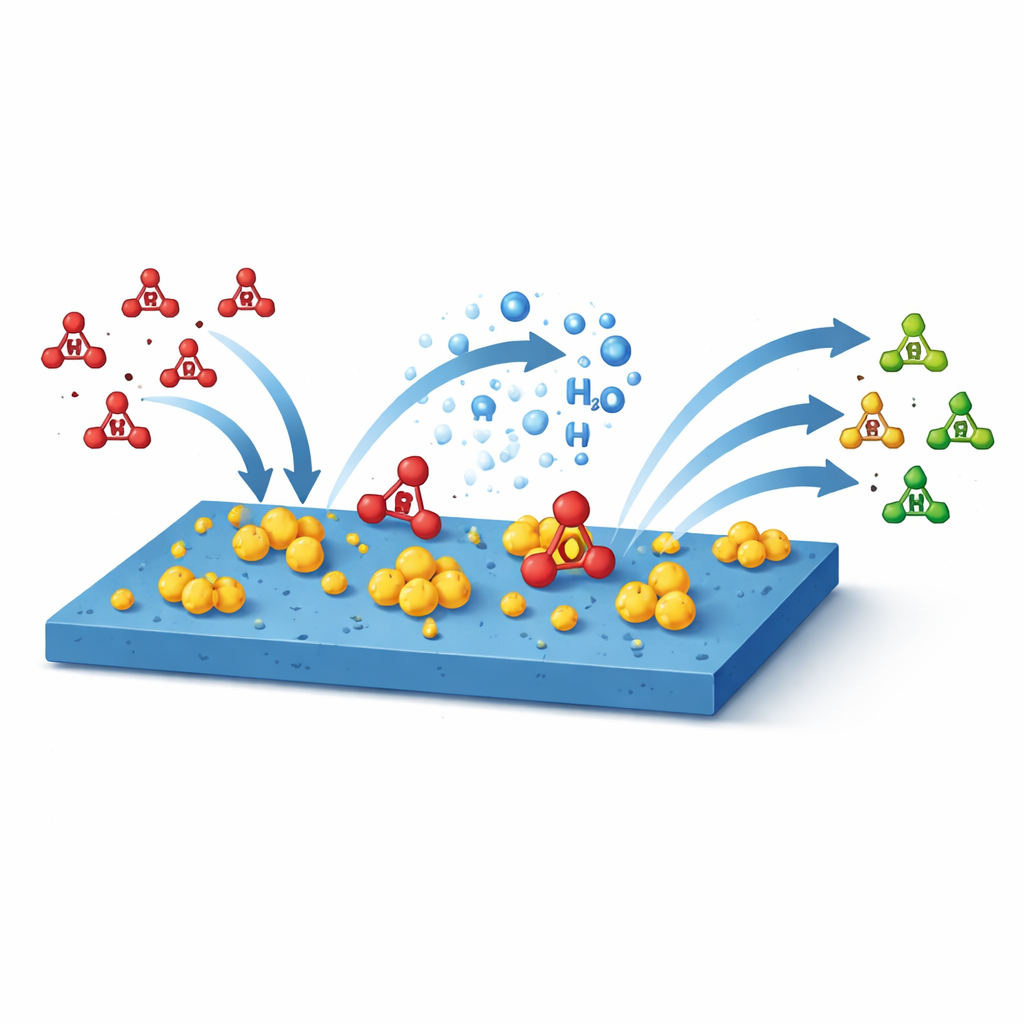
For the reaction to run efficiently, two things must happen in harmony: nitrate must stick to the catalyst surface strongly enough to react, and water at the interface must split to supply “active” hydrogen atoms that gradually transform nitrate into ammonia. If nitrate binds too tightly, the surface clogs; if too weakly, it slips away unused. Likewise, slow water splitting starves the reaction of hydrogen. Tests showed that the cobalt-based catalyst hits this sweet spot. Compared with the nickel and iron versions, it starts the reaction closer to the ideal voltage, reaches almost 100% selectivity for ammonia, and attains an energy efficiency of about 50% at a positive operating voltage—unusually low energy demand for this chemistry. It also maintains high activity for over 1,200 hours at industrially relevant current levels, while removing nitrate from simulated wastewater to below drinking-water limits.
Peering into the Hidden Steps
To understand why cobalt works best, the team monitored the reaction in real time using optical and electrochemical probes, and backed up the observations with computer modeling. They found that the cobalt hydroxide support reshapes the thin layer of water at the surface, weakening its hydrogen-bond network so that water molecules split more easily into reactive fragments. At the same time, the electronic interaction between cobalt hydroxide and ruthenium adjusts how strongly nitrate and its intermediates bind. Calculations show that on this surface, the most difficult step—converting a nitrosyl-like fragment into a more hydrogen-rich species—requires far less energy than on the nickel-supported or iron-supported versions. In effect, the cobalt support provides just the right balance: nitrate is held firmly but not trapped, and water supplies hydrogen rapidly, allowing the sequence of steps from nitrate to ammonia to proceed smoothly.
From Waste Cleanup to Power and Plastic Upcycling
Building on the efficient catalyst, the authors assembled a rechargeable battery that pairs zinc metal with nitrate reduction at the cobalt–ruthenium cathode. During discharge, nitrate is converted to ammonia while zinc is oxidized, delivering electrical power. During charging, they replace the usual oxygen-forming reaction with the gentler oxidation of ethylene glycol, a building block that can be recovered from waste plastic. This twist lowers the energy needed to recharge the battery and upgrades plastic-derived molecules into more valuable products, while the ammonia produced can form ammonium salts. The hybrid device runs stably over many cycles, illustrating how pollution control, resource recovery, and energy storage can be woven into a single system.
A New Lever for Cleaner Chemistry
In accessible terms, this work shows that fine-tuning how a metal catalyst interacts with its supporting material can dramatically improve the efficiency of turning harmful nitrate in water back into useful ammonia. By choosing a support that neither clutches nitrate too tightly nor lets it go, and that helps water break apart to feed the reaction, the researchers reach high efficiency at gentler voltages and sustain performance for long periods. The same design principle—carefully adjusting metal-support interactions—could guide the development of future catalysts for many other sustainable chemical processes.
Citation: Tang, Y., Wan, Y., Yan, W. et al. Modulated metal-support interactions for efficient nitrate electroreduction at positive potentials. Nat Commun 17, 3006 (2026). https://doi.org/10.1038/s41467-026-69802-5
Keywords: nitrate pollution, ammonia production, electrocatalysis, wastewater treatment, energy storage