Clear Sky Science · en
Femtosecond concerted rotation of molecules on a 2D material interface
Light That Makes Molecules Spin in Sync
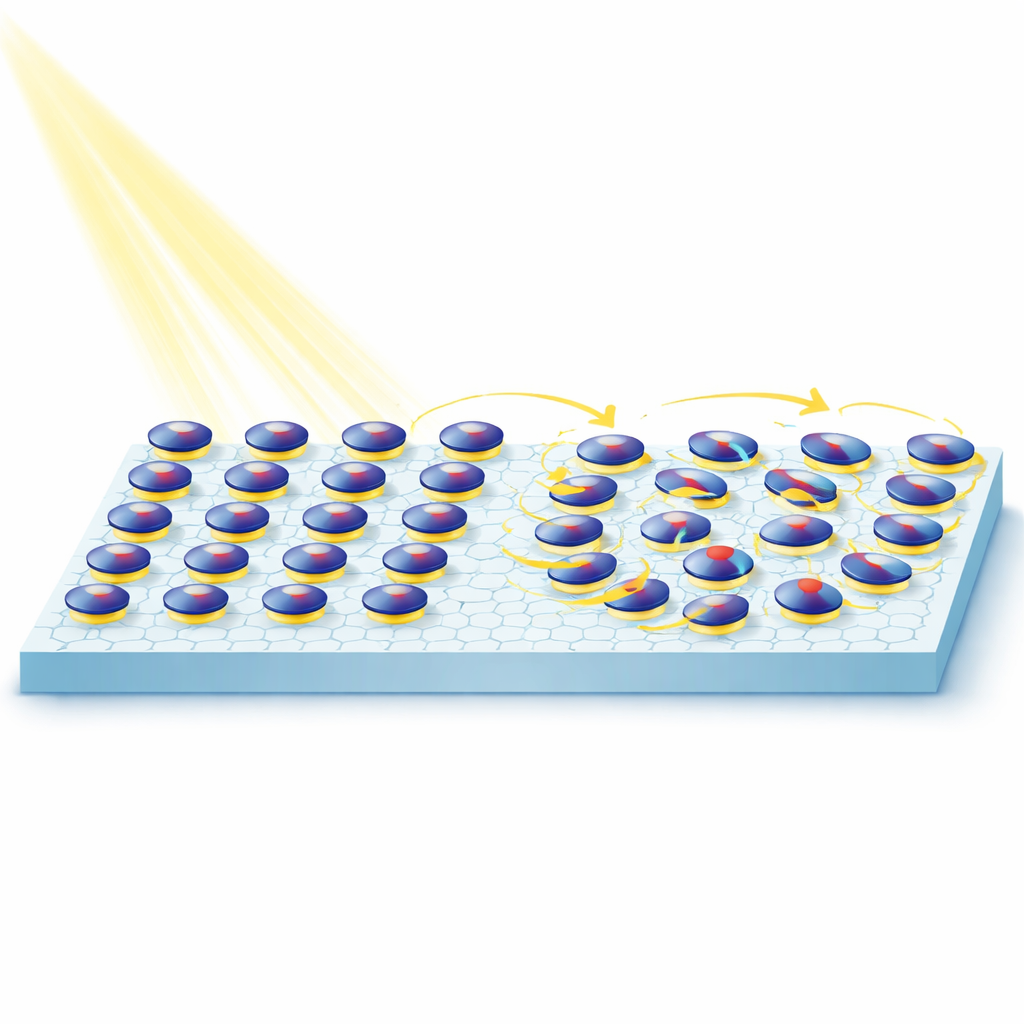
Imagine a sheet of material so thin it is only a few atoms across, covered with tiny molecules that can behave like gears in a watch. This study shows that a brief flash of light can make those molecules twist together in a coordinated way within a few trillionths of a second. Understanding and steering such motion could help engineers build future molecular machines, advanced electronic components, and surfaces whose properties can be turned on and off with light.
Why Moving Molecules Matter
Many technologies rely on how molecules sit and move on surfaces, from catalysts that clean exhaust gases to components in solar cells and computer chips. At rest, molecules usually arrange themselves into the most stable pattern and then stay put. But nature often works differently: with a constant supply of energy, living systems maintain motion and order far from equilibrium. Researchers want to mimic this behavior on solid surfaces, turning random thermal jiggling into directed motion that can perform useful tasks, like tiny rotors, gears, or switches that respond to light or electric fields.
A Flat Playground for Tiny Gears
The team studied a carefully built interface between a two-dimensional crystal, called TiSe₂, and a single layer of copper phthalocyanine molecules. These flat, disk-like molecules pack tightly and lie flat on the crystal, forming an ordered film. Under normal conditions, the balance between how each molecule sticks to the surface and how neighboring molecules attract or repel each other fixes their positions and orientations. By hitting this interface with an ultrafast laser pulse, the researchers injected energy and charge into the system, temporarily reshaping this balance and allowing new patterns of motion that are impossible when everything is at rest.
Filming Electrons and Atoms in Real Time
To see what happens during and after the light pulse, the scientists used a suite of advanced techniques that act like a high-speed camera for electrons and atoms. Extremely short bursts of X-rays and extreme ultraviolet light knocked electrons out of the sample, and a specialized microscope recorded where these electrons went in energy and momentum. By analyzing both the outer electrons that define chemical bonds and the deeper core electrons tied to specific atoms, the team could track changes in electronic charge, molecular shape, and orientation with femtosecond time resolution and nearly atomic spatial precision. This multimodal “electronic movie” revealed not just that electrons moved, but how that motion reshaped the forces between molecules.
Charge That Turns Molecules Like Cogwheels
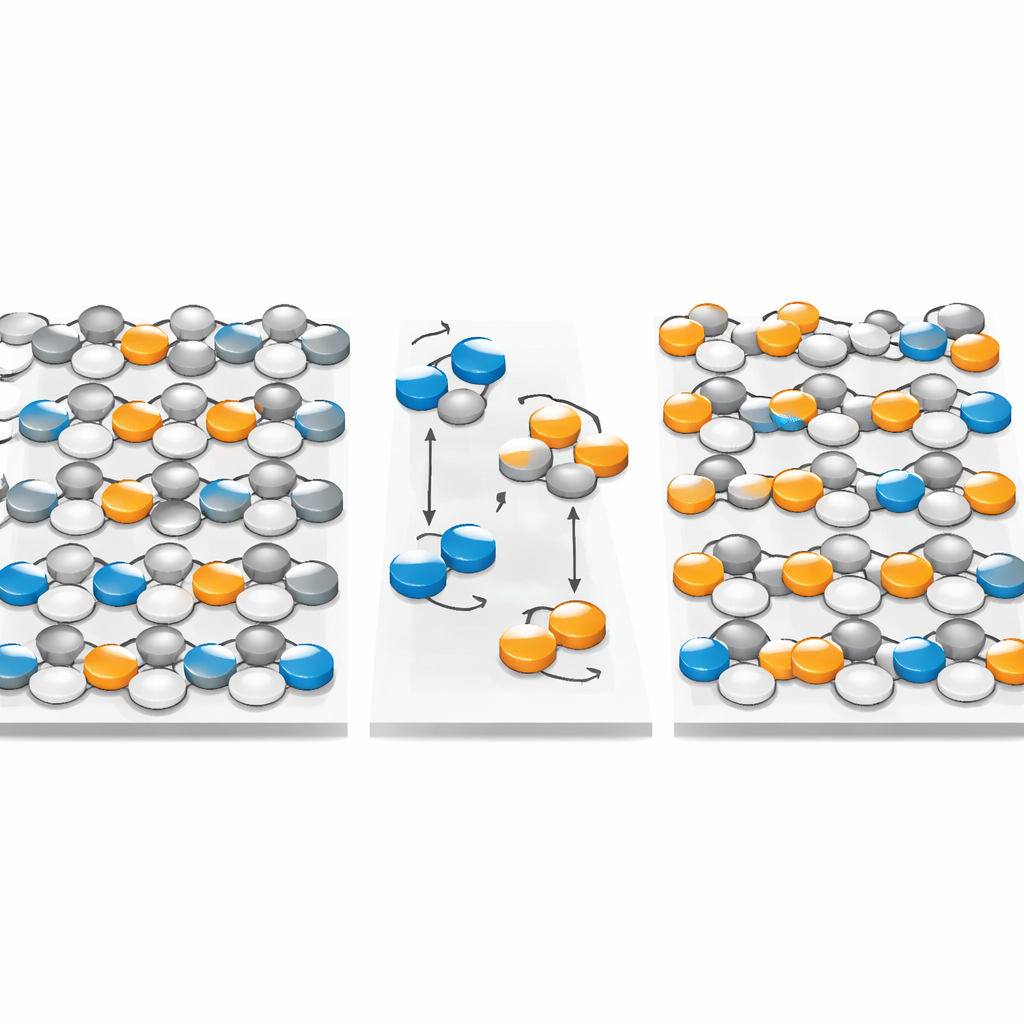
When the light pulse hit the interface, electrons were pushed from the valence band of the TiSe₂ crystal into its conduction band, and within about 400 femtoseconds, positively charged “holes” were transferred into the molecules. Roughly half of the molecules became positively charged, while the rest stayed neutral. This uneven charging changed the electric landscape across the surface, modifying how each molecule felt the presence of its neighbors and the substrate. The result was a concerted, gear-like rotation: most neutral molecules turned by about 15 degrees in one direction, while most charged molecules turned by the same angle in the opposite direction. Some molecules also bent slightly toward the surface, showing that out-of-plane distortions helped break the original symmetry and guide the collective motion.
From Mirror Twins to a Single Handed Pattern
Before excitation, the molecular layer contained mirror-image domains, like left- and right-handed versions of the same tiling pattern. Simple theory suggests that under light, these mirror domains should rotate in opposite ways. However, the time-resolved measurements did not show a mixture of opposite rotations. Instead, the system behaved as if one handedness dominated: the molecular layer transiently formed homochiral domains, where molecules share the same sense of twist. This suggests that the external energy input helps the system cross small barriers between mirror patterns, smoothing out domain walls and favoring a single chiral arrangement that is more efficient at dissipating energy.
What This Means for Future Devices
This work demonstrates that a brief burst of light can trigger a fast, coordinated rotation of molecules on a surface by shifting how charges and forces are distributed at the interface. In everyday terms, the researchers learned how to nudge a carpet of molecules so that they all twist together in a preferred direction, forming a temporarily more ordered and handed structure. Such control over motion and symmetry at the nanoscale could be harnessed to design light-driven molecular machines, programmable surfaces, and chiral electronic or optical devices, where the flow of charge and energy is guided by how molecules move rather than just where they sit.
Citation: Baumgärtner, K., Nozaki, M., Reuner, M. et al. Femtosecond concerted rotation of molecules on a 2D material interface. Nat Commun 17, 2110 (2026). https://doi.org/10.1038/s41467-026-69801-6
Keywords: molecular rotation, 2D materials, charge transfer, chiral surfaces, ultrafast dynamics