Clear Sky Science · en
Global increases in built-up volume indicate more divergent and less dispersed urban expansion patterns
Why City Skylines Matter for the Planet
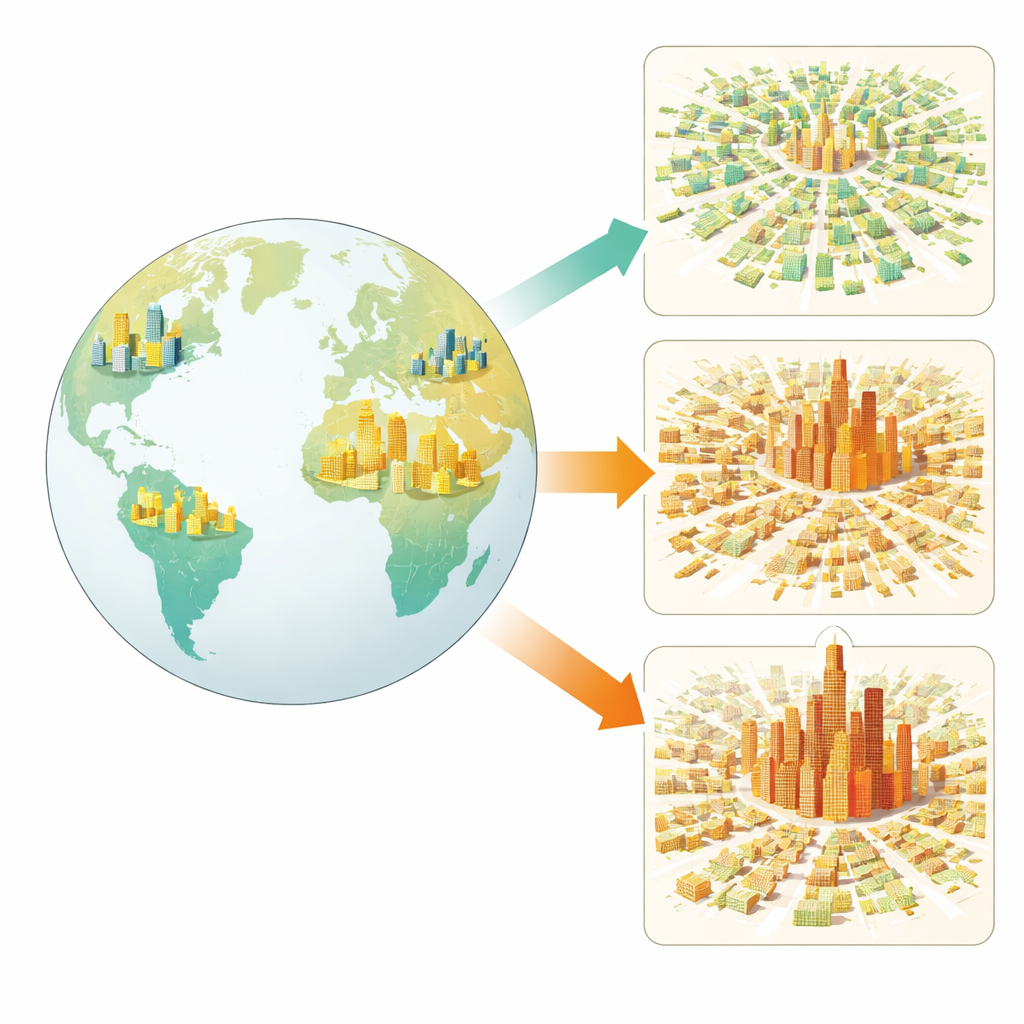
From glass towers to endless suburbs, the way cities grow shapes everything from traffic jams to climate change. This study looks at urban growth not just as a flat map, but as a three-dimensional landscape of building volume. By tracking how tall and how clustered new buildings are in more than 1800 cities worldwide, the authors reveal surprising differences between regions—and show why the shift from spreading out to building up can both help and hurt environmental sustainability.
Seeing Cities in Three Dimensions
Most global studies of urban growth treat cities like ink spreading on paper, measuring the expansion of built-up land in two dimensions. But what happens in the vertical direction—how high we build and where those tall buildings are located—can matter just as much. Using newly available satellite and radar-based datasets, the researchers estimated changes in both the footprint and the volume of buildings between 2000 and 2018. They created two measures: a Centrality Index that shows how close new development is to city centers, and an Intensity Index that reflects the average height of new construction. Together, these indicators capture not just how far cities spread, but how they stack upward.
Vertical Growth Is Less Scattered Than Sprawl
When the team compared two-dimensional and three-dimensional measures of expansion, they found that added building volume tends to be more tightly clustered around urban centers than added land area. In other words, as cities add floors, they generally do so in more central places than where they add new surface. The two perspectives are related—cities that sprawl in 2D also tend to be dispersed in 3D—but not identical. For most cities, the 3D centrality score is higher than the 2D one, and the spread of 3D scores is wider. This means vertical growth adds a new layer of inequality between cities: some concentrate their new volume in a compact core, while others scatter tall buildings across wider areas.
Four Distinct Ways Cities Are Building Up
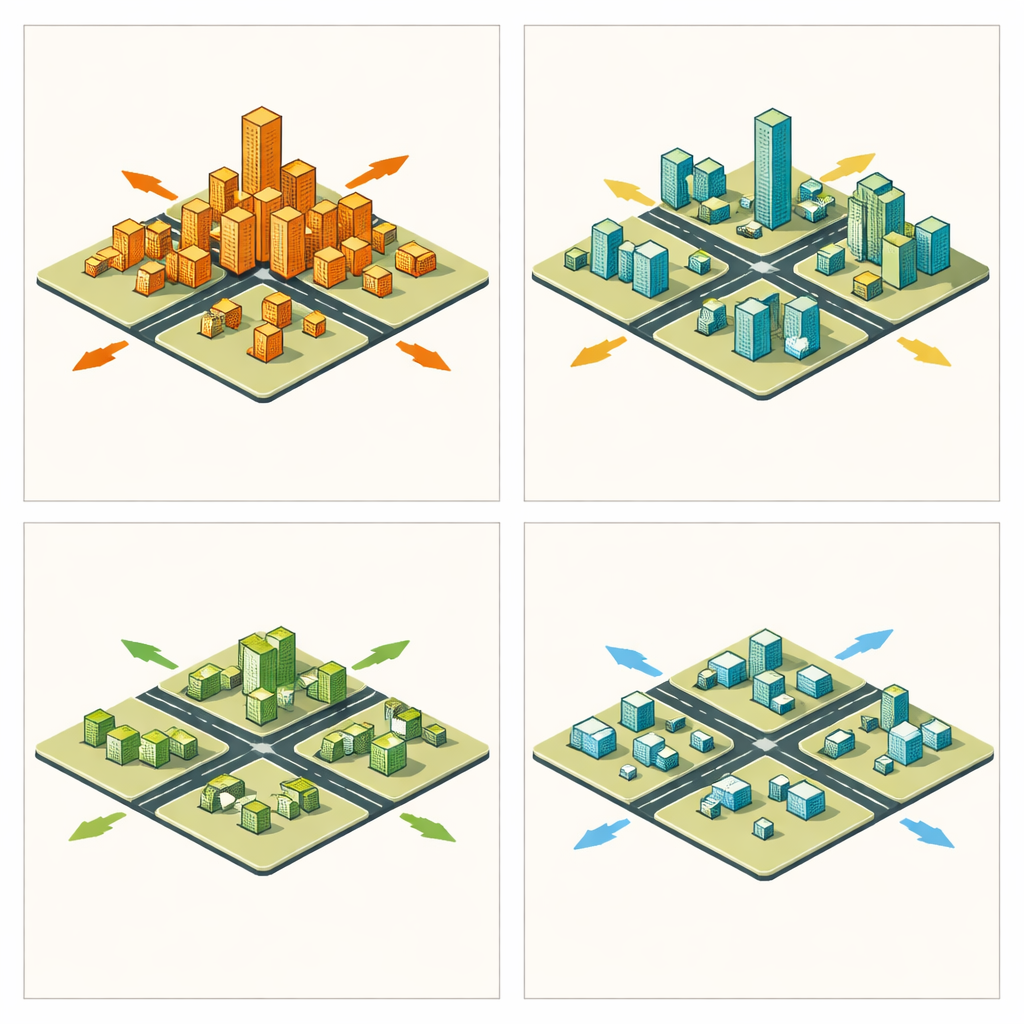
By combining centrality and intensity, the authors identify four global patterns of 3D expansion. Some cities show high centrality and high intensity, where tall new buildings cluster strongly around downtown and major subcenters; these resemble the "compact city" ideal and are common in parts of East Asia and Europe. Others show low centrality but high intensity, with tall towers popping up in scattered, often peripheral locations. A third group has high centrality but low intensity, forming fairly compact yet mostly mid-rise centers, typical of many North American and Western European cities. The fourth pattern features both low centrality and low intensity, with modest, widely spread construction, particularly common in rapidly urbanizing regions of Africa, Latin America, and South Asia.
What Shapes These Urban Patterns
To understand why cities fall into different categories, the study uses a machine-learning model that relates expansion patterns to natural conditions, economic strength, transport networks, and existing city form. The analysis highlights the importance of previous urban structure—cities that started with more centralized forms tend to stay that way, showing a strong path dependence. Maximum building heights, terrain, population size, and baseline density also matter. Steep landscapes often push growth upward rather than outward, while dense road networks can encourage tall buildings away from the center by making car travel easier. Climate appears too: warmer cities are more likely to grow in less centralized ways, which may help release heat but can lengthen commutes.
Future Growth Hotspots and Climate Trade-Offs
The study suggests that future urbanization will be driven largely by cities in Africa and South Asia, where low-centrality patterns—whether tall and scattered or low and scattered—are already widespread. These forms can use land more efficiently than pure horizontal sprawl, but they risk locking in long, car-dependent trips if public transit and mixed land-use planning do not keep pace. Highly compact and tall cities, on the other hand, may curb land consumption and some emissions, yet worsen heat stress and building energy use. By showing that global urban growth is becoming more vertically divergent and less evenly dispersed, this work argues that planners and policymakers must think in 3D: the height and placement of new buildings will be as critical as city size in steering land use, mobility, and carbon footprints for decades to come.
Citation: Li, Y., Zhong, X., Derudder, B. et al. Global increases in built-up volume indicate more divergent and less dispersed urban expansion patterns. Nat Commun 17, 2710 (2026). https://doi.org/10.1038/s41467-026-69766-6
Keywords: 3D urban growth, city density, vertical expansion, urban sprawl, built-up volume