Clear Sky Science · en
Stratospheric biomass burning aerosols compensate record-breaking ozone depletion over the Arctic in spring 2020
Wildfire Smoke and a Surprising Ozone Twist
When news broke that the Arctic ozone layer had suffered record-breaking damage in spring 2020, many worried we were backsliding on a hard‑won environmental success story. This study looks at an unexpected player in that drama: smoke from giant wildfires. The authors show that smoke reaching high into the atmosphere over the Arctic did not just help destroy ozone, as feared—it also changed winds and temperatures in ways that partially shielded the region from even worse ozone loss.
Why Ozone over the Arctic Matters
The ozone layer high in the atmosphere screens life on Earth from harmful ultraviolet radiation. In polar regions, changes in ozone do more than affect local sunburn risk; they can alter large‑scale weather patterns across the Northern Hemisphere. In recent years, attention has turned from man‑made chemicals alone to new threats linked to climate change, including the rise of huge wildfires in boreal forests. Smoke from these fires can be lofted all the way into the stratosphere, the same layer that hosts most of the ozone. Until now, most work had focused on how such smoke accelerates ozone‑eating chemistry, especially near Antarctica. Much less was known about what it does to ozone over the rapidly warming Arctic.
Smoke High Above the Arctic
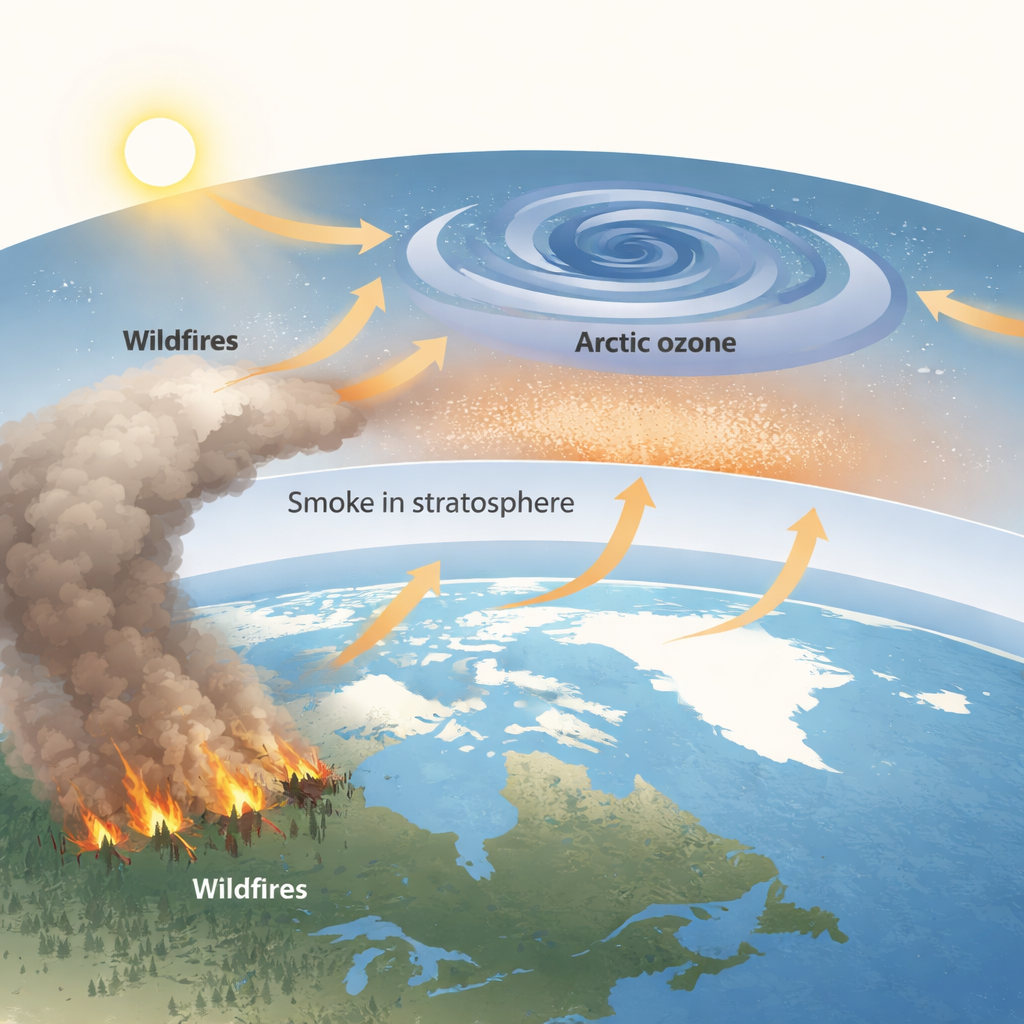
Using detailed satellite observations, the authors found that in late summer and autumn 2019 the Arctic stratosphere was unusually hazy. The amount of light‑blocking particles there more than doubled compared with typical years. Multiple lines of evidence—how the particles behaved with different colors of light, the lack of volcanic gases, and a distinctive warming of the lower stratosphere—pointed to smoke from intense Siberian wildfires rather than from a volcanic eruption. Just a few months later, in spring 2020, the Arctic experienced the strongest ozone depletion seen in more than four decades of records, under exceptionally cold, stable conditions in the polar vortex that favor ozone‑destroying chemistry.
Simulating an Unusual Chain Reaction
To untangle this chain of events, the team used a sophisticated Earth system model that simulates both atmospheric chemistry and weather. They ran a set of experiments that either included or excluded wildfire emissions, and adjusted how high the smoke was injected to match what satellites saw. By comparing these runs, they could separate the effects of smoke‑driven chemical reactions from its influence on temperature and winds. Surprisingly, their best‑estimate simulations showed that the 2019 smoke caused a net increase in total ozone over the Arctic during spring 2020—about 11.5 Dobson units, offsetting roughly 19 percent of the observed loss.
Smoke That Both Hurts and Helps
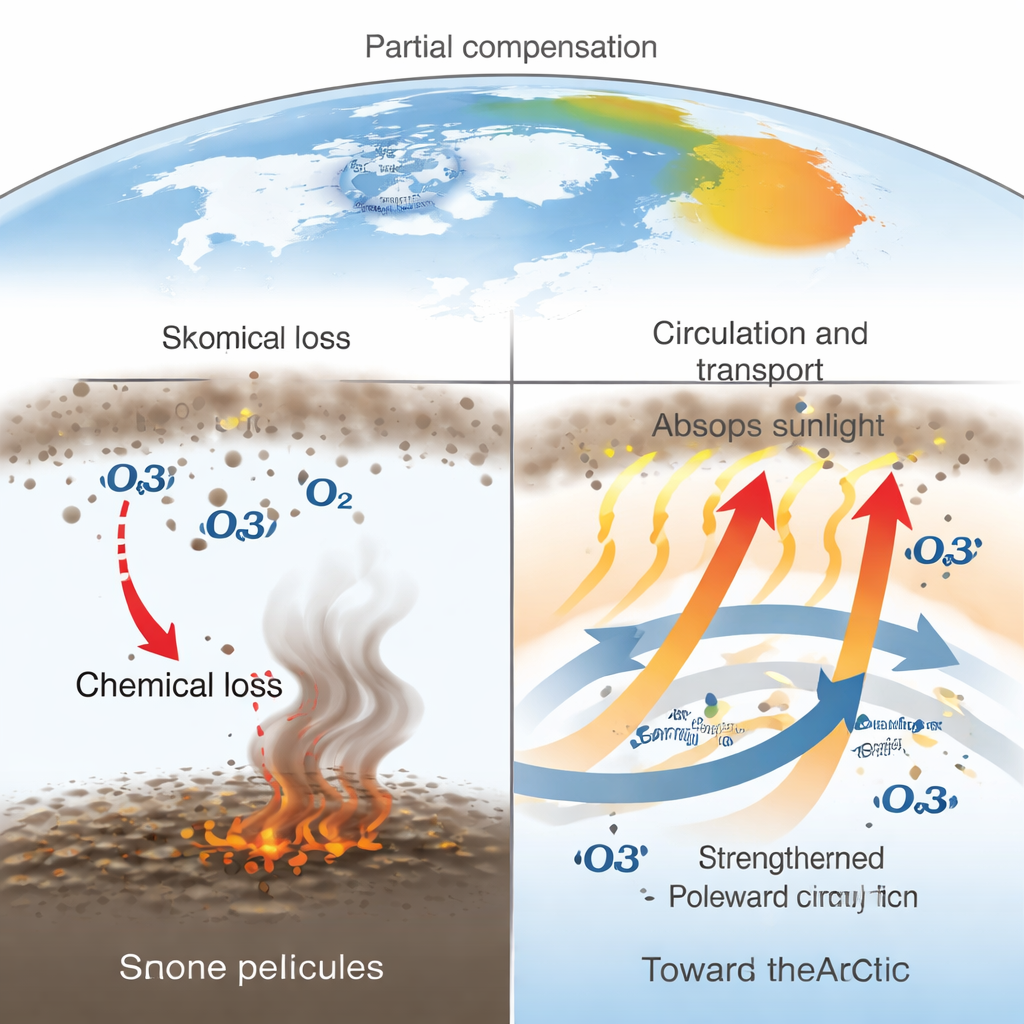
The key lies in smoke’s double personality. On the one hand, the particles provide surfaces that help turn chlorine into forms that more readily destroy ozone, leading to additional ozone loss. The model suggests this chemical pathway alone would have reduced Arctic ozone by about 6 Dobson units in spring 2020. On the other hand, the smoke absorbs sunlight and warms the lower stratosphere. That warming modifies large‑scale circulation, strengthening the flow of ozone‑rich air from lower latitudes toward the Arctic and increasing downward motion over the pole. This dynamical response boosts ozone by about 18 Dobson units—more than enough to outweigh the chemical losses in the simulations. Without this circulation‑driven replenishment, the authors estimate that parts of the Arctic could have briefly crossed the traditional “ozone hole” threshold used for Antarctica.
How Fire and Weather Team Up
The study also asks why 2019 was so special. The authors show that it was not simply the amount of smoke that mattered, but where and when it was produced and how the winds behaved. In 2019, an unusually large share of extreme Siberian fires burned far to the north, and a strong cyclone high in the atmosphere helped lift smoke into the upper air and steer it into the Arctic. In other recent years with intense fires, different wind patterns kept smoke trapped at lower latitudes instead. This means that future impacts on Arctic ozone will depend on the chance alignment of severe fire seasons with particular circulation patterns, not just on fire intensity alone.
What This Means for a Warming World
For non‑specialists, the main message is that wildfire smoke in the stratosphere is a new and complicated piece of the ozone story. In this case, smoke both aided ozone destruction and, more powerfully, reshaped atmospheric currents so that more ozone was dragged into the Arctic, softening the blow of an extreme depletion event. As climate change drives more frequent and intense boreal fires, and possibly shifts where they burn and how the winds respond, such episodes may become more common. Understanding this tug‑of‑war—between smoke‑driven chemistry that erodes ozone and smoke‑driven circulation that can partially protect it—will be crucial for predicting future ultraviolet exposure and climate feedbacks in the far North.
Citation: Zhong, Q., Veraverbeke, S., Yu, P. et al. Stratospheric biomass burning aerosols compensate record-breaking ozone depletion over the Arctic in spring 2020. Nat Commun 17, 1993 (2026). https://doi.org/10.1038/s41467-026-69728-y
Keywords: Arctic ozone, wildfire smoke, stratospheric aerosols, climate change, boreal fires