Clear Sky Science · en
Dawn-dusk Asymmetrical Distribution of Saturn’s Cusp
Why Saturn’s Edge Matters
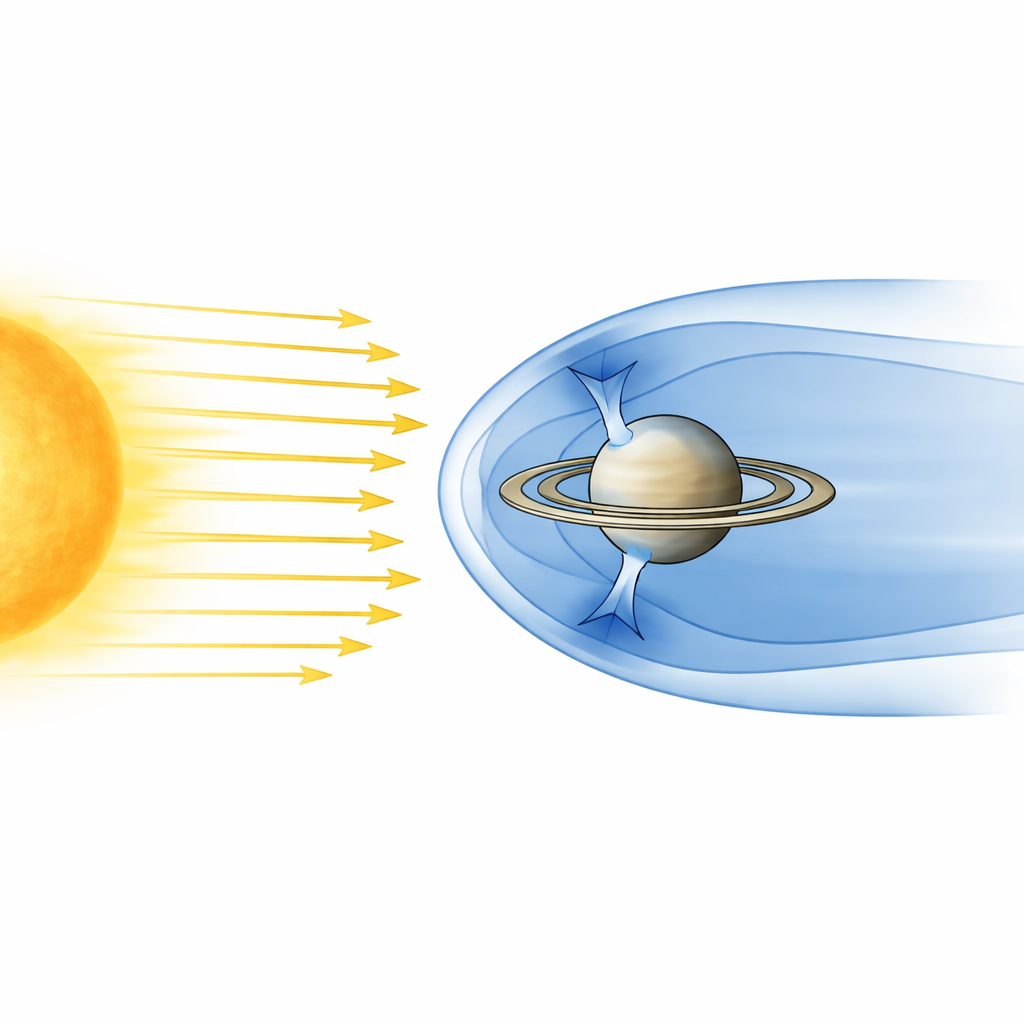
Far from Earth, Saturn is wrapped in an invisible magnetic bubble that shields it from the stream of charged particles blowing out from the Sun. Where this bubble is thinnest, solar particles can slip through narrow gateways called cusps and rain into the planet’s atmosphere, driving auroras and reshaping the space environment. This study uses years of data from NASA’s Cassini spacecraft, together with advanced computer simulations, to reveal that Saturn’s gateway is lopsided in time of day—tilted toward afternoon and evening rather than sitting squarely at noon as it does at Earth. That skewed geometry turns out to be a window into how fast-spinning giant planets interact with their stars.
Different Shields for Different Worlds
Every planet with a magnetic field carves out a protective cavity in the solar wind, but the way that cavity behaves can differ dramatically. Earth’s magnetic bubble is mostly shaped by changing conditions in the solar wind itself. In contrast, giant planets like Jupiter and Saturn spin rapidly and are loaded with material from inner moons such as Enceladus. Their magnetospheres are driven strongly from within, as rotation drags plasma around like a gigantic flywheel. In all of these systems, cusps form near the magnetic poles where solar wind particles can stream down along open field lines into the atmosphere, feeding auroras and redistributing mass and energy. At Earth, decades of observations show that these cusps are broadly centered around local noon with only modest morning–afternoon differences. The question this work tackles is whether Saturn, with its rapid rotation and internal plasma, arranges its cusps in the same way or in a fundamentally different pattern.
Following Cassini Through Saturn’s Gateway
The authors combed through Cassini data from 2004 to 2010, focusing on times when the spacecraft was at high latitude and still inside Saturn’s magnetic boundary. They identified cusps using telltale particle signatures: electrons with energy patterns resembling those in the region just outside the magnetosphere, along with occasional structured ion beams and changes in magnetic strength that signal magnetic reconnection—the process that opens field lines and lets solar particles in. Using a set of strict criteria drawn from earlier work at both Earth and giant planets, they expanded the catalog of known Saturn cusp encounters from about a dozen to 67. Crucially, they also accounted for how long Cassini dwelled in each region, allowing them to turn these raw counts into fair occurrence rates as a function of local time around the planet.
A Cusp That Favors Afternoon and Evening
When the team mapped all of Cassini’s cusp crossings, a clear pattern emerged. Instead of clustering around noon, Saturn’s cusps show their highest occurrence in the post-noon sector and extend deep into the early night side, close to 8 p.m. local time. Even after correcting for Cassini’s uneven sampling of morning and afternoon hemispheres, the probability of encountering the cusp in the afternoon was several times higher than in the morning. The researchers compared this with a similar analysis of Earth’s cusp using data from ESA’s Cluster mission, which confirmed the expected near-noon peak for our planet. Saturn, then, is fundamentally different: its solar-wind entry funnel is shifted toward dusk, echoing recent findings that Jupiter’s cusp is also displaced toward the evening side.
What Simulations Reveal About the Hidden Shape
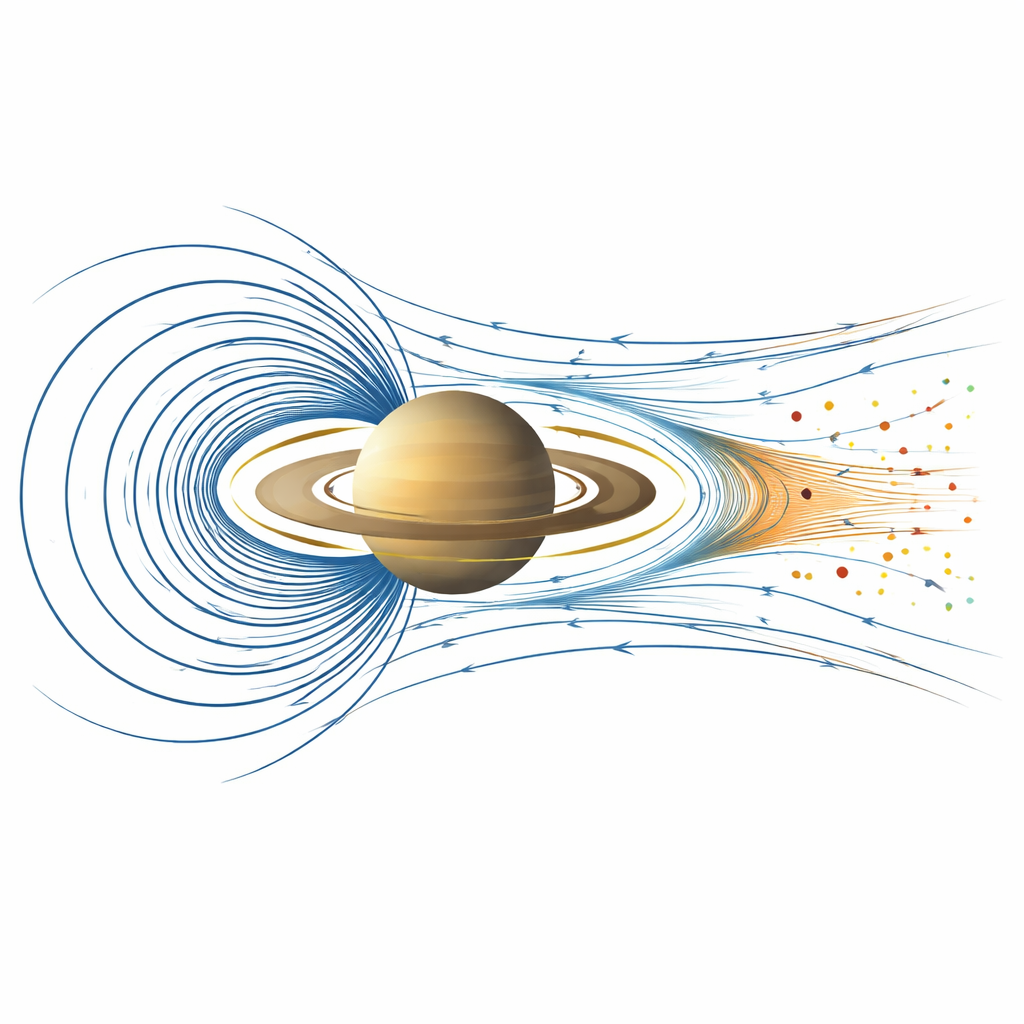
To understand why the cusp is shifted, the study turned to high‑resolution magnetohydrodynamic simulations that model Saturn’s entire magnetic bubble, including its rotation and interaction with the solar wind. These simulations show that closed magnetic field lines pile up on the dayside morning sector because rotation-driven flows push them there, while reconnection with the solar wind is relatively weak. The extra magnetic pressure bulges the boundary outward on the dawn side and compresses it on the dusk side. Open field lines, once created, are carried azimuthally by the rotating system and tend to drift duskward before their particles reach the spacecraft. The cusp, which sits at the boundary between open and closed field lines, is therefore anchored to an inherently lopsided structure. The result is a magnetosphere whose solar-wind gateway is displaced toward afternoon and even early night, a configuration closely resembling model predictions and observations at Jupiter.
What This Means for Other Worlds
In simple terms, the study shows that Saturn’s fast spin and internal plasma supply twist and reshape its magnetic shield so strongly that the main “doorway” for solar particles opens toward evening rather than noon. While the small‑scale physics of how particles stream through cusps appears similar at Earth, Saturn, and Jupiter, the large‑scale placement of those cusps is governed by how each planet’s rotation and magnetic field balance the push of the solar wind. By firmly establishing Saturn’s dusk‑shifted cusp, this work strengthens the idea that rapidly rotating giant planets, both in our solar system and around other stars, share a common type of space‑weather interaction that differs fundamentally from Earth’s. Understanding that difference will be essential for interpreting future spacecraft observations and for reading the signatures of magnetic storms and auroras on distant worlds.
Citation: Xu, Y., Yao, Z.H., Arridge, C.S. et al. Dawn-dusk Asymmetrical Distribution of Saturn’s Cusp. Nat Commun 17, 1861 (2026). https://doi.org/10.1038/s41467-026-69666-9
Keywords: Saturn magnetosphere, planetary cusp, solar wind interaction, giant planets, magnetic reconnection