Clear Sky Science · en
Chiral orbital lasing in a twisted bilayer metasurface
Light That Twists in Space
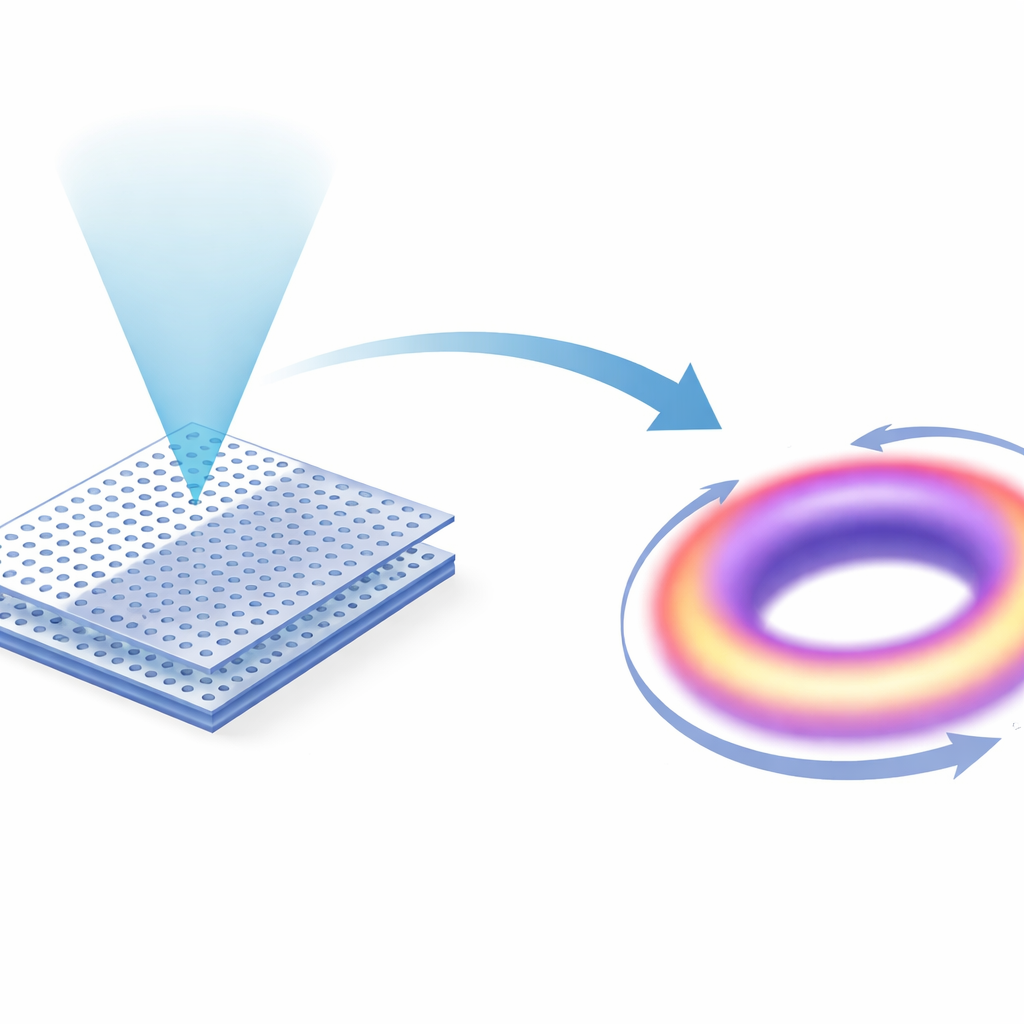
Light is usually described as moving in straight lines, but it can also swirl like a tiny tornado. Beams that twist in this way can carry information, grab microscopic objects, or probe biological material in new ways. In this work, researchers have built a microscopic laser that naturally produces such twisting light by stacking and rotating two ultra-thin patterned layers of semiconductor material. Their approach could make compact, chip-based sources of “chiral” light—light with a built‑in handedness—much easier to build and use.
Why Twisting Layers Changes Light
Over the past few years, scientists have discovered that simply rotating two atomically thin materials with respect to each other can radically change how electrons move, even turning an insulator into a superconductor. This idea, known as “twistronics,” has inspired a photonic counterpart: twisting artificial optical materials to reshape how light behaves. In a twisted pair of patterned semiconductor membranes, the mismatch between their lattices produces a larger, slowly varying pattern called a moiré superlattice. Crucially, this stacked structure is chiral—it cannot be made to look identical to its mirror image—so it can distinguish left from right in the way it handles light.
Building a Tiny Twisted Laser
The team designed two identical, perforated semiconductor sheets, each dotted with a square array of circular holes. These sheets act as metasurfaces, structures that trap and guide light in very thin layers. By rotating the top sheet by just over 22 degrees relative to the bottom one and keeping them only 100 nanometers apart, they created a twisted bilayer device that supports special guided resonances—waves of light that circulate within the membranes yet can leak out vertically. The material is engineered to amplify light in the telecommunications band around 1550 nanometers, the same range used for fiber‑optic communications, making the device technologically relevant.
How the Light Starts to Swirl
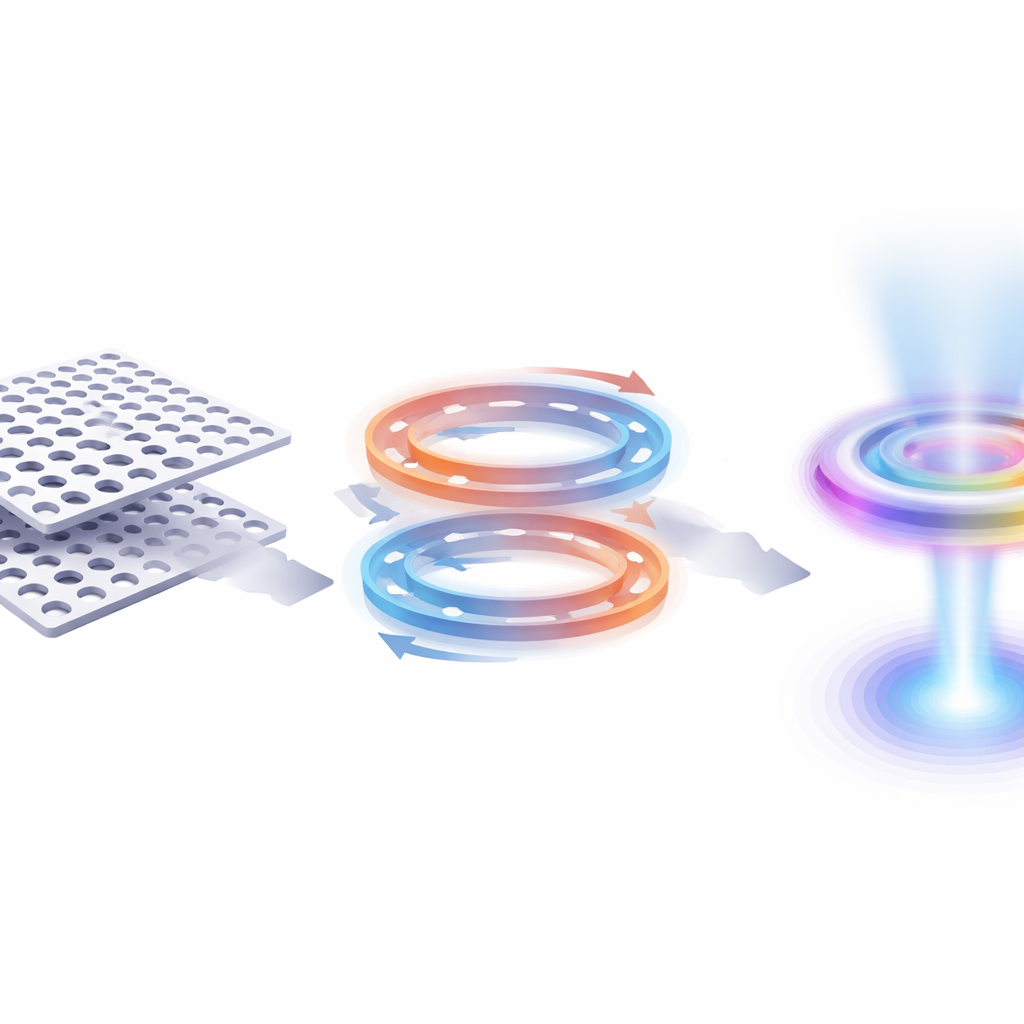
To turn the structure into a laser, the researchers shine a circular pump beam onto the device. This pumping creates a round region where the material amplifies light more strongly, effectively forming a soft, lens-like cavity that does not itself prefer any direction or handedness. Inside this cavity, light waves can circulate around the center in clockwise or counterclockwise loops, much like cars on a ring road. In a perfectly symmetric, non-twisted system, these two directions would be equivalent. But in the twisted bilayer, subtle, direction-dependent couplings between the two layers, together with unavoidable gain and loss, favor one rotating pattern over the other. The system naturally organizes itself so that one chiral circulating mode dominates when lasing sets in.
Seeing the Vortex Beam
Experimentally, the laser switches on sharply when the pump intensity reaches a certain threshold, emitting at telecom wavelengths over a remarkably broad spectral window of about 250 nanometers while remaining in a single spatial mode. Images of the beam profile show a bright ring with a dark center—a classic “doughnut” shape associated with light that carries orbital angular momentum. Interference measurements, in which the beam is made to overlap with a shifted copy of itself, reveal fork-like fringe patterns. These are the telltale signatures of a phase vortex, confirming that the beam truly twists as it propagates and that its handedness is fixed by the structure’s intrinsic chirality rather than by the external pump.
What This Means for Future Technologies
By carefully twisting and bonding two patterned light-guiding membranes, the researchers have created a microscopic laser that emits light with a built-in orbital twist, without needing additional spiral elements or complex external control. In simple terms, the device turns straight laser light into a robust optical vortex directly on a chip. Such compact, high-quality sources of chiral light could become powerful tools for precision sensing, manipulating tiny particles with light, and encoding more information into laser beams for advanced communication systems.
Citation: Wang, M., Lv, N., Zhang, Z. et al. Chiral orbital lasing in a twisted bilayer metasurface. Nat Commun 17, 2369 (2026). https://doi.org/10.1038/s41467-026-69665-w
Keywords: twisted bilayer photonics, chiral laser, orbital angular momentum, metasurface, vortex beam