Clear Sky Science · en
Siderophore-producing Bacillus and free-living nematodes are associated with soil suppressiveness to banana root-knot nematodes
Why healthier soil matters for bananas
Bananas are a daily staple for hundreds of millions of people, but their roots are constantly under attack by tiny worms called root‑knot nematodes. These pests invade the roots, cause swollen galls, and quietly sap yields. Farmers often turn to chemical treatments, which can be costly and harmful to the environment. This study follows banana fields over more than a decade to ask a hopeful question: can the soil itself learn to fight back, using its own living community of microbes and beneficial nematodes?
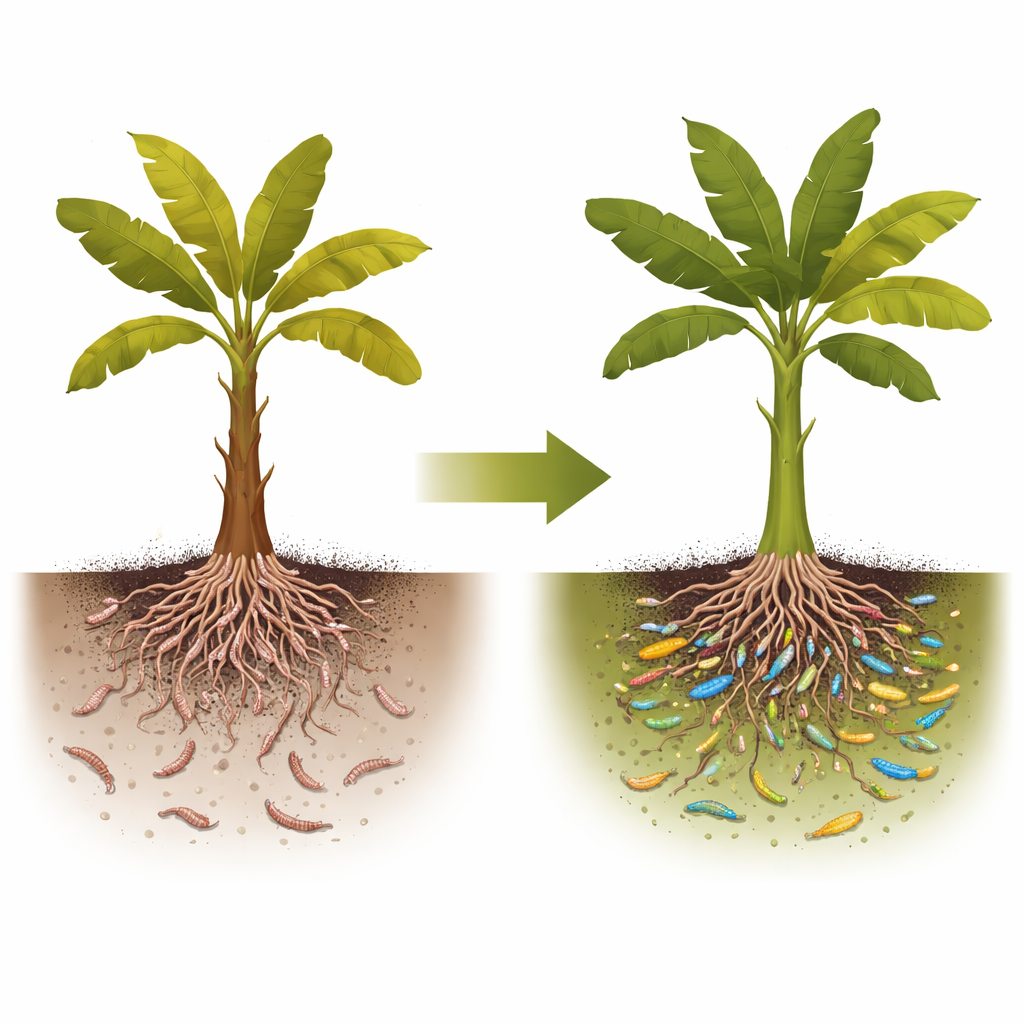
From disease hotspot to self-defending field
The researchers tracked banana plantations in southern China that had been planted with the same variety year after year for 11 years. In the early years, root‑knot disease exploded, with up to almost all plants showing severely galled roots. Surprisingly, after about seven years, disease levels dropped sharply, even though the crop and farming practices stayed the same. At the same time, the total number of nematodes in the soil actually increased. This suggested a shift from a soil that favors disease to one that naturally keeps the root‑knot nematode in check.
Good worms versus bad worms
Not all nematodes are plant parasites. Many are free‑living, feeding on bacteria or fungi and helping to recycle nutrients. By counting nematodes under the microscope and sequencing their DNA, the team showed that long‑term banana cropping reshaped the underground worm community. Early on, plant‑parasitic nematodes, especially the root‑knot genus Meloidogyne, became more common. Later, as disease waned, these troublemakers declined while free‑living groups, including fungal feeders and predators that can eat other nematodes, became more abundant. The balance in the underground food web had tipped away from plant parasites toward a more beneficial mix.
Bacteria that act like microscopic bodyguards
The scientists then asked whether changes in soil bacteria around the roots were linked to the decline in disease. DNA surveys of the rhizosphere—the thin soil layer clinging to roots—showed that bacterial diversity rose over time, and the overall community shifted as monoculture continued. Using network analysis and machine‑learning models, they pinpointed particular bacterial groups that were more common in older, disease‑suppressive soils and negatively linked with root‑knot nematode abundance. One standout was a strain belonging to Bacillus velezensis, a species already known for protecting plants.
A special molecule that targets the pest
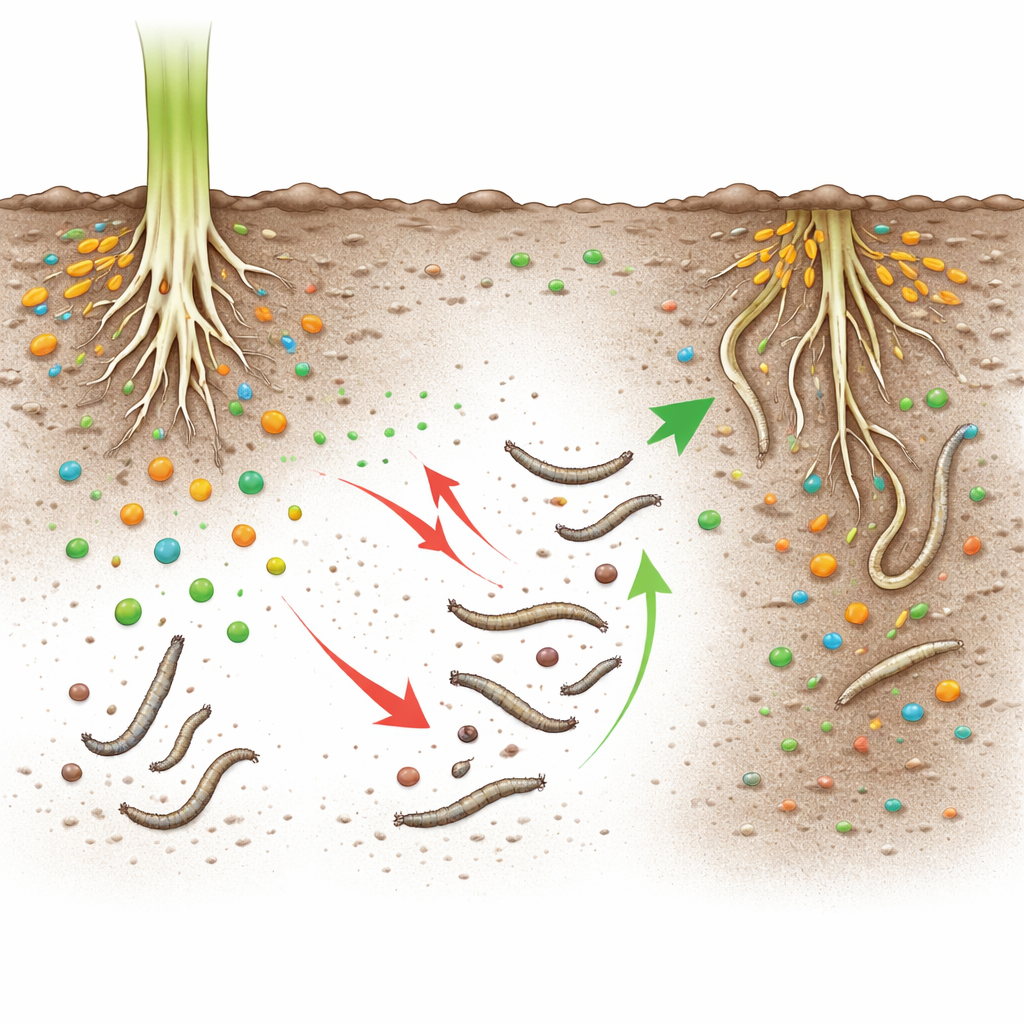
To move from correlation to function, the team isolated this Bacillus strain, named Y11.1, from suppressive fields. In greenhouse trials, adding the bacterium to soil reduced root galls and egg masses of Meloidogyne on banana roots and boosted plant growth, under both sterilized and natural soil conditions. Genome and chemical analyses showed that Y11.1 produces several defensive compounds, but the researchers homed in on a metal‑binding molecule called a siderophore, specifically bacillibactin. In lab tests, bacillibactin killed and repelled juvenile root‑knot nematodes, yet did not harm—and even attracted—the free‑living nematode Caenorhabditis elegans. When bacillibactin alone was added to pots, it lowered root‑knot infection and improved banana performance, indicating that this single metabolite plays a key role.
A living recipe for sustainable pest control
Putting the pieces together, the study paints a picture of how long‑term monoculture can gradually foster a self‑defending soil. Over years, banana roots and their surrounding microbiome shift toward a community where beneficial Bacillus bacteria and free‑living nematodes flourish. Bacillus secretes bacillibactin, which selectively repels and harms plant‑parasitic nematodes while drawing in harmless or helpful nematodes, reinforcing a healthier underground ecosystem. For growers, these findings suggest that carefully managing soil life—by encouraging protective microbes rather than relying solely on chemicals—could offer a more sustainable way to control root‑knot disease and safeguard banana yields.
Citation: Lu, Q., Wang, K., Gu, S. et al. Siderophore-producing Bacillus and free-living nematodes are associated with soil suppressiveness to banana root-knot nematodes. Nat Commun 17, 2688 (2026). https://doi.org/10.1038/s41467-026-69647-y
Keywords: banana root-knot nematode, disease-suppressive soils, Bacillus velezensis, soil microbiome, sustainable pest management