Clear Sky Science · en
Visuomotor decision-making through multifeature convergence in the larval zebrafish hindbrain
How tiny fish help explain everyday choices
Every moment, our brains juggle many pieces of visual information: where things are moving, where it is bright or dark, and how those patterns change. This study uses tiny larval zebrafish to answer a big question that also matters for humans: when different visual cues point in different directions, does the brain pick a winner, or does it quietly add everything up to decide how to move?
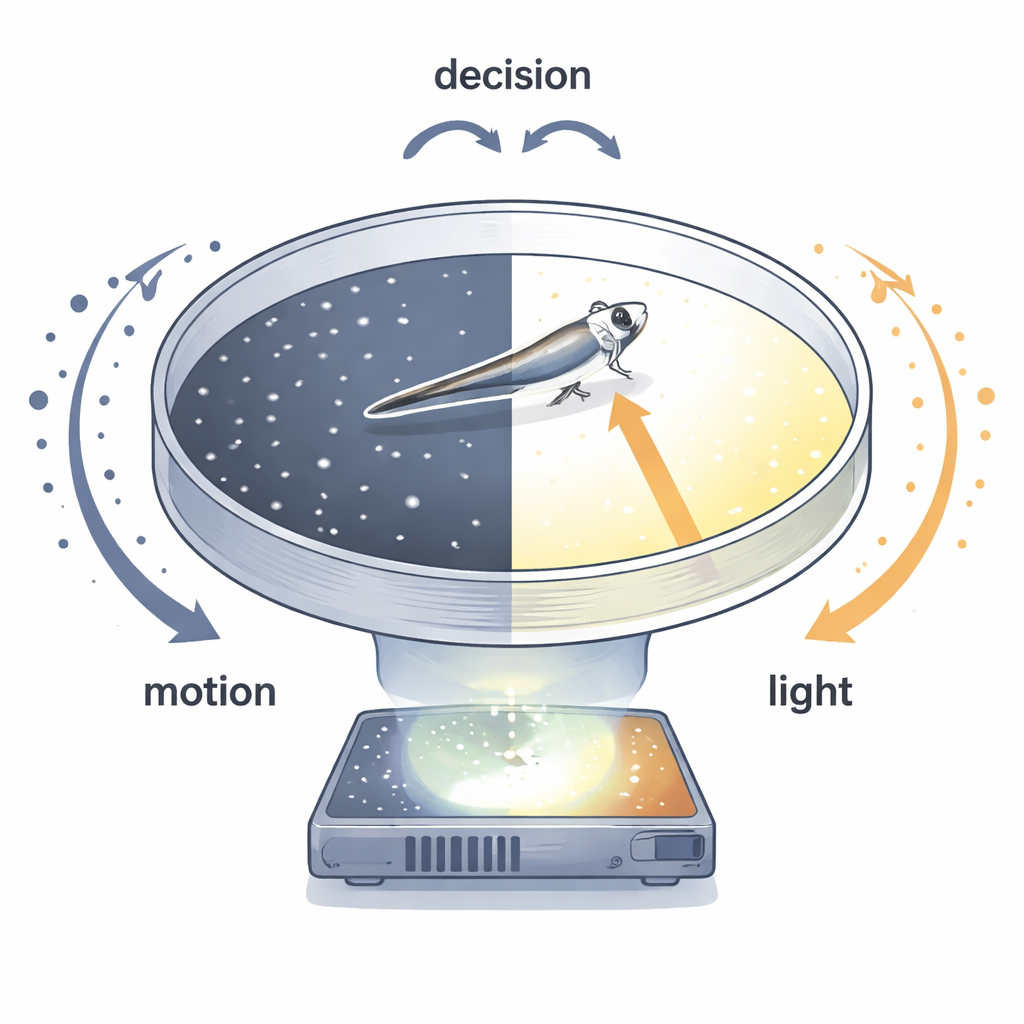
Watching fish decide which way to swim
Larval zebrafish are ideal for this problem because they are transparent and their whole brain can be imaged while they see and move. The authors designed a simple but powerful setup: a single fish swims freely in a circular dish while a projector underneath shows two kinds of visual patterns. One is a field of moving dots that normally makes the animal swim with the flow, a stabilizing reaction known as the optomotor response. The other is a left–right light difference—one half of the visual world brighter than the other—which draws the animal toward the brighter side, a behavior called phototaxis. By carefully combining these patterns, sometimes in agreement and sometimes in conflict, the team could measure how often each fish chose to turn left or right, and how quickly those decisions were made.
Adding signals instead of picking a single winner
The researchers compared the behavior to two simple decision rules. In a “winner-takes-all” strategy, the strongest cue—motion or light—should completely dominate, especially when it is clear and reliable. In an “additive” strategy, motion and light would each push the fish a bit toward one direction; the actual choice would reflect the sum of these pushes. Across many fish, the choice patterns followed the additive rule: changing the light on one side shifted the entire curve of motion-driven turns up or down, as if a separate light bias were simply being added. When motion and light both pointed the same way, the fish were more accurate and reacted faster; when they pointed in opposite directions, choices hovered near chance and reaction times slowed, consistent with two influences pulling in opposite directions rather than one side winning outright.
Three visual pathways shaping a single decision
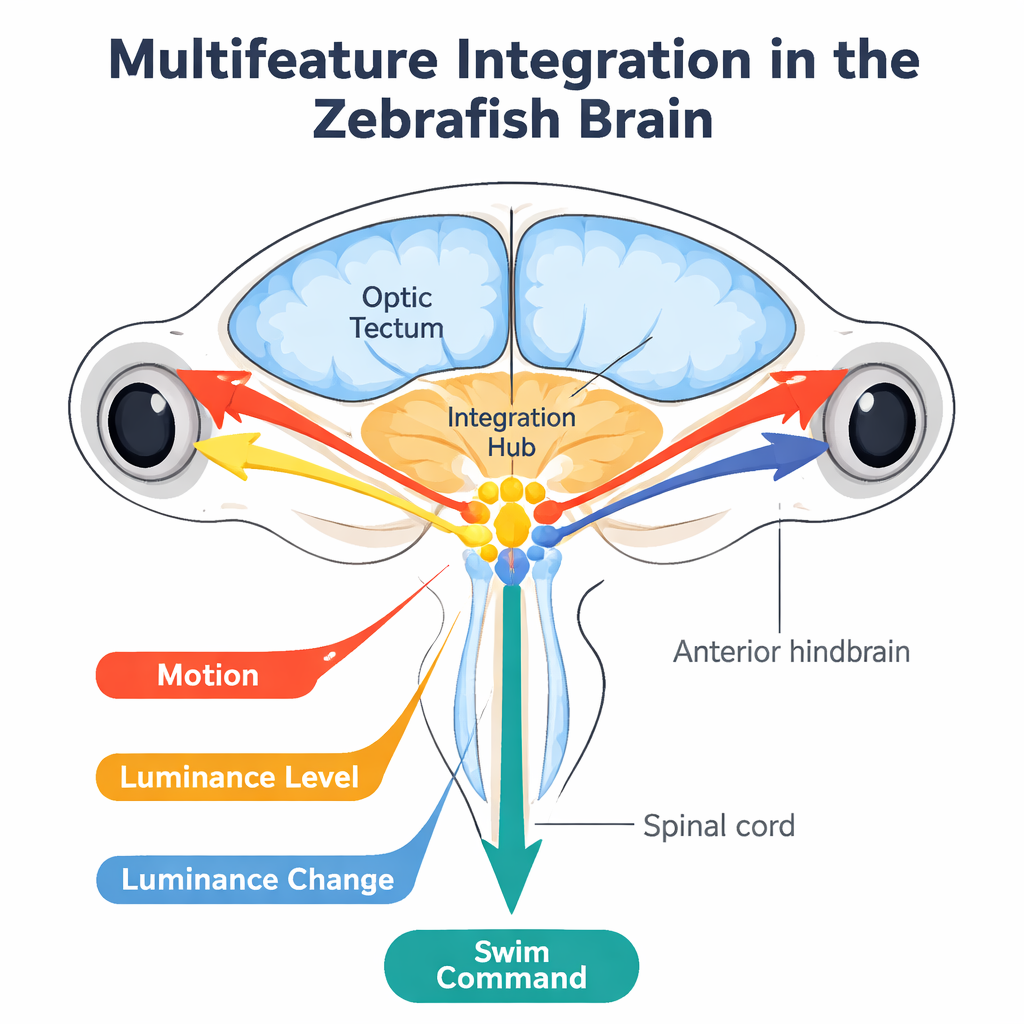
Looking more closely in time, the team discovered that “light” was not a single influence. Instead, behavior revealed three separate contributions that together shaped each bout of swimming. First, motion cues were slowly integrated: the longer dots drifted in one direction, the more likely the animal was to turn that way. Second, steady differences in light level between the two sides gently attracted the fish toward the brighter half. Third, sudden changes in light—when one side abruptly became brighter or darker—briefly pushed the fish away from the changing side, acting like a short-lived repulsive cue. A compact mathematical model with these three ingredients, each with its own strength and time scale, accurately predicted how turning decisions unfolded over time for dozens of different stimulus combinations, even those not used to fit the model.
Finding the brain hub that combines motion and light
To uncover where these computations happen, the authors used brain-wide two-photon calcium imaging, which reports activity from nearly all neurons in the living fish. They presented the same motion and lighting patterns while recording and looked for cells whose activity matched the model’s predicted signals. Neurons responding to light level and light changes appeared mainly in the optic tectum, a midbrain visual center, and in related regions. Cells that integrated motion, and neurons whose activity reflected the final combined “multifeature” signal, clustered in a part of the hindbrain just behind the cerebellum. Further experiments that labeled excitatory and inhibitory cells, and traced the shapes and projections of individual neurons, showed a largely balanced local circuitry with multiple pathways from the eyes into this anterior hindbrain “integration hub” and outputs toward motor circuits that control swimming.
From fish brains to general rules of decision-making
In everyday life, animals rarely receive a single, perfectly reliable cue. This study shows that, at least for basic visual guidance in zebrafish, the brain solves this by keeping motion, brightness, and brightness change in partly separate channels and then adding them together in a dedicated hindbrain hub to produce a movement decision. Rather than letting one signal veto all others, the circuit behaves like a simple calculator, weighing each feature according to its strength and timing. Because similar additive strategies appear in mammals, including humans, these results suggest that a shared, brain-wide principle may underlie how diverse vertebrates merge conflicting sensory information into coherent actions.
Citation: Slangewal, K., Aimon, S., Capelle, M.Q. et al. Visuomotor decision-making through multifeature convergence in the larval zebrafish hindbrain. Nat Commun 17, 2024 (2026). https://doi.org/10.1038/s41467-026-69633-4
Keywords: multisensory integration, zebrafish, visual motion, phototaxis, sensorimotor decision-making