Clear Sky Science · en
Heterogeneous weakly coupled polar nanoclusters enabling superior high-temperature capacitive energy storage
Why fast, heat-proof capacitors matter
From electric cars to renewable power plants, modern technology needs components that can gulp and release electrical energy in an instant, even in hot, cramped spaces. Ceramic capacitors are promising workhorses for this job because they charge and discharge extremely quickly and can handle high voltages. Yet most current versions lose their punch or waste energy as heat when temperatures climb. This study shows how redesigning the internal structure of a lead-free ceramic at the nanometer scale can deliver both high energy storage and rock-solid performance from room temperature up to the heat of a car engine bay. 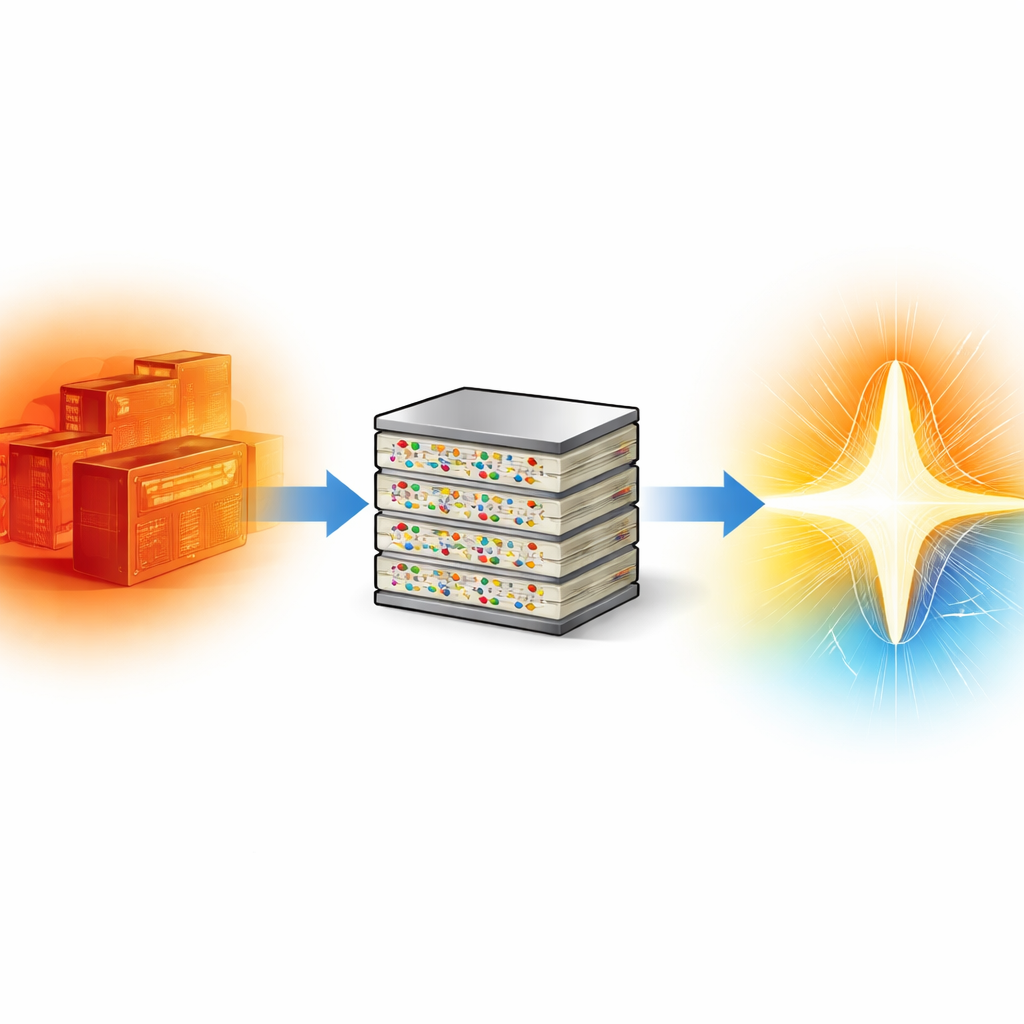
From simple ceramics to smart energy storage
Ordinary ceramic capacitors behave a bit like tiny springy charge reservoirs: push in charge with a high electric field and they store energy, remove the field and they give it back. To be useful in compact, high-power devices, they must store a lot of energy per unit volume and give most of it back without loss. However, in many ceramics the electric dipoles inside switch direction sluggishly and hysteretically, tracing out fat loops when plotted against the applied field. That wasted effort turns into heat, lowering efficiency and limiting how hard and how hot the devices can be driven. Earlier efforts using so‑called relaxor ceramics improved efficiency but still suffered from strong temperature sensitivity and limited energy density at high heat.
Taming tiny regions of order inside disorder
The researchers tackled this problem by reshaping how electric dipoles are organized inside a well-known, lead-free ceramic based on barium titanate and sodium bismuth titanate. Using computer simulations as a guide, they added a carefully chosen mix of other elements—strontium, lanthanum, and zirconium. These added atoms disturb the long, continuous regions of aligned dipoles that normally form inside the crystal, breaking them up into much smaller polar “nanoclusters” that sit in a largely nonpolar background. In this so‑called superparaelectric state, each tiny cluster can reorient its polarization quickly and reversibly when an electric field is applied and removed, without getting stuck in one preferred direction. 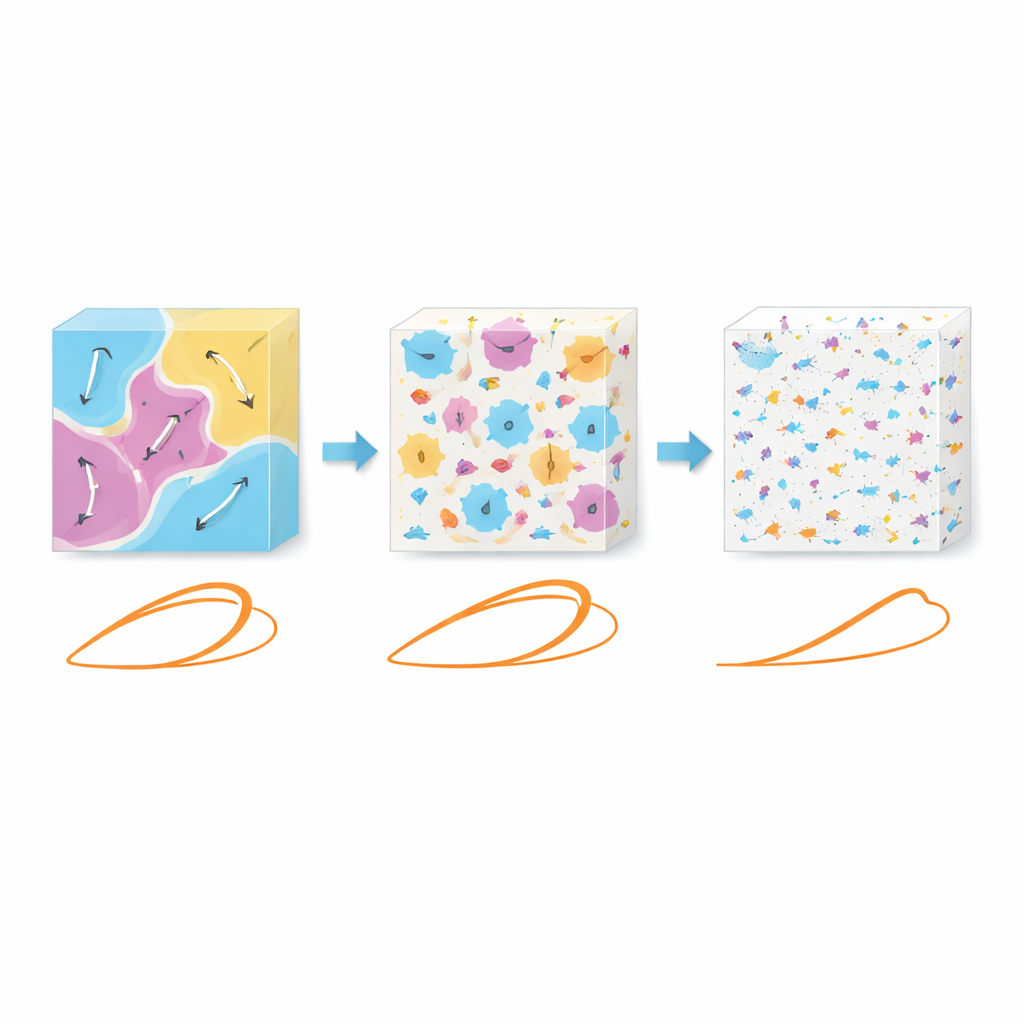
Seeing the new structure in action
To confirm that their design really created the desired nanoscale landscape, the team used advanced electron microscopes to map atomic positions and local polarization directions. They observed a patchwork of small, weakly linked polar regions with different distortion patterns embedded in a more neutral matrix. Measurements of how the material responds to changing electric fields showed slim, nearly linear charge–field loops, consistent with rapid, low-loss switching of many tiny clusters rather than a few large, sluggish domains. Further tests of the dielectric properties over a wide temperature range revealed that these nanoclusters stay active and stable from well below freezing to well above the boiling point of water, with only modest changes in their behavior.
Building real multilayer devices
Engineering insights only matter if they translate into practical devices, so the researchers fabricated multilayer ceramic capacitors using their optimized composition. By refining the grain size and stacking several ultra-thin dielectric layers between metal electrodes, they boosted the electric field the device can safely withstand. The resulting capacitors stored up to about 19 joules of energy per cubic centimeter at room temperature while returning roughly 95% of that energy—figures that rival or surpass leading lead-free devices. Crucially, when the temperature was raised to 160 degrees Celsius, the capacitors still delivered more than 10 joules per cubic centimeter with efficiencies above 95%, and they maintained this performance over many charging cycles and at different operating frequencies.
What this means for future electronics
In everyday terms, this work shows that by carefully introducing disorder at the atomic scale, it is possible to make ceramic capacitors that act like nearly ideal, loss-free springs for electric charge, even when they run hot. The key is a landscape of many tiny, weakly connected polar pockets that flip easily and reversibly under an applied field, instead of a few large, stubborn regions. Capacitors built on this principle could help shrink and harden power electronics in electric vehicles, aerospace systems, and grid hardware, where compact, fast, and heat-tolerant energy storage is at a premium.
Citation: Yuan, Q., Zheng, B., Lin, Y. et al. Heterogeneous weakly coupled polar nanoclusters enabling superior high-temperature capacitive energy storage. Nat Commun 17, 3000 (2026). https://doi.org/10.1038/s41467-026-69631-6
Keywords: ceramic capacitors, energy storage, high temperature electronics, lead-free materials, polar nanoclusters