Clear Sky Science · en
A red/blue optoswitch for temporal control of chloroplast transcription and biogenesis in Arabidopsis
Turning Light into a Genetic Dimmer Switch
Chloroplasts, the green factories inside plant cells, power nearly all life on Earth by capturing sunlight. When these factories fail to form, seedlings become white “albinos” that cannot feed themselves. This study shows how scientists built a precise, light-controlled genetic switch in the model plant Arabidopsis to turn chloroplast formation on or off at will. Their approach not only rescues otherwise non-viable plants, but also reveals when, during early growth, a cell permanently loses the ability to become green.
A Problem with Silent Solar Panels
Some mutant plants lack a key enzyme complex called PEP, which normally drives the activity of many chloroplast genes. Without PEP, seedlings stay albino and die unless supplied with sugar. These mutants are valuable for understanding how chloroplasts form, but they are hard to study because they produce few seeds and cannot survive long. The authors tackled this by designing a way to “complement” a PEP-defective mutant—specifically the pap7-1 line—only when desired, using light as a clean, fast on/off signal instead of chemical additives that diffuse slowly and may have side effects.
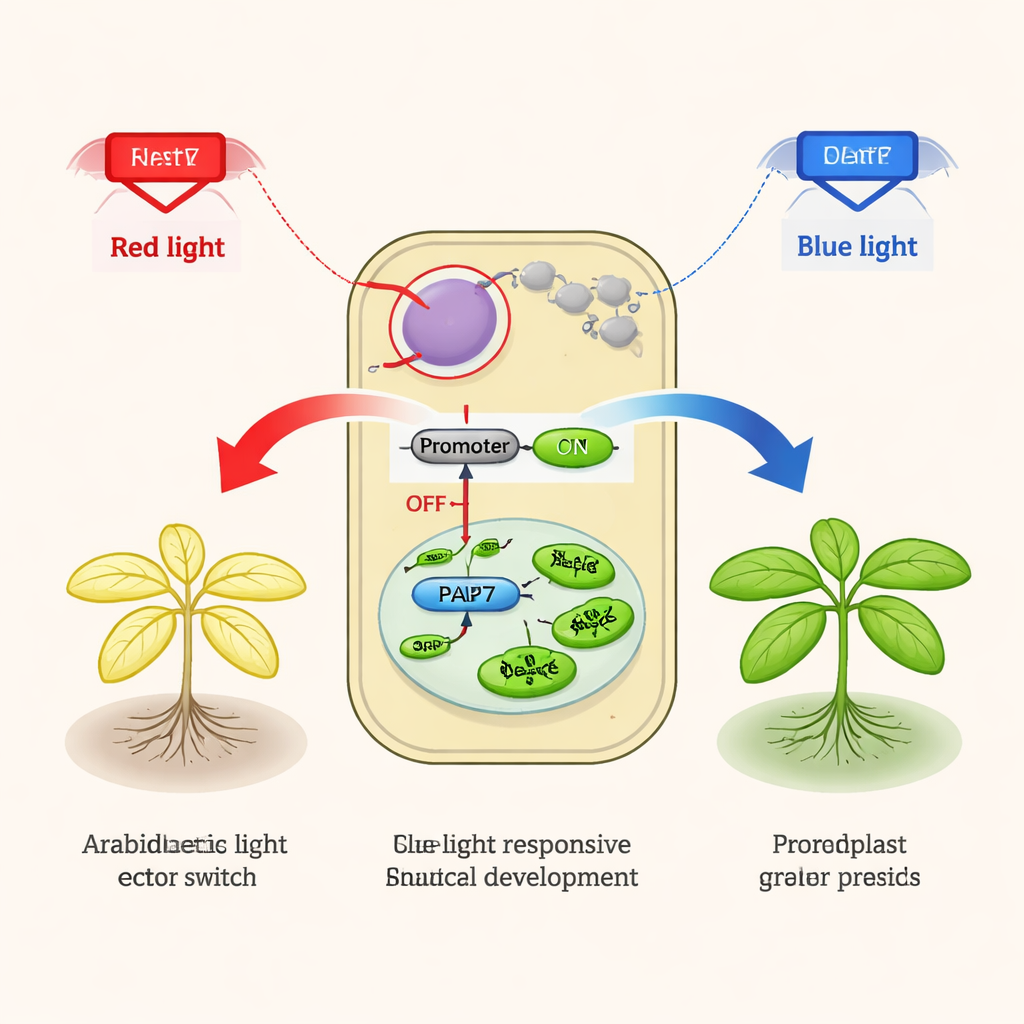
Building a Blue-Light-Controlled Rescue System
The team engineered a genetic cassette that places the missing PAP7 gene under the control of short DNA elements naturally activated by blue light in plants. Under pure red light, these elements stay silent; under pure blue light, they switch on strongly. By inserting multiple copies of these blue-responsive elements, they created an “optoswitch” they call blue-light-valved biogenesis (BVB). In the pap7-1 mutant background, seedlings grown under red light remained white, but when moved to blue light they turned green and developed functioning chloroplasts and normal photosynthesis. Fine-tuning the number of regulatory repeats allowed strong activation in blue light while avoiding unwanted “leakiness” in red light.
Discovering a Cellular Point of No Return
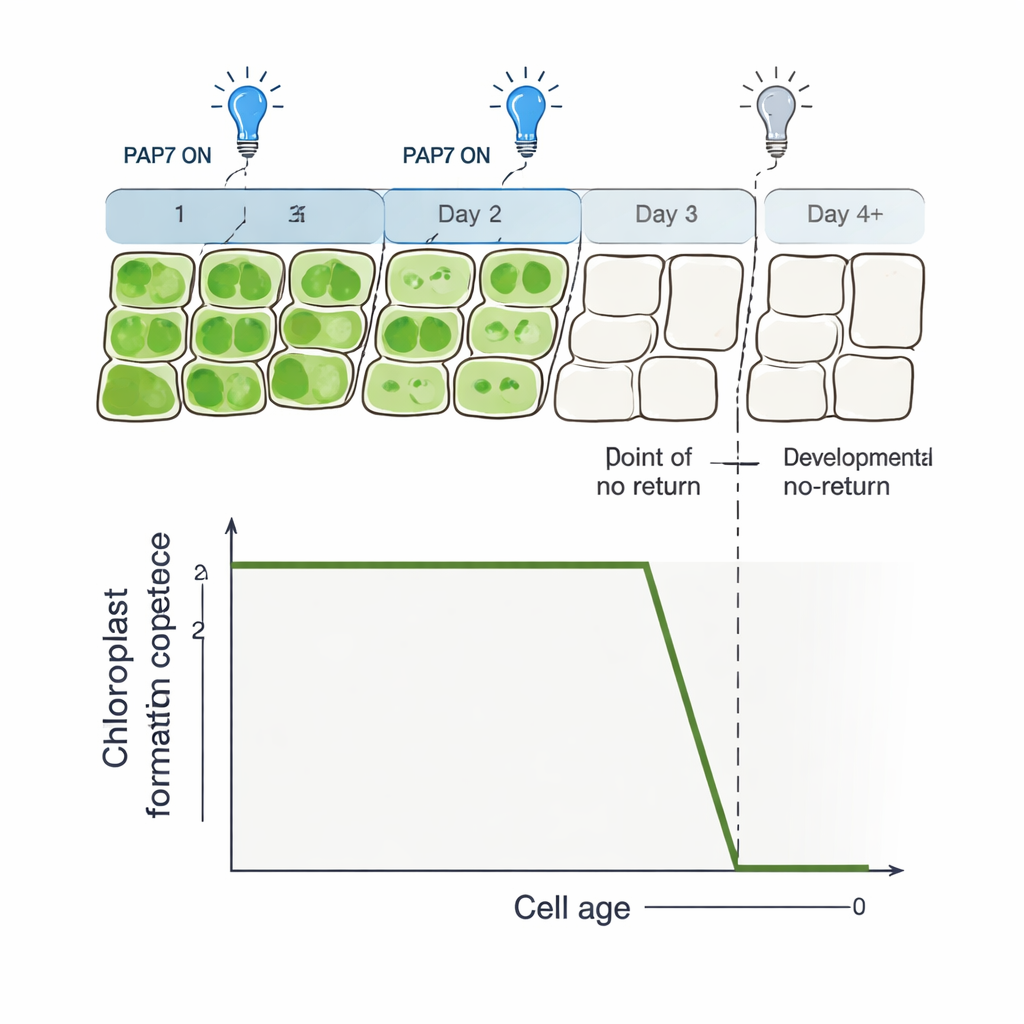
Using their switch, the researchers could decide exactly when to provide PAP7 during development. They grew plants for different lengths of time in red light or in darkness, then shifted them to blue light. When PAP7 was switched on very early, young leaf cells formed green chloroplasts. But if the shift came too late—about three days after leaf development began—existing white cells stayed white forever, while only newly formed cells could still become green. This behavior produced leaves with striking green-and-white patterns and revealed a “point-of-no-return” in individual cells: beyond a certain age, they irreversibly lose the ability to initiate chloroplast biogenesis, even though PAP7 can still be expressed.
Chloroplast Startup Without Sun-Powered Electricity
Because several PEP-associated proteins were thought to respond to the redox state of photosynthesis, the authors tested whether electron flow through the photosynthetic machinery was required for building a PEP complex. They treated seedlings with a herbicide (DCMU) that blocks the first steps of electron transport and then activated PAP7 with blue light. Even with photosynthesis chemically shut down, the plants assembled the PEP complex, expressed chloroplast genes, and began to green. Some genes showed modest changes, but overall PEP formation and initial function did not depend on active photosynthetic electron flow, challenging previous ideas about how redox signals control this system.
A New Toolkit for Green Engineering
The study introduces a simple, plant-native optogenetic tool that can keep lethal mutations “hidden” under red light and reveal them under blue light, using only standard LED growth chambers. This blue-light-controlled rescue exposes a tightly timed developmental window during which cells can still commit to building chloroplasts, and shows that the earliest stages of chloroplast gene activation do not require running photosynthesis. For plant science and biotechnology, such light-operated switches open the door to dissecting otherwise non-viable mutants, probing how cells coordinate growth with organelle formation, and eventually engineering crops whose key traits can be turned on with nothing more than a change in light color.
Citation: Uecker, F., Ahrens, F.M., Ruder, T. et al. A red/blue optoswitch for temporal control of chloroplast transcription and biogenesis in Arabidopsis. Nat Commun 17, 1984 (2026). https://doi.org/10.1038/s41467-026-69626-3
Keywords: chloroplast biogenesis, optogenetics, Arabidopsis mutants, gene expression control, photosynthesis