Clear Sky Science · en
Single-crystal 2D covalent organic frameworks for high-capacity methane storage
Turning a Common Fuel into a Compact Power Source
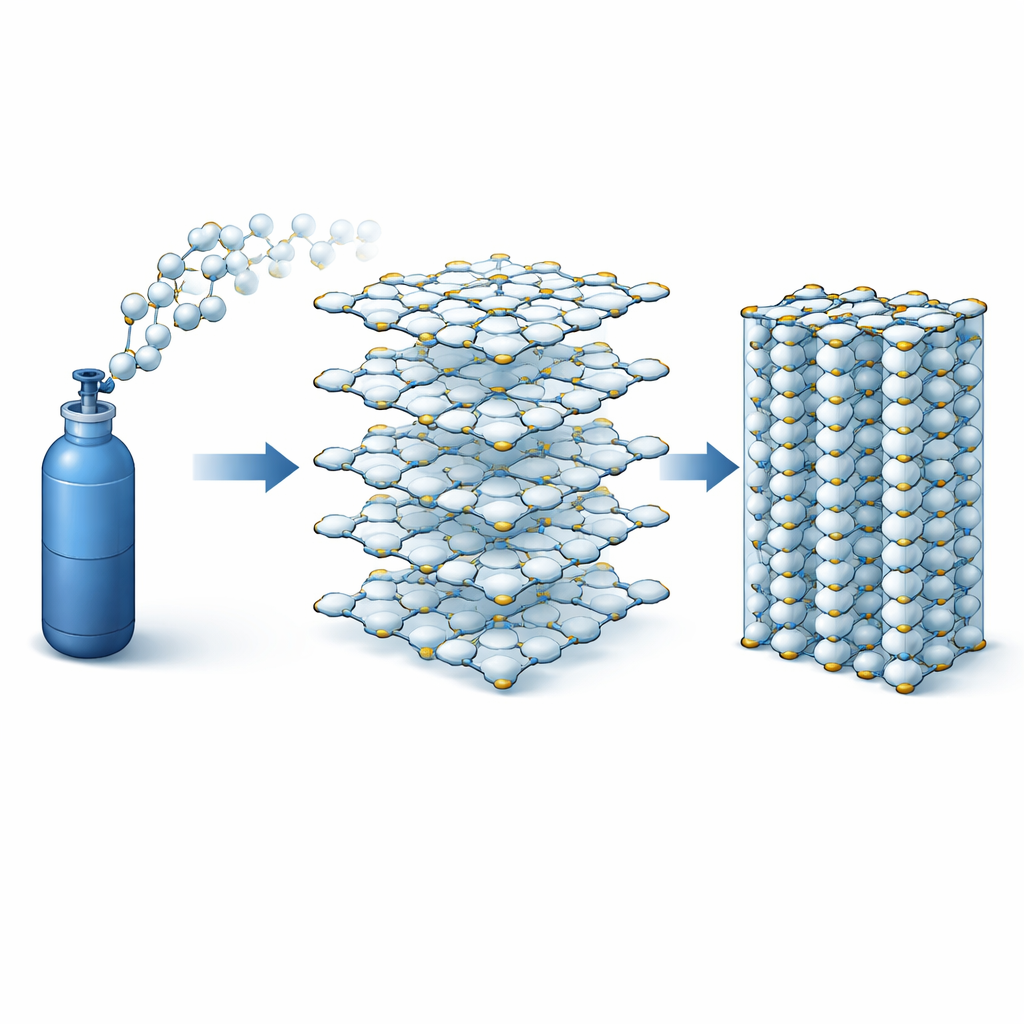
Natural gas, made mostly of methane, is a cleaner-burning fuel than gasoline or diesel, but it has a big drawback: as a gas, it takes up a lot of space. Compressing it to very high pressures or chilling it into a liquid is costly and technically demanding. This study explores a different approach—soaking methane into sponge‑like crystals—by designing a new kind of orderly, ultra‑porous solid that can hold large amounts of gas in a small volume, potentially making natural‑gas vehicles and other clean‑energy technologies more practical.
Building Better Molecular Sponges
The materials at the heart of the work are called covalent organic frameworks, or COFs—crystals made entirely from light elements such as carbon, hydrogen, nitrogen, and oxygen, linked together into rigid, repeating nets. Many three‑dimensional versions of these frameworks already show promise for gas storage, but two‑dimensional COFs, which resemble stacks of atom‑thin sheets, have lagged behind because they often form as disordered powders with less internal space. The authors set out to change this by designing COFs that grow as well‑ordered single crystals and by carefully controlling how their layers stack, which in turn governs how much empty space is available to store methane.
A Smart Twist in the Building Blocks
To steer the way the COF layers pack, the researchers subtly modified the molecular building blocks, adding small “side groups” such as methyl (–CH₃) and methoxy (–OCH₃) units at specific positions. These small attachments force the flat, ring‑shaped units to twist slightly out of plane, breaking the tendency of the sheets to sit directly on top of one another. When the modified units are linked by simple chemical reactions, they assemble into three closely related COFs, named GZU‑1, GZU‑2, and GZU‑3. Each forms a honeycomb‑like layer with channels running through the crystal, but the exact way these layers are offset and repeated differs, creating distinct “stacking patterns” and slightly different pore sizes and shapes.
Unusual Stacks and Hidden Attractions
Using advanced electron‑diffraction techniques, the team determined the atomic arrangement in these tiny crystals and discovered highly unusual stacking orders. GZU‑1 and GZU‑3 adopt a rare six‑layer repeating pattern, while GZU‑2 displays a four‑layer tilted pattern not seen before in this family of materials. Computer calculations revealed why these arrangements are so stable: numerous gentle attractions between hydrogen atoms and nearby aromatic rings act like tiny locks between the sheets, holding them in place without crushing the pores. These interactions, made possible by the added side groups and the shifted stacking, give the crystals exceptional mechanical stability and keep their internal passages open even after solvent molecules are removed.
From Open Channels to Methane Storage
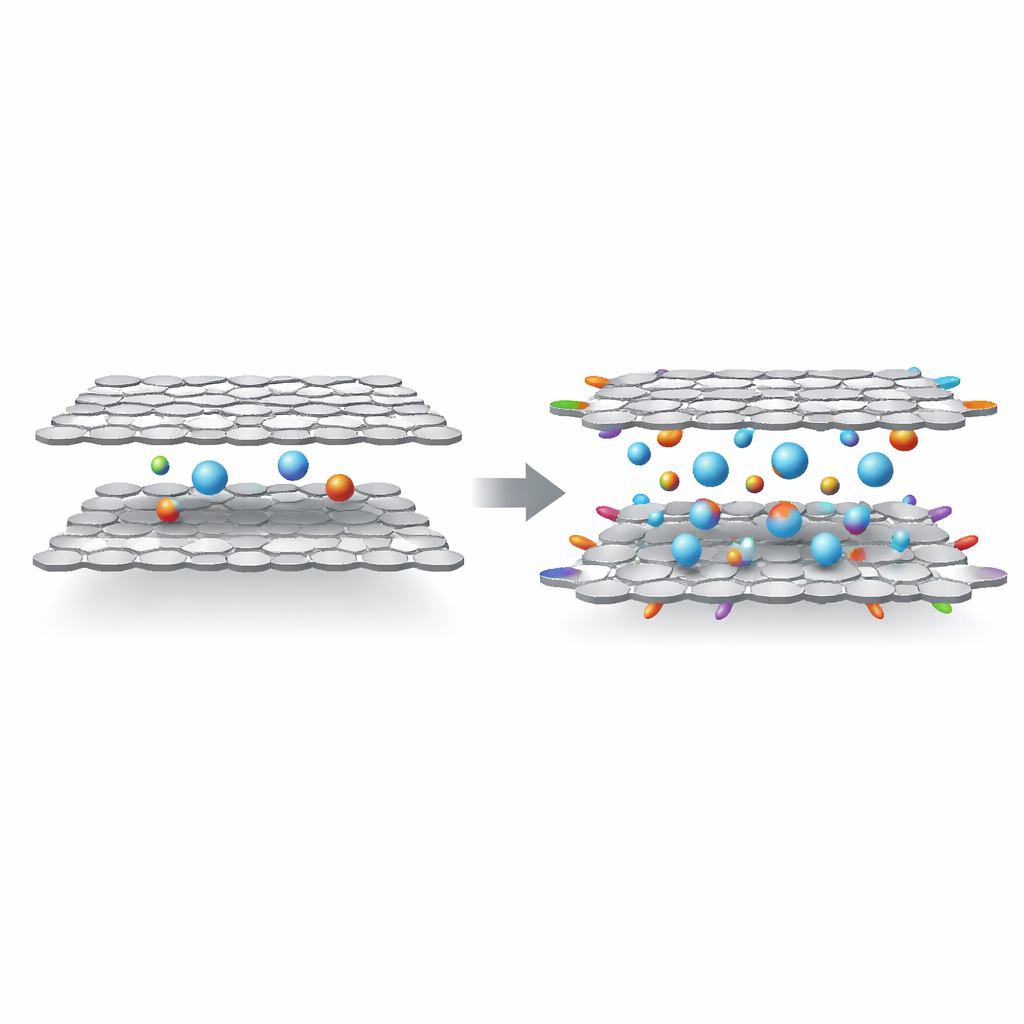
Gas‑adsorption experiments showed that all three COFs have very high internal surface areas—up to about 2,100 square meters per gram for GZU‑1, comparable to or exceeding many well‑known porous materials. When exposed to methane at pressures up to 100 bar (roughly 100 times atmospheric pressure), the activated crystals soak up large amounts of gas. GZU‑1 performs best, storing methane at densities similar to some state‑of‑the‑art three‑dimensional porous frameworks and achieving record performance among two‑dimensional COFs. Notably, it offers an excellent “working capacity,” meaning it can load a lot of methane at high pressure but does not hold on too strongly at lower pressure—exactly the balance needed for practical filling and emptying of storage tanks.
Why This Matters for Future Energy Use
In everyday terms, the study shows how tiny adjustments—adding small side groups and changing how molecular sheets slide over one another—can dramatically improve how much fuel a crystal can hold. By finely tuning the distance and alignment between layers, the researchers created two‑dimensional COFs that rival or even approach the best three‑dimensional materials for methane storage. This suggests that flat, layered crystals, once seen as second‑best, could become prime candidates for compact, reusable gas tanks in vehicles or backup power systems. The broader message is that precise control over molecular stacking can unlock new levels of performance in porous materials, with implications not only for fuel storage but also for separation, sensing, and catalysis.
Citation: Yu, B., Oliveira, F.L., Li, W. et al. Single-crystal 2D covalent organic frameworks for high-capacity methane storage. Nat Commun 17, 2740 (2026). https://doi.org/10.1038/s41467-026-69614-7
Keywords: methane storage, covalent organic frameworks, porous materials, natural gas, gas adsorption