Clear Sky Science · en
Topological protection by local support symmetry and destructive interference
Hidden Order in Everyday Materials
Many modern technologies, from ultra-precise sensors to robust quantum devices, rely on exotic electronic behavior called topological phases. These phases are usually thought to demand perfect, crystal-wide symmetry—a tall order for real, messy materials. This paper overturns that expectation, showing that special electronic patterns can stay protected even when a symmetry holds only in part of a material. That discovery broadens the hunt for useful quantum materials and explains why some puzzling experimental features refuse to disappear, even in imperfect crystals.
When Symmetry Only Lives Next Door
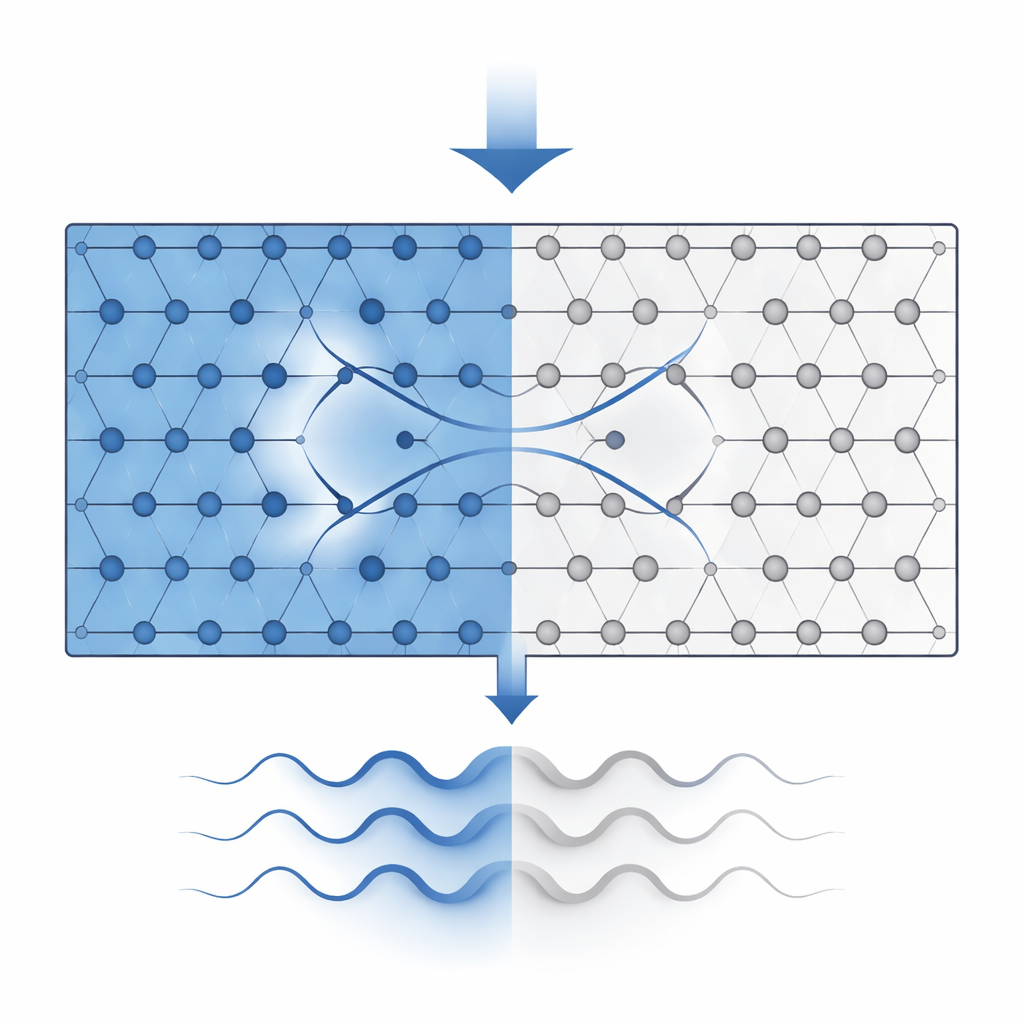
Physicists typically imagine symmetries—like mirror flips or 180-degree rotations—as acting on a whole crystal at once. Those global symmetries can prevent energy bands from merging or opening gaps, giving rise to topological insulators and semimetals. The authors instead look at a more realistic scenario: a material split into two regions. One region, S1, still respects a symmetry; the neighboring region, S2, does not. At first glance, this should destroy any symmetry-based protection. The key claim of the paper is that under the right conditions, S1 can still imprint topological behavior on the full system. The authors call this situation a local support symmetry: the symmetry acts faithfully only on S1, yet the entire material inherits protected band crossings or robust topological bands.
Waves That Refuse to Leak
How can one part of a crystal protect the whole? The answer lies in wave interference. Electrons in a solid behave like waves spread across the lattice. If paths from S1 into S2 interfere destructively—peaks canceling troughs—the electronic wave in certain bands has exactly zero amplitude on S2. In effect, those electrons are "caged" inside S1, even though physical bonds connect the two regions. Because the relevant wave functions never reach S2, they only "feel" the symmetry that S1 preserves. Mathematically, the authors show that if the couplings between S1 and S2 satisfy specific orthogonality conditions, entire sets of energy bands remain identical to those of S1 alone. That means familiar topological labels, like the Z2 index of a quantum spin Hall insulator or mirror-based invariants, still apply even though the global symmetry is broken.
Model Crystals That Trap Topological States
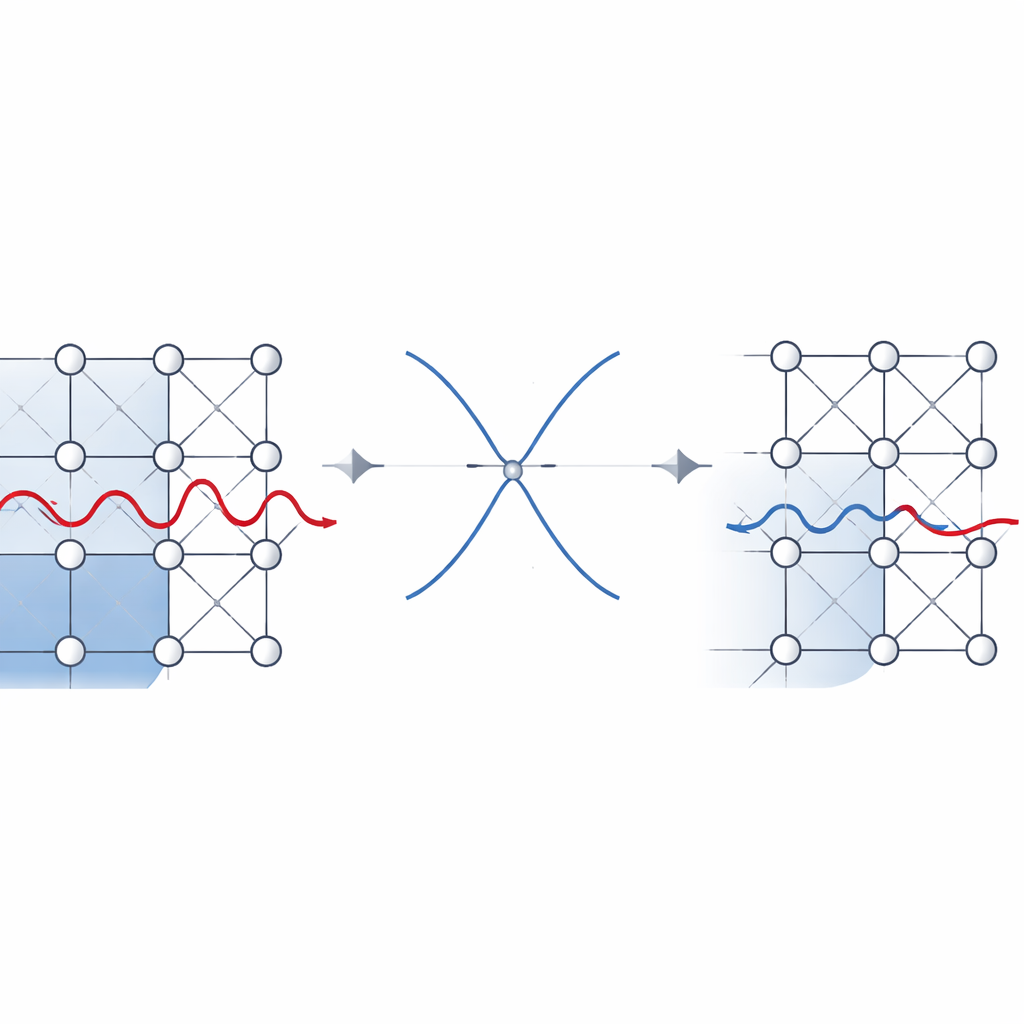
To make these ideas concrete, the authors design several lattice models where the mechanism can be seen explicitly. In one, a well-known “Lieb lattice” hosts both flat (dispersionless) bands and topological bands. They attach an extra set of sites that breaks time-reversal symmetry overall. By carefully choosing how electrons hop between the two parts, they arrange for destructive interference so that the topological bands remain confined to the original lattice. The system as a whole no longer has time-reversal symmetry, but its occupied bands still carry the same Z2 topological index, and characteristic edge states survive—with only tiny shifts where symmetry is slightly polluted by residual leakage. Other models show similar behavior for massless “Dirac” electrons protected not by global crystal rotation or screw symmetries, but by these symmetries acting only within S1. Again, band crossings remain pinned and robust as long as interference keeps at least one of the crossing states strictly zero on S2.
Near-Missed Gaps in a Real Carbon Sheet
Beyond toy models, the authors examine a realistic two-dimensional carbon material: the biphenylene network decorated with fluorine atoms. Fluorine strongly distorts the lattice and breaks a rotation symmetry that, in the pristine material, protects special “type-II” Dirac points. Using detailed quantum calculations, the team finds that after fluorination these Dirac points do acquire a gap—but one of the gaps is astonishingly small, thousands of times weaker than the main bonding energies. By mapping the system onto their local support framework, they show that a subset of carbon atoms still forms a region S1 with approximate rotational symmetry. For certain electronic states, destructive interference keeps the wave function almost entirely inside S1, so the symmetry continues to nearly protect a Dirac crossing. Small, longer-range hoppings eventually spoil the cancellation and open a minute gap, matching the numerical results.
Why This Matters for Future Materials
The study reveals a general principle: if part of a material quietly preserves a symmetry and interference prevents electrons from escaping that region, then topological features and band crossings can persist even when the rest of the crystal looks disorderly from a symmetry standpoint. This helps explain why nearly gapless Dirac points and robust edge modes often survive in materials that appear to violate the textbook symmetry rules. It also offers a practical recipe for discovering new topological systems: look for structures with local patches of symmetry and flat or nearly flat bands, where compact, interference-stabilized wave patterns are likely. In real crystals, the protection is rarely perfect, but the resulting energy gaps can be so small that, for many purposes, the system behaves as if the symmetry were still fully intact.
Citation: Rhim, JW., Seo, J., Mo, S. et al. Topological protection by local support symmetry and destructive interference. Nat Commun 17, 2739 (2026). https://doi.org/10.1038/s41467-026-69613-8
Keywords: topological materials, local support symmetry, destructive interference, Dirac semimetals, flat bands