Clear Sky Science · en
Atmospheric CO2 drawdown during the Emeishan flood basalt volcanism
When Volcanoes Cool the Planet
Most of us think of giant volcanic eruptions as planet‑heating disasters that pump huge amounts of carbon dioxide (CO2) into the air and help drive mass extinctions. This study looks at one such ancient volcanic episode in southwest China and finds a surprising twist: during the most intense outpouring of lava, atmospheric CO2 actually fell sharply. Understanding why offers a fresh perspective on how Earth’s deep interior, surface landscapes, oceans, and climate interact over millions of years.
A Giant Eruption with a Puzzling Signal
About 260 million years ago, during the Permian Period, the Emeishan Large Igneous Province (LIP) erupted enormous volumes of lava over a few million years. This episode coincided with a serious crisis in marine life, especially for reef builders and other shallow‑water organisms. The standard picture is that such eruptions liberate vast quantities of CO2, warming the planet and stressing ecosystems. Yet direct evidence for how atmospheric CO2 changed during Emeishan volcanism had been lacking, leaving the true climate impact uncertain.
Reading Ancient CO2 from Molecular Fossils
To reconstruct past CO2 levels, the authors sampled marine rocks in the Shangsi section of South China that span the interval before, during, and after the Emeishan eruptions. Instead of relying only on bulk rock chemistry, they focused on tiny molecular fossils derived from chlorophyll—specifically a compound called phytane. The ratio of light to heavy carbon in phytane, compared with that in co‑occurring carbonate minerals, records how strongly ancient algae discriminated against heavy carbon while photosynthesizing. That discrimination grows when CO2 is abundant and shrinks when CO2 is scarce. By calibrating these isotopic “fingerprints” with modern relationships and accounting for temperature and nutrient effects, the team produced a high‑resolution curve of atmospheric CO2 across several million years. 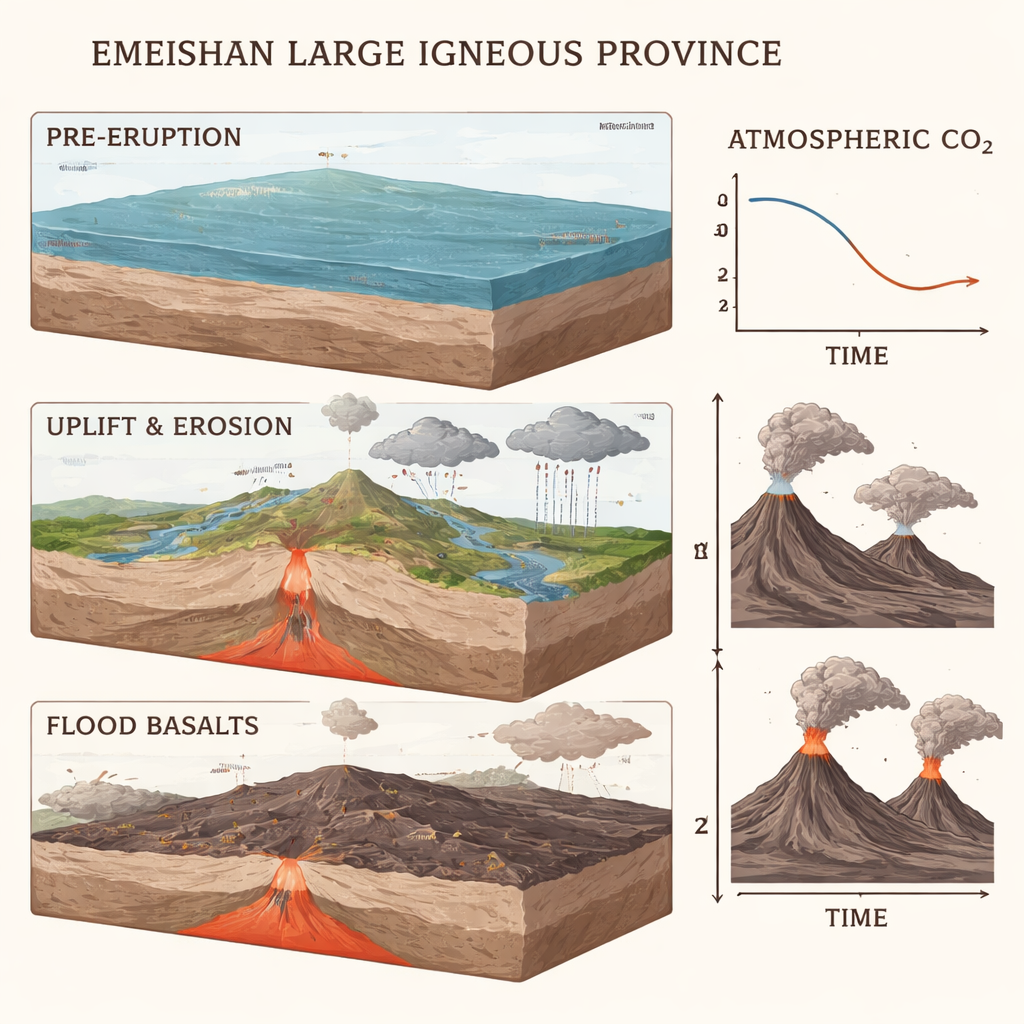
A CO2 Drop During Peak Lava Flooding
The resulting record reveals an unexpected pattern. In the time leading up to the main eruptions, CO2 levels hovered around 700 parts per million (ppm). Beginning roughly 263.5 million years ago—just as the volcanic province was developing—CO2 declined steadily, reaching values near 350 ppm around the end of the main flood basalt phase. Strikingly, this low point overlaps with strong mercury spikes in the sediments, an independent sign of intense volcanic activity. Only later, during smaller but more explosive silicic eruptions, did atmospheric CO2 climb again toward about 1000 ppm before easing back to around 600 ppm after volcanism waned. Thus, the period of greatest lava production coincided with major atmospheric CO2 drawdown, the opposite of what conventional models predict.
Uplifted Seafloor Rocks as a Giant CO2 Sponge
To explain this paradox, the authors look beneath the lava to the crustal foundations of the Emeishan province. Before major eruptions began, a hot mantle plume rose from deep within Earth and pushed the overlying crust upward, forming a broad dome hundreds of kilometers across and up to a kilometer high. This uplift exposed thick stacks of carbonate rocks—former seafloor limestones of the Yangtze platform—to rain, rivers, and chemical attack. As these carbonates weathered, they consumed atmospheric CO2 and delivered it, in dissolved form, to the oceans. Geochemical tracers of weathering intensity, such as lithium isotopes and a clay‑based alteration index, peak during the same interval as the CO2 decline, supporting this interpretation. Calculations suggest that erosion of the uplifted carbonates could have drawn down an amount of CO2 comparable to, or greater than, the entire atmosphere, even after accounting for partial buffering by the ocean.
Why This LIP Behaved Differently
The Emeishan lava itself also seems unusually poor in CO2 compared with many other volcanic provinces, meaning eruptions added relatively modest amounts of gas to the air. Unlike the Siberian Traps, where magma intruded into thick, organic‑rich sediments and released huge volumes of carbon from baking those rocks, Emeishan intrusions were mostly confined to carbonate hosts and a limited inner zone. As a result, the main carbon story was not massive degassing but rather massive weathering, supercharged by uplift in a warm, rainy tropical belt and by the relatively sluggish buffering of the Permian oceans. Together, these factors allowed the CO2‑absorbing power of freshly exposed limestone to outweigh volcanic emissions for several million years. 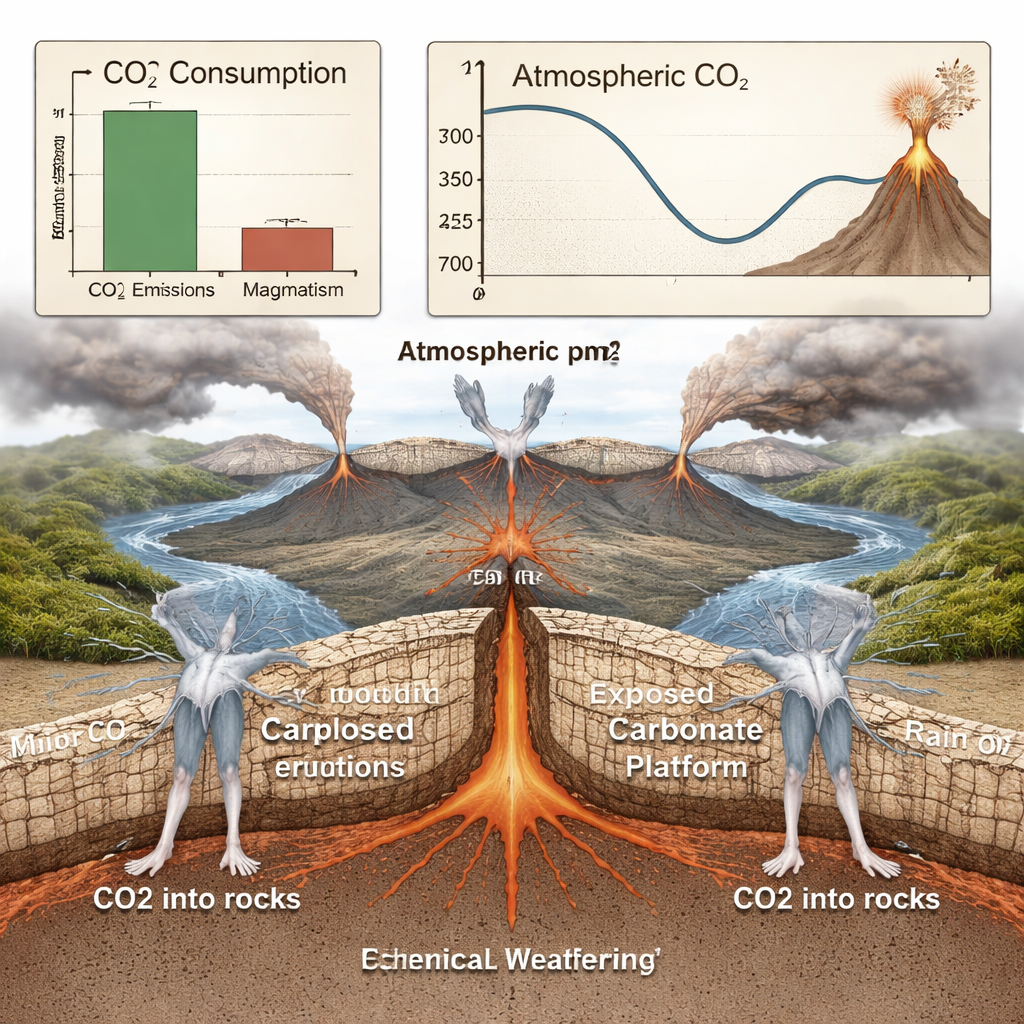
Rethinking Volcanoes and Climate
For non‑specialists, the key message is that giant volcanic episodes do not always push climate in the same direction. In the Emeishan case, deep‑sourced heat reshaped the landscape in a way that temporarily turned exposed rocks into an enormous CO2 sponge, even as lava flooded the surface. Later, different styles of eruption tipped the balance back toward CO2 release. This complexity helps explain why some large igneous provinces coincide with catastrophic extinctions while others do not, and it underscores the need to consider the full chain from mantle plume to mountain uplift, erosion, ocean chemistry, and atmospheric change when reading Earth’s deep‑time climate history.
Citation: Shen, J., Zhang, Y.G., Yuan, DX. et al. Atmospheric CO2 drawdown during the Emeishan flood basalt volcanism. Nat Commun 17, 1657 (2026). https://doi.org/10.1038/s41467-026-69600-z
Keywords: ancient climate, large igneous provinces, carbon dioxide, rock weathering, mass extinction