Clear Sky Science · en
Water mass specific genes dominate the Southern Ocean microbiome
Life in a Remote Ocean
The ocean that circles Antarctica may look empty and hostile, but it is teeming with microscopic life that helps regulate Earth’s climate. These invisible communities of bacteria, archaea, viruses and tiny algae recycle carbon, sulfur and nutrients, influencing everything from cloud formation to how much carbon sinks into the deep sea. This study asks a simple but far-reaching question: what makes the genetic makeup of these Southern Ocean microbes so special, and how is it shaped by the water they live in?
A Hidden Genetic World
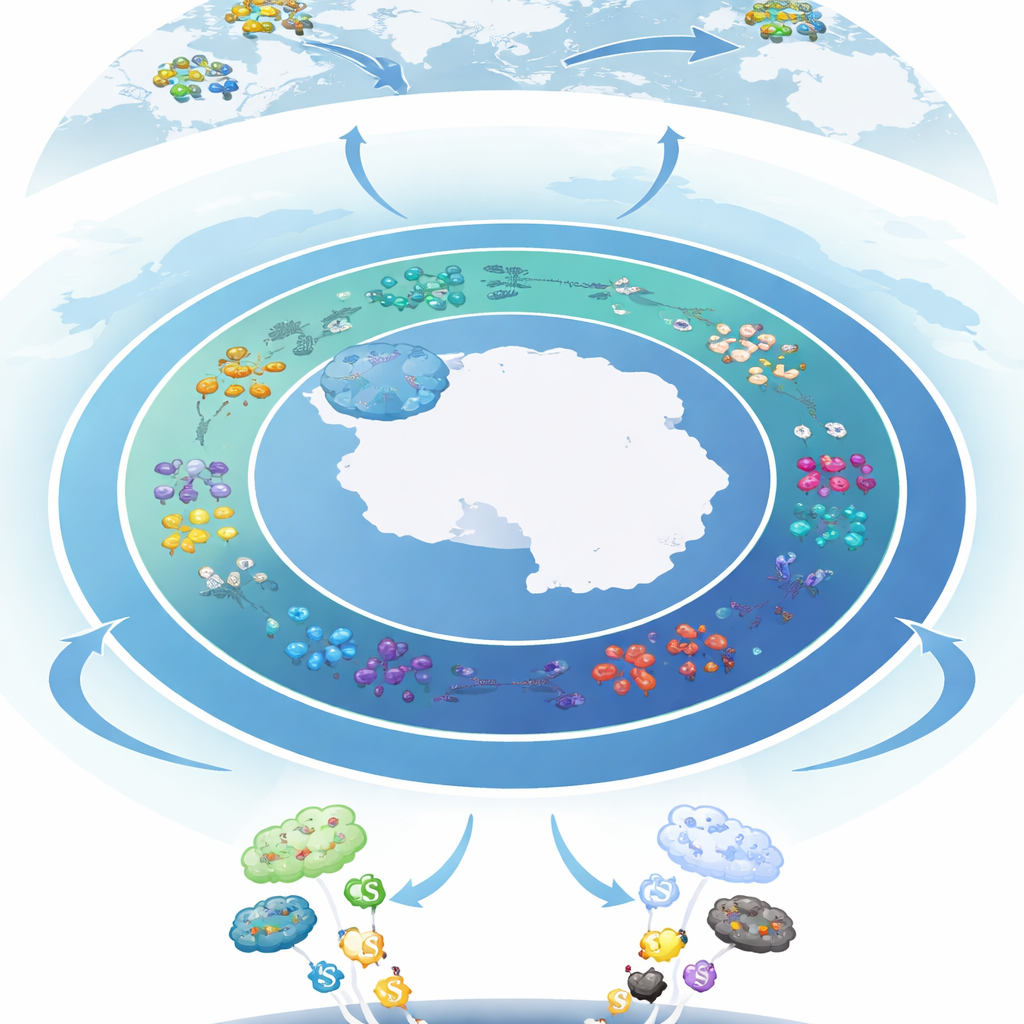
To explore this question, researchers sailed around Antarctica during the Antarctic Circumnavigation Expedition, collecting 218 DNA samples from different depths and particle sizes across the Southern Ocean. They then assembled a vast catalog of microbial genes, far larger than any previous effort in this region. When they compared this catalog with the best existing global marine gene databases, they found that over half of the Southern Ocean genes did not match known sequences. Even when they limited the comparison to similar sampling conditions, nearly 40% of genes still stood alone. This reveals a strikingly original genetic “seascape” in Antarctic waters, rich in functions that have never been described.
Shared Polar Traits, Isolated Polar Worlds
The team next asked how Southern Ocean genes are distributed around the globe. By seeing where these genes could be detected in other ocean surveys, they discovered a bipolar pattern: a large set of genes appears in both the Arctic and Antarctic but is largely absent from lower latitudes. Many of these polar-specific genes are linked to surviving cold, low light and harsh conditions, such as proteins that help cells cope with freezing temperatures, intense ultraviolet light and trace metal scarcity. Yet, even with these shared polar traits, Southern Ocean genes show a high degree of local uniqueness, underscoring how isolated and specialized this remote ocean has become.
Water Masses as Neighborhoods for Microbes
Within the Southern Ocean itself, the study found that the main driver of microbial gene patterns is not simple geography but the distinct bodies of water—called water masses—that differ in temperature, salt content, depth and circulation. By grouping samples according to these water masses, the researchers showed that each water type hosts its own characteristic gene community. Shallow subantarctic, Antarctic surface, deep circumpolar and dense shelf waters all carry different, predictable gene groupings. This means that as water forms, mixes and sinks, it also organizes who lives there and what they can do, from nutrient uptake to cell-to-cell combat via specialized secretion systems.
Bloom Hotspots and Viral Players
One striking case study focused on the Mertz polynya, an open-water area near the Antarctic coast where a massive diatom bloom turns the sea into a green soup each summer. Here, the team identified gene clusters associated with bacteria tailored to feast on the bloom’s rich organic leftovers, equipped with transporters and enzymes to strip sugars and proteins from sinking particles. They also uncovered intense viral activity, including classic bacteriophages and giant viruses that infect algae, some belonging to newly described viral groups. These viruses carry unusual genes, including zinc-binding regulators that may mirror similar adaptations in their polar algal hosts, hinting at co-evolution in this extreme environment.
Everywhere Bacteria, Local Solutions
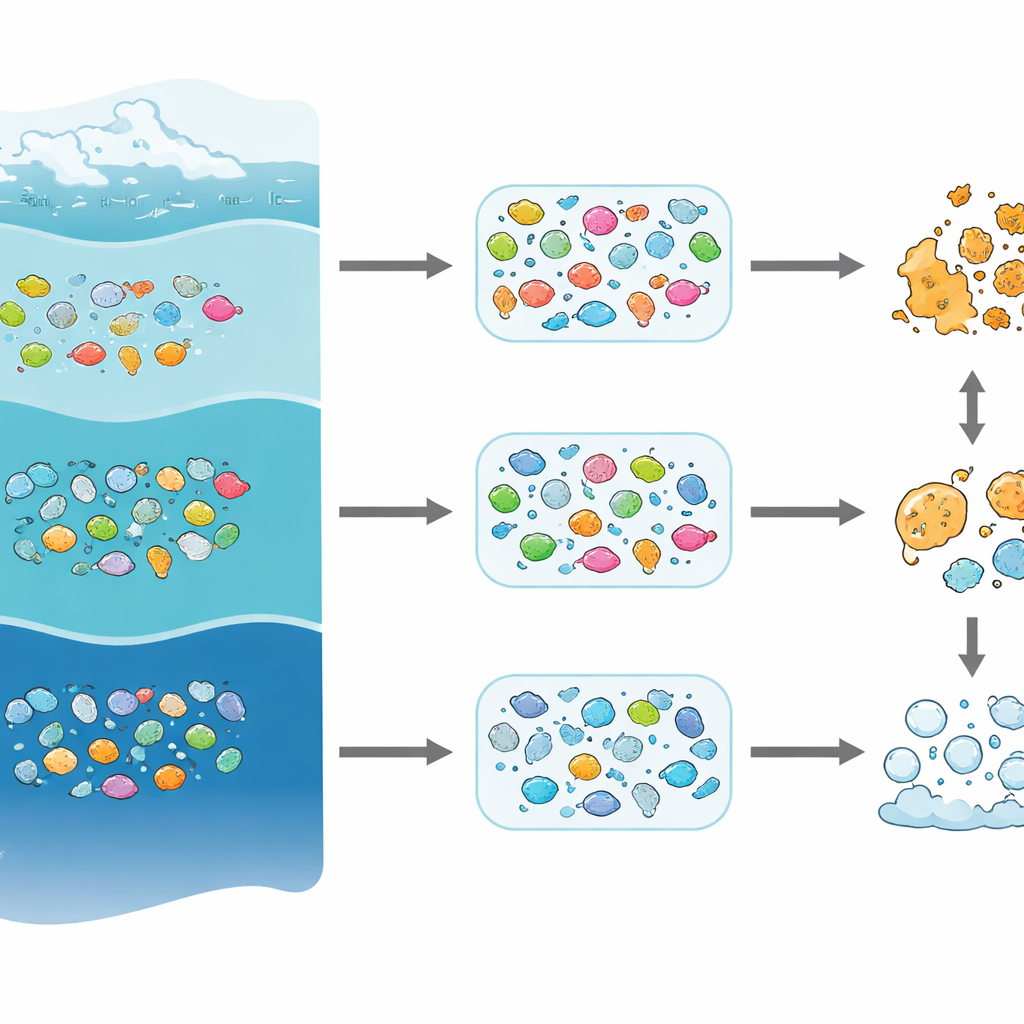
The scientists also zoomed in on Pelagibacter, one of the most common marine bacteria on Earth. Although this group is globally widespread, the study found that its gene sets shift across the Southern Ocean’s temperature and nutrient gradients. In warmer, saltier waters north of the polar front, Pelagibacter carries extra transport systems to grab metals like nickel and zinc, as well as compounds that help balance salt stress. In colder, more oxygen-rich Antarctic waters, other genes become more prominent, including those that may protect against oxidative stress or help cells attach to organic particles. Even a single bacterial lineage, it seems, splits into locally tuned variants that solve the challenges of each water mass in different ways.
Why These Tiny Genes Matter
Together, these findings show that the Southern Ocean hosts a unique and still largely unknown reservoir of microbial genes, many of which are tightly linked to specific water masses and polar conditions. These genes underlie processes that control how much carbon sinks to the deep ocean, how sulfur gases that seed clouds are produced, and how coastal blooms recycle nutrients. As climate change alters sea ice, meltwater input and deep-water formation around Antarctica, the structure of these water masses—and thus the microbial genes they carry—will likely shift. Mapping this hidden genetic landscape now provides a crucial baseline for understanding how a warming world could reshape one of Earth’s most important but least explored climate engines.
Citation: Faure, E., Pommellec, J., Noel, C. et al. Water mass specific genes dominate the Southern Ocean microbiome. Nat Commun 17, 2025 (2026). https://doi.org/10.1038/s41467-026-69584-w
Keywords: Southern Ocean microbiome, polar marine microbes, water mass biogeography, microbial gene catalog, dimethylsulfoniopropionate (DMSP)