Clear Sky Science · en
Smooth doubly curved origami shells with reprogrammable rigidity
Folding Flat Sheets into Strong Curved Shells
Imagine packing a rigid protective shell, a curved antenna, or even a wearable support suit into a flat envelope, then unfolding it into a smooth, strong 3D surface exactly when and where it is needed. This paper shows how ideas from paper folding and cable structures can turn thin, flexible sheets into doubly curved shells that are not only smooth to the touch but can also become remarkably stiff on demand, opening paths for lighter spacecraft, safer medical implants, and more comfortable exoskeletons.
Why Smooth Curves and Strength Are Hard to Combine
Many technologies depend on rigid, smoothly curved surfaces—from satellite dishes and aircraft skins to orthopedic implants and wearable supports. Yet making something that is at once compact, shape-shifting, smooth, and load-bearing has proven extremely difficult. Inflatable structures can morph and pack easily but end up squishy and fragile; classic origami patterns can be strong but typically create faceted, jagged surfaces that are uncomfortable on the body and drag-inducing in air or water. Even when origami is refined to better approximate a curve, the sheet must be divided into many tiny panels, thinning the overall structure and weakening it. Engineers have long faced a trade-off: smoother curvature usually means less stiffness and poorer load-bearing capacity.
A New Kind of Folded Building Block
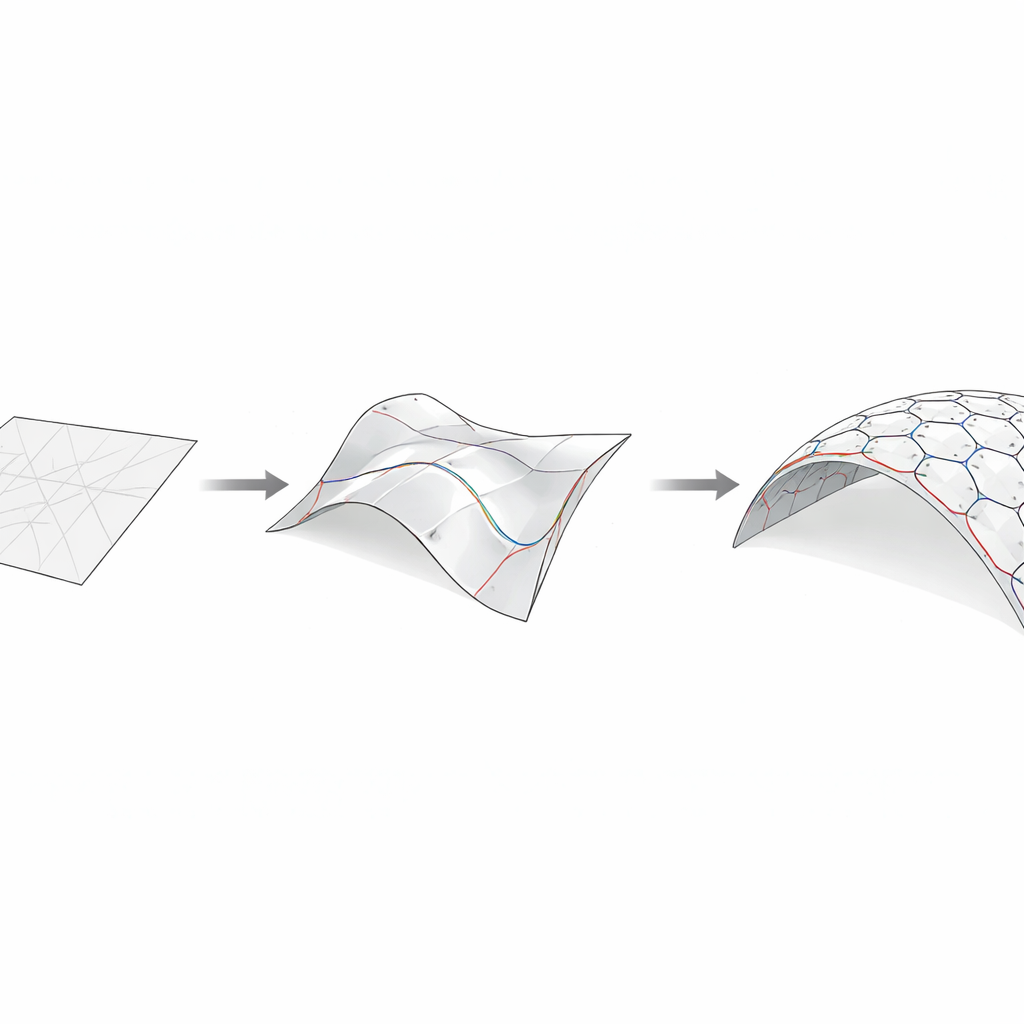
The authors introduce a new repeating origami unit, called the “doubly curved lens-box,” designed specifically to sidestep this trade-off. Each unit combines gently curved folds that form lens-shaped panels with straight-folded connector pieces. When tiled, these units can be cut from flat sheet material, folded, and then “locked” into a shell that is smooth in one direction and closely approximates curvature in the other. The geometry is carefully crafted so that, at a certain folding position, the connectors lie flat and mechanically block further motion. At that locked configuration, the tessellated surface matches a desired 3D shape, such as sections of cylinders, spheres, tori (donut-like shapes), or even vase- and chair-like contours. By solving an inverse design problem, the researchers can start from a target smooth surface and compute the crease pattern that will fold into that surface when locked.
From Floppy Origami to Cable-Stiffened Shells
While the locked pattern can resist compression along the surface, a large shell assembled from many units can still twist and buckle because of hidden internal motions and the flexibility of the thin panels. To tackle this, the team threads slender tendons—cable-like elements that carry only tension—through carefully chosen points of the origami units. When these tendons are pulled tight, they draw the partially folded pattern toward its locked state and squeeze neighboring units against one another, much like tightening the cords in a tensegrity structure. This internal bracing suppresses both the idealized folding motions and unwanted deformations such as twisting or local buckling. Experiments with paperboard prototypes show that tendon-stiffened shells can hold their shape with almost no sagging, even when clamped at one end and twisted or loaded with weights many times their own mass.
Dialing In Stiffness on Demand
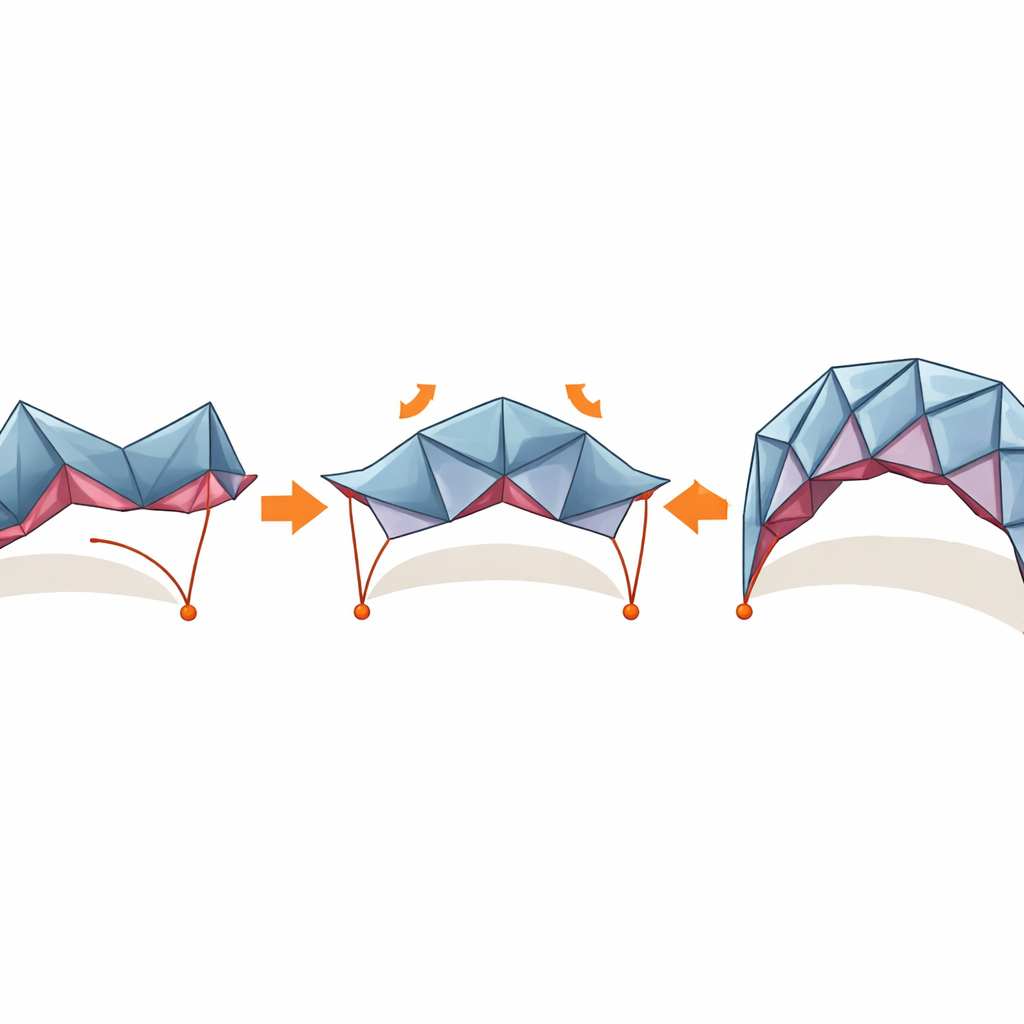
To make the stiffness adjustable, the authors pair the origami shell with simple gear mechanisms that incrementally stretch selected tendons. Starting from a loose, ultra-soft configuration that drapes under its own weight, the shell can be progressively tightened until it becomes a rigid, load-bearing arch. Three-point bending tests reveal that the apparent bending stiffness increases by orders of magnitude as tendon tension rises, following a strongly nonlinear trend. In practical terms, a lightweight paper-based arch can reach a load-to-weight ratio around 162, far outperforming a similar non-deployable arch stiffened only by glue. Along the way to the final locked shape, the shell can pause in multiple stable intermediate forms, hinting at applications where controlled motion and shape change are essential, such as soft robots that must navigate tight or delicate environments.
New Possibilities for Shape-Shifting Structures
By marrying curved-crease origami with tendon networks, this work demonstrates flat sheets that can be cut, folded, and then selectively stiffened into smooth, doubly curved shells with programmable rigidity. The same underlying pattern can be tailored to produce different target geometries, and its stiffness can be tuned in operation simply by adjusting cable tension, without relying on air pressure, heat, or external fields. Although there are mathematical limits—any shape folded from a flat sheet can only approximate double curvature—the approach offers a powerful new toolkit for deployable antennas, morphing wings, ergonomic exoskeletons, adaptive implants, and reconfigurable robots, all starting from something as simple as a flat, foldable sheet.
Citation: Mirzajanzadeh, M., Pasini, D. Smooth doubly curved origami shells with reprogrammable rigidity. Nat Commun 17, 2729 (2026). https://doi.org/10.1038/s41467-026-69562-2
Keywords: origami metamaterials, deployable structures, tunable stiffness, curved shells, tensegrity tendons