Clear Sky Science · en
Potential-dependent interfacial specific adsorption accelerates charge transfer in sodium-ion batteries
Why faster sodium batteries matter
As our power grids take in more solar and wind energy, we need big, affordable batteries that can charge quickly and last for years. Sodium-ion batteries are attractive because sodium is abundant and inexpensive, but today’s versions still struggle to deliver both fast charging and long life. This study shows how rethinking the inner structure and surface of a key battery component—the positive electrode, or cathode—can unlock much faster charging without sacrificing stability.
Building a better battery heart
The researchers focus on a family of cathode materials called P2-type layered oxides, which let sodium ions move relatively easily. They compare a standard material (NM) with a newly engineered one (NMCFT) in which several extra metals are added and the crystal stacking is carefully tuned. This tuning promotes the formation of a so‑called Z-phase that intergrows with the original structure. Unlike the harmful structural shift that usually appears at high charge, this Z-phase transition is gentle and reversible, helping the cathode cope with deep charging without cracking or slowing ion motion. In tests, the NMCFT material delivers much higher capacity at fast charge rates and maintains performance over hundreds of cycles, including in pouch cells closer to real-world devices. 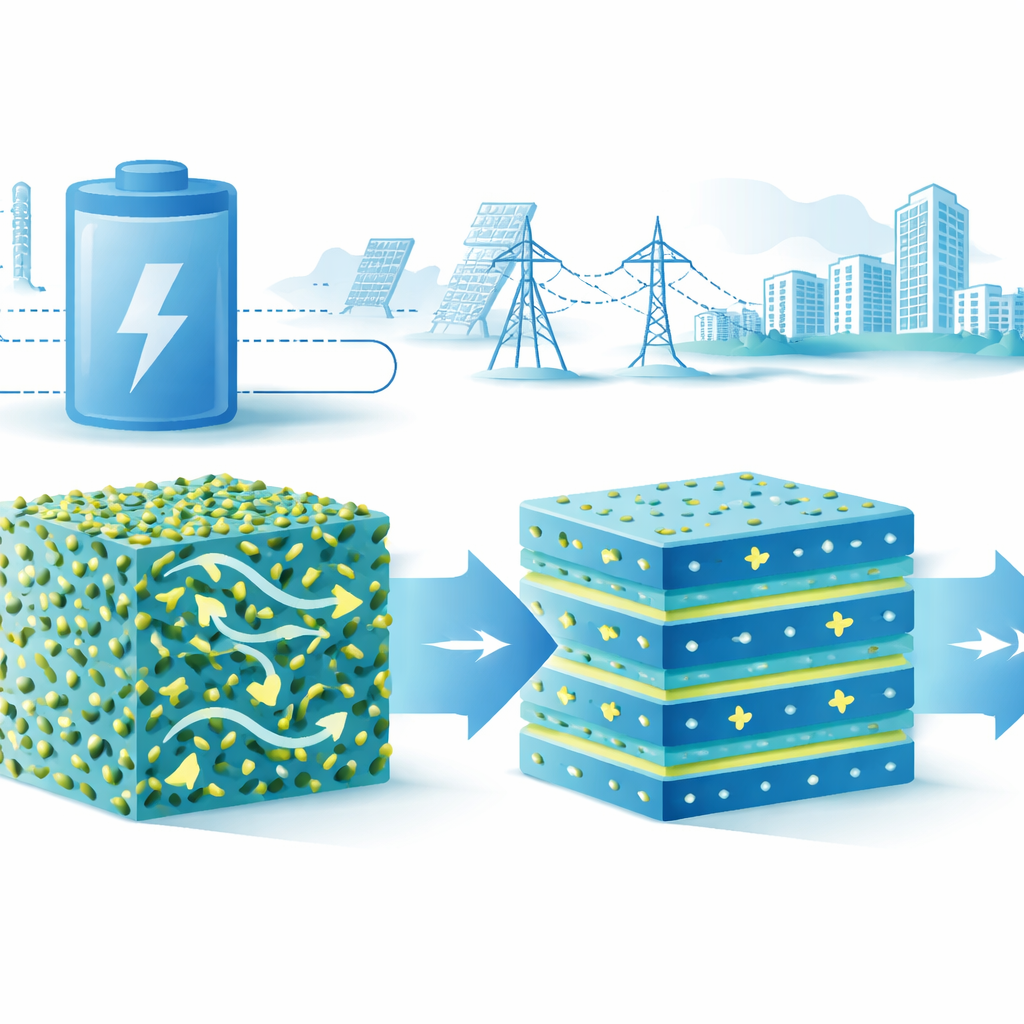
Keeping oxygen in line inside the crystal
At high voltage, many oxide cathodes rely not only on metal atoms but also on oxygen atoms to store and release charge. This “oxygen redox” can add capacity, but it often comes with voltage losses and permanent structural damage. By using advanced X-ray techniques, the authors show that in the conventional NM material, oxygen begins to participate in charge storage at very high voltage in a way that leads to large energy losses and unstable behavior. In the new NMCFT cathode, the added metals (such as copper and iron) mix their electronic states with oxygen earlier and more smoothly. This hybridization allows oxygen to contribute to charge storage through a more controlled route, reducing the energy penalty (thermodynamic hysteresis) and helping the structure stay intact during repeated deep charging.
What happens where liquid meets solid
Fast charging is not only limited by how quickly ions move inside the crystal. The interface where the solid cathode touches the liquid electrolyte is often the true bottleneck. Here, sodium ions must leave the crystal, shed some of their surrounding solvent molecules, and cross an electrical double layer before entering the liquid. The team uses detailed impedance measurements in three-electrode cells to watch how this interface behaves at different charge levels. They find that as the cathode becomes more positively charged, negatively charged anions from the salt crowd toward the surface and compete with solvent molecules for the closest positions. This “specific adsorption” of anions can either help or hinder charge transfer, depending on how densely they pack.
When surface crowding helps—and when it hurts
The authors combine experiments with computer simulations to map out this delicate balance. At moderate anion coverage, the extra negative charge close to the surface increases the voltage drop between the cathode and the nearby liquid layer, which effectively pulls sodium ions across the interface more quickly. However, once anions cover too much of the surface, they block solvent molecules from reaching the sodium exit points and raise the energy barrier for electrons to move. Simulations show that in this crowded state, sodium ions near the surface form shorter, stronger bonds to oxygen, making them harder to extract. The conventional NM material tends to reach this over-crowded state early, leading to large charge-transfer resistance at high charge. In contrast, NMCFT maintains a more moderate, dispersed anion layer over a wide voltage range, keeping interfacial resistance lower and enabling rapid ion and electron motion. 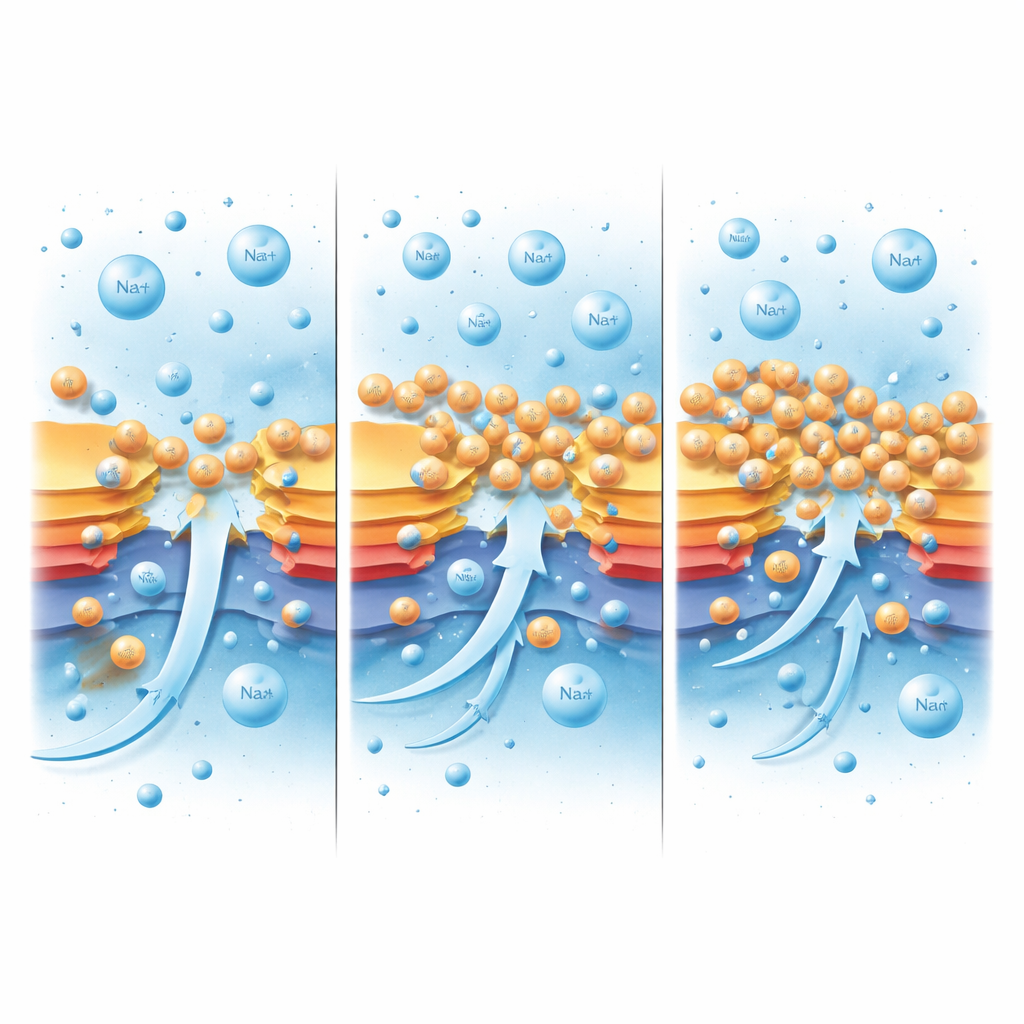
Protective skin for long battery life
Over many cycles, cathode surfaces can crack and dissolve, gradually reducing capacity. Surface-sensitive probes reveal that NMCFT naturally develops a thin, fluoride-rich protective film at its interface with the electrolyte. This layer, formed from controlled reactions involving the anions and solvent, covers the particles uniformly and limits the loss of transition metals into the liquid. The standard NM cathode, by contrast, develops bare spots, cracks, and a thicker damaged surface region in which the original layered structure converts to a less active rock-salt phase. The healthier interfacial chemistry of NMCFT, combined with its more forgiving internal structure, allows large-format pouch cells to retain about 80% of their capacity after 300 cycles while delivering practical energy density.
What this means for future sodium batteries
By tying together changes inside the crystal with the behavior of ions and molecules at the surface, this work shows that fast-charging performance hinges on a careful balance: stabilize the cathode’s bulk structure, guide oxygen redox along a reversible pathway, and keep anion adsorption in the “just right” range that speeds up rather than blocks charge transfer. The NMCFT material demonstrates that such combined bulk-and-interface design can deliver sodium-ion batteries with both rapid charging and long life, making them more competitive for grid-scale storage and other high-power applications.
Citation: Xu, SW., Liu, W., Zhu, X. et al. Potential-dependent interfacial specific adsorption accelerates charge transfer in sodium-ion batteries. Nat Commun 17, 2868 (2026). https://doi.org/10.1038/s41467-026-69559-x
Keywords: sodium-ion batteries, fast charging, cathode materials, electrode interfaces, energy storage