Clear Sky Science · en
Unconventional spin-intertwined charge density wave in magnetic phases of kagome metal GdTi3Bi4
Waves of Order in a Patterned Metal
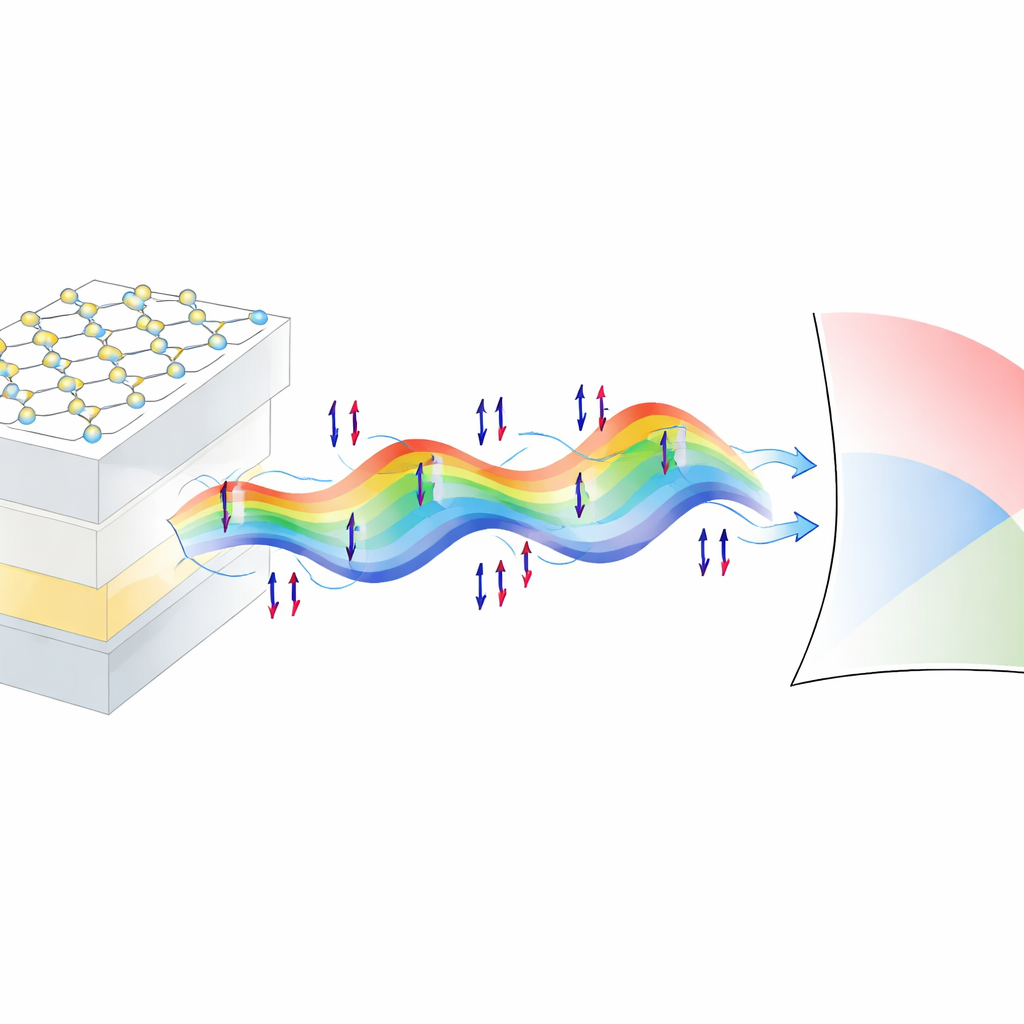
Many of today’s most intriguing quantum materials behave as if invisible waves of electrons and magnetism are rippling through them. This study looks at one such material, a kagome metal called GdTi3Bi4, where the electrons’ charge and their tiny magnetic moments, or spins, form a tightly knit pattern. Understanding how these hidden waves appear and disappear under changing temperature and magnetic field could point the way to new electronic and spin-based technologies.
A Crystal Made of Triangles and Chains
GdTi3Bi4 is built from repeating layers of atoms arranged in a kagome pattern—a two-dimensional network of corner-sharing triangles—stacked together with chains of gadolinium atoms. This special geometry makes the electrons highly mobile in flat planes while also feeling the influence of the magnetic gadolinium chains. At low temperatures, the gadolinium spins line up in an antiferromagnetic pattern, where neighboring spins point in opposite directions. As a magnetic field is applied, the crystal passes through distinct magnetic stages, including a curious state where the overall magnetization settles at one-third of its maximum value.
Discovering a Hidden Charge Pattern
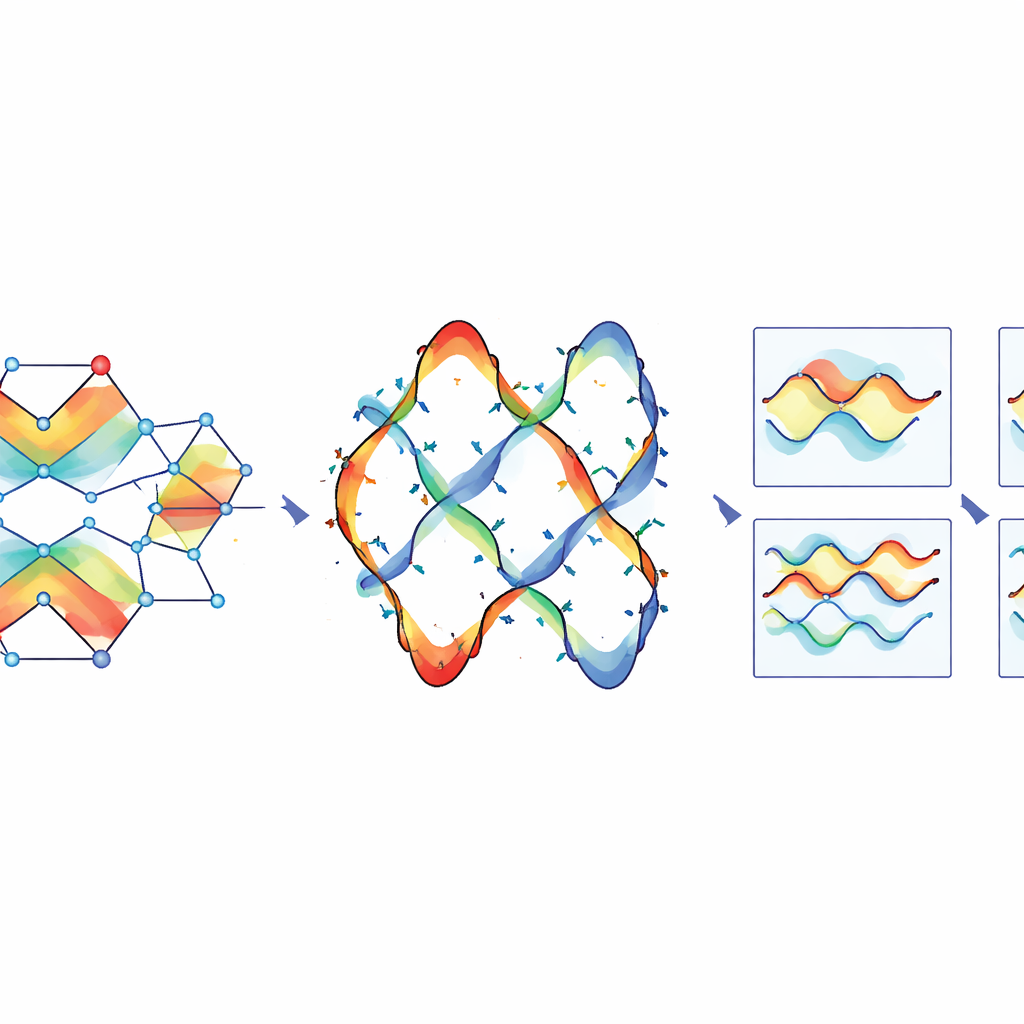
To probe what the electrons are doing on the surface of this crystal, the researchers used scanning tunneling microscopy and spectroscopy, techniques that map how easily electrons can tunnel into the material at each point in space and energy. These measurements revealed that, at very low temperatures, the electronic charge is not evenly spread out: instead it forms a repeating pattern known as a charge density wave. Unusually, this pattern is built from three wave components running in different directions, creating a 3Q state that does not line up neatly with the underlying crystal grid. Because the wave’s period and orientation do not match the atomic lattice, the pattern is called incommensurate and it breaks all the usual mirror and rotational symmetries of the surface.
Charge Waves Tied to Magnetic Order
The most striking finding is how sensitively this charge pattern responds to an applied magnetic field. As the field is ramped up from the antiferromagnetic ground state, the initially skewed, incommensurate three-wave pattern suddenly snaps into a more regular, nearly 3-by-3 superlattice whose orientation now tracks the crystal directions. This rearrangement occurs as the bulk magnetization enters the one-third plateau phase, and then the charge pattern gradually dissolves as the field becomes strong enough to fully align the spins in a ferromagnetic state. The team also raised the temperature in zero field and watched the three-wave pattern melt in stages: first two of the three wave directions weaken, leaving a single-direction pattern, and then that final wave disappears close to the temperature where magnetic order itself vanishes.
A Shared Map for Spins and Charges
By plotting when each type of charge pattern appears or melts against temperature and magnetic field, the researchers constructed a phase diagram. They then compared it directly with an independently measured magnetic phase diagram obtained using magnetic force microscopy. The two maps closely mirror each other: each change in the magnetic state has a matching change in the charge pattern. This close lockstep behavior shows that the charge waves are not just influenced by magnetism from a distance but are deeply intertwined with the spin arrangement throughout the bulk of the crystal.
Why This Matters for Future Materials
From a layperson’s perspective, the key message is that in GdTi3Bi4 the waves of charge and magnetism act as a single, coupled entity that can be steered with temperature and magnetic field. This "spin-intertwined" charge density wave represents a new kind of ordered state in kagome metals, going beyond familiar charge or spin patterns that appear separately. By revealing how this state forms, transforms, and melts, the work provides a blueprint for designing materials where electronic and magnetic waves can be finely controlled—an important step toward advanced devices that exploit quantum order for information processing and low-power electronics.
Citation: Han, X., Chen, H., Cao, Z. et al. Unconventional spin-intertwined charge density wave in magnetic phases of kagome metal GdTi3Bi4. Nat Commun 17, 2667 (2026). https://doi.org/10.1038/s41467-026-69544-4
Keywords: kagome metal, charge density wave, spin charge coupling, quantum phase diagram, magnetic order