Clear Sky Science · en
Spectroscopic limits of diamond anvils to 520 GPa and projected bandgap closure
Diamonds Under Extreme Squeeze
Diamonds are famous for being both hard and clear, which makes them perfect tiny “windows” for studying matter at crushing pressures like those deep inside giant planets. But as scientists push these diamond tools to ever higher pressures in the race to create metallic hydrogen and other exotic states, a basic question becomes critical: do the diamonds themselves stay transparent and reliable as windows, or do they quietly change and mislead our measurements? This study takes a close look at how diamonds behave optically when squeezed far beyond everyday conditions, up to more than five million times Earth’s atmospheric pressure.
How Diamond Tools Let Us See Inside Extreme Worlds
The experiments center on diamond anvil cells, devices that press two opposing diamond tips against a tiny sample, confining it at enormous pressures while still allowing light and X‑rays to pass through. For decades, these cells have been the workhorses of high-pressure research, typically up to about 400 gigapascals (GPa). Scientists now want to reach the terapascal range to test predictions about metallic hydrogen, a phase expected to show remarkable behaviors such as superconductivity and superfluidity. Several high‑profile claims of metallic hydrogen have already appeared, but their reliability hinges on how accurately pressure is measured and how faithfully the stressed diamonds transmit light from the sample.
Watching Diamonds Darken Under Pressure
To track how transparency changes, the authors compressed neon in different diamond anvil designs and measured how much light, from ultraviolet to infrared, could still pass through the diamonds. Neon itself stays transparent, so any loss of transmitted light must come from the diamonds. As pressure climbed above about 300 GPa and up to 520 GPa, the visible part of the spectrum progressively shifted toward red and then faded, leading to nearly complete darkness at the highest pressures. These measurements, combined from multiple anvil shapes, revealed a consistent pattern: the “edge” where the diamond stops transmitting light moves steadily to lower energies as pressure increases, signaling that the diamond’s electronic gap is shrinking. 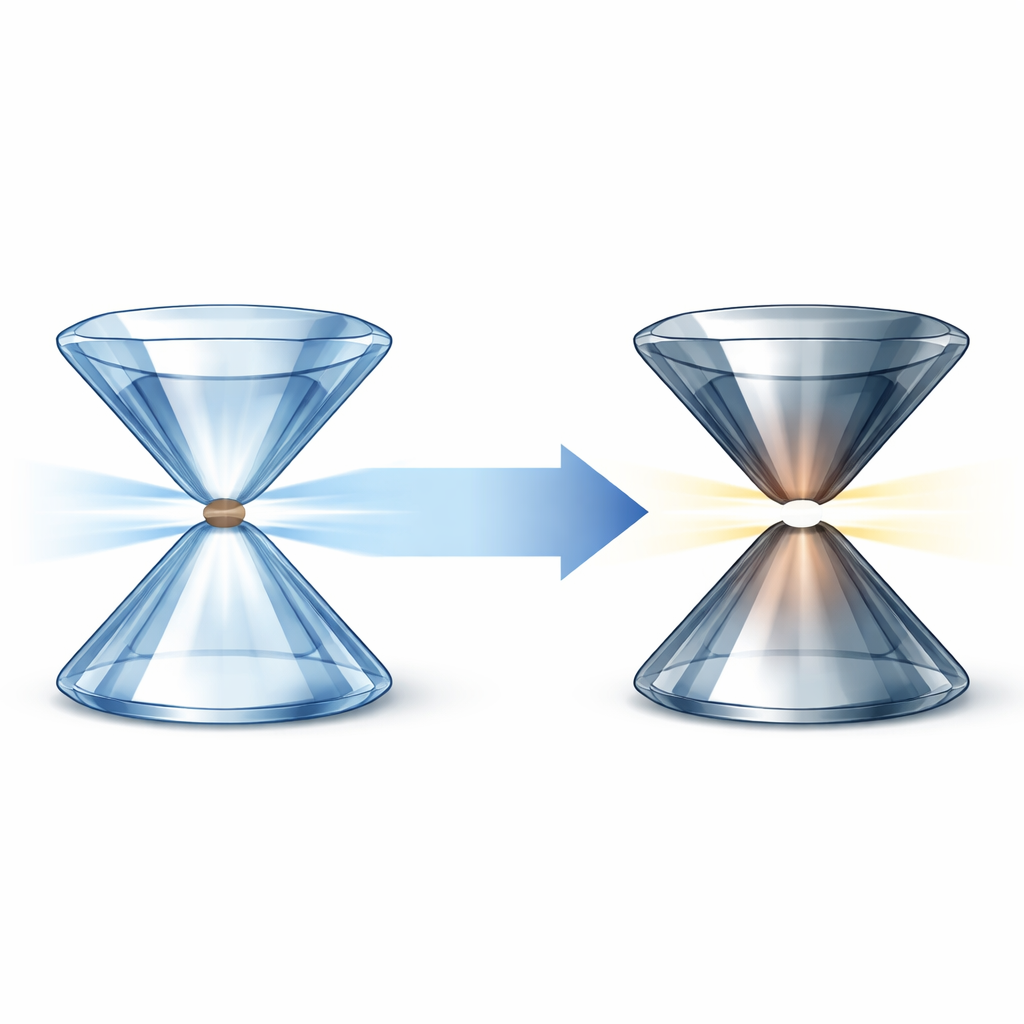
Peering Into the Stressed Skin of the Diamond
The team then asked where inside the diamond this loss of transparency actually comes from. Using Raman scattering, a technique that reads how light interacts with vibrations in the crystal, they mapped how stress varies along the axis of the anvil. They found that just beneath the flat tip that touches the sample, there is a thin layer a few micrometers thick where the pressure is nearly uniform but strongly uneven in different directions, distorting the crystal in a tetragonal way. This layer experiences the highest stress, while pressure drops rapidly deeper into the diamond. By combining this stress map with a simple mechanical model, the authors showed that this highly stressed surface layer dominates the observed absorption: it behaves like a thin, nearly uniform slab whose electronic gap narrows as density increases.
Projecting When Diamond Itself Turns Metallic
From the absorption spectra, the researchers extracted how the diamond’s indirect bandgap—the energy range that keeps it insulating and transparent—changes as the surface layer is compressed. When expressed in terms of diamond density, the bandgap shrinks almost linearly, and extrapolation suggests it would vanish, signaling a transition to metallic behavior, at a density around 5.4 grams per cubic centimeter. In terms of pressure on the trapped sample, this corresponds to roughly 560 GPa. Crucially, this trend appears universal: it does not depend on the exact shape or size of the diamond tip, mirroring the robustness of an independent pressure scale based on the diamond’s Raman signal. 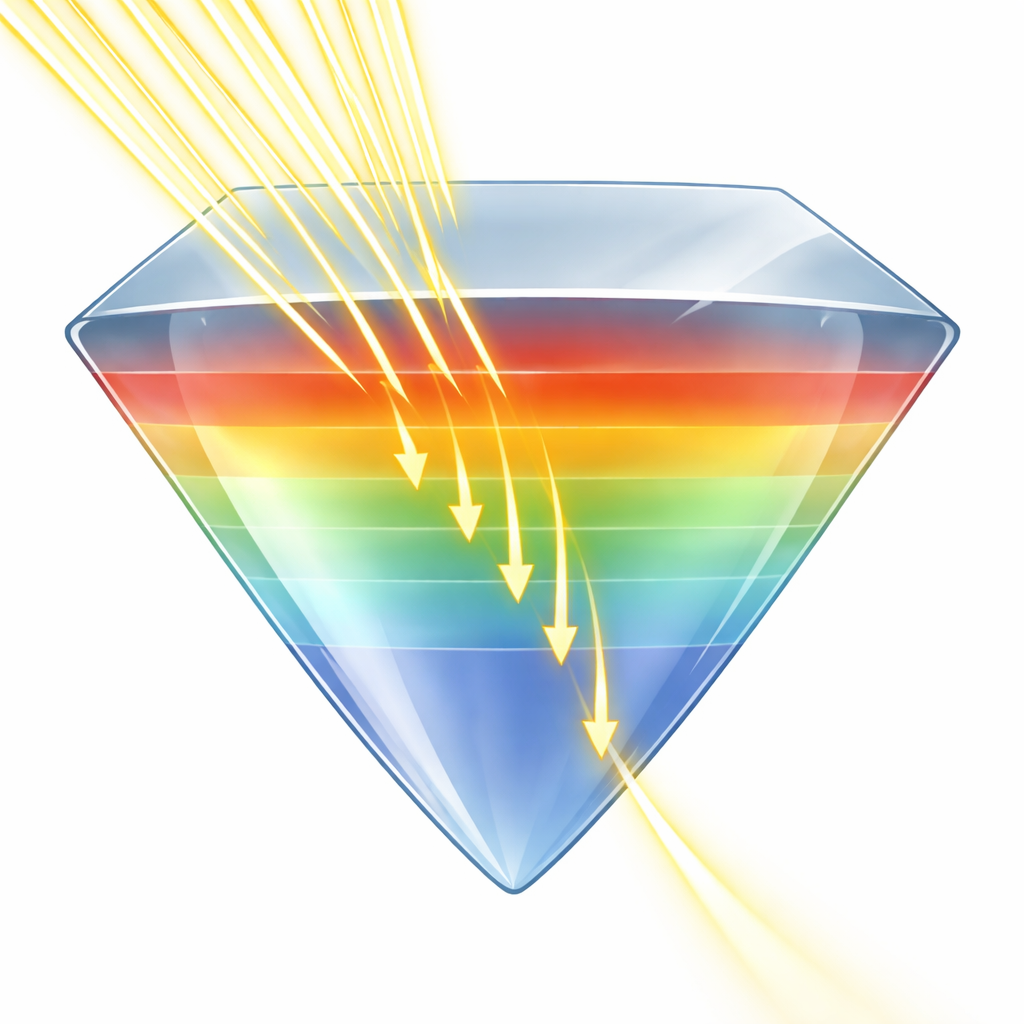
Redrawing the Limits for Seeing Metallic Hydrogen
These findings have direct consequences for controversial reports of metallic hydrogen. The authors map out three regimes: at lower pressures, diamonds are fully transparent; at intermediate pressures they partially absorb light; and above a threshold the anvils become opaque in the visible range, though they may still pass some infrared light and X‑rays. They show that certain infrared measurements of hydrogen and deuterium likely remain trustworthy because they were taken while the diamonds were still largely transparent. However, a widely publicized claim of atomic metallic hydrogen at about 495 GPa relied heavily on visible light reflectance, precisely where this study finds the diamonds themselves should already be essentially opaque. That mismatch casts serious doubt on those earlier conclusions and suggests that the definitive detection of atomic metallic hydrogen will probably have to rely on infrared reflectance and X‑ray methods at even higher pressures.
What This Means Going Forward
For non-specialists, the key takeaway is that even diamonds, pushed far enough, stop behaving like the perfectly clear windows we usually imagine. Their electronic structure changes under extreme directional stress, gradually stealing away the light we depend on to see what is happening to the sample inside. By quantifying exactly how and when this happens, the study draws a bright line around the “spectroscopic limits” of diamond anvil cells. This makes it possible to judge which past and future claims about metallic hydrogen and other extreme states of matter can be trusted and which must be revisited, ensuring that the quest to recreate exotic planetary conditions in the lab is built on solid, transparent ground.
Citation: Hilberer, A., Loubeyre, P., Pépin, C. et al. Spectroscopic limits of diamond anvils to 520 GPa and projected bandgap closure. Nat Commun 17, 2644 (2026). https://doi.org/10.1038/s41467-026-69533-7
Keywords: diamond anvil cell, high pressure, metallic hydrogen, optical transparency, bandgap closure