Clear Sky Science · en
Bubble-burst-induced Puddle Jumping and Jet Printing
When Big Droplets Learn to Jump
On a rainy leaf or a fogged-up surface, tiny water droplets sometimes leap into the air all by themselves. This jumping helps surfaces clean themselves and move heat or even electrical charge. Until now, that trick has only worked for very small drops, limiting its usefulness in real-world technologies. This study shows how nature’s own bubble-bursting can hurl much larger “puddles” of water off a surface, opening new possibilities for cleaning, cooling, energy harvesting, and even a new kind of 3D printing. 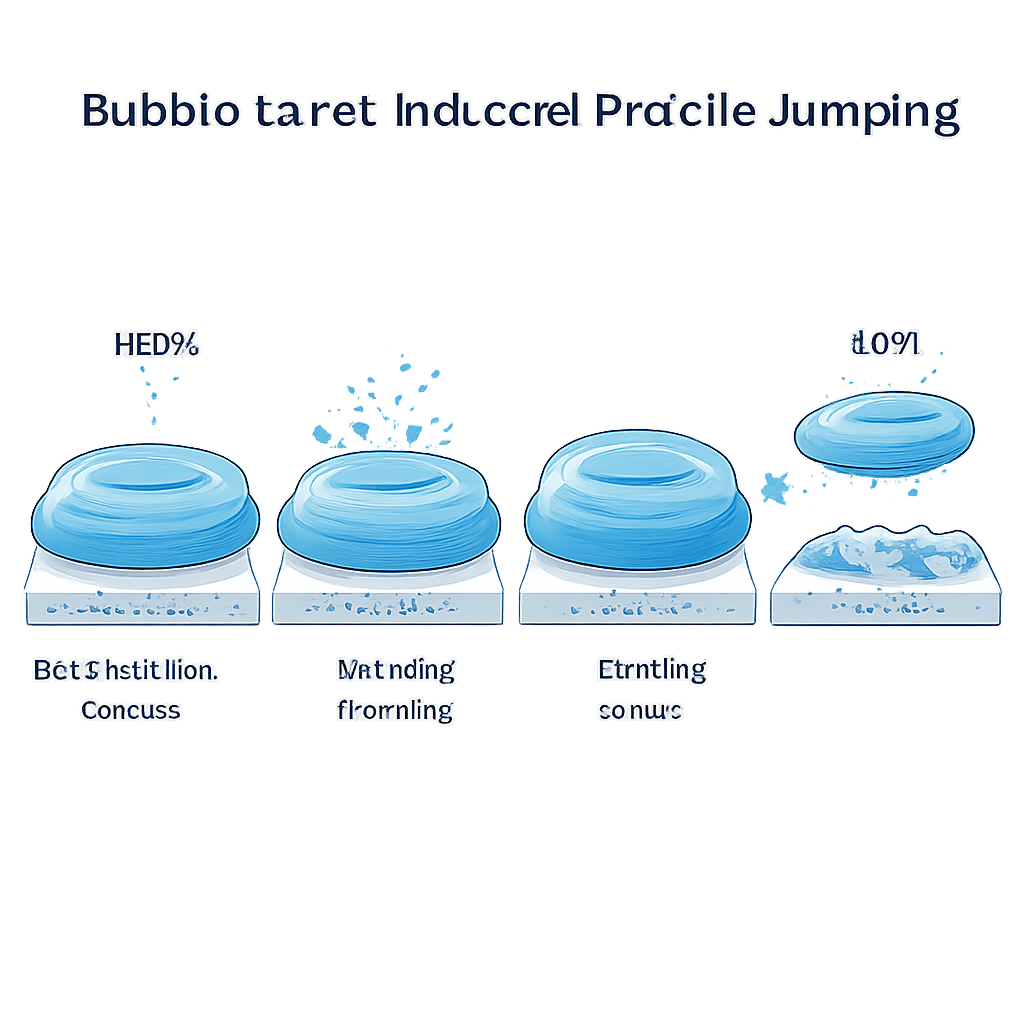
A Size Problem for Self-Cleaning Water
Engineers love jumping droplets because they can move material, heat, and charge across surfaces without pumps or moving parts. Smaller droplets, however, carry very little mass or energy, so they are not powerful enough for many industrial tasks. Making droplets bigger increases their transport capacity, but it also makes them heavier, so gravity quickly wins. For water, theory says that once a drop is larger than about 2.7 millimeters, its own surface tension can no longer easily launch it from a surface. This trade-off between useful size and the pull of gravity has been a major roadblock for using jumping droplets in devices like condensers, fuel cells, and advanced printers.
Borrowing a Trick from Dewy Leaves
The researchers began by watching something familiar: dew on plant leaves. During photosynthesis, leaves release oxygen through tiny pores, sometimes trapping bubbles inside dew droplets. When such a bubble bursts, it can throw the droplet off the leaf, helping it shed water and dirt. Inspired by this, the team created a “hollow” droplet on a super water-repelling surface by injecting an air bubble into a puddle of water. When the thin film at the top of the bubble broke, the liquid rim snapped back and launched ripples—capillary waves—over the puddle’s surface. Those waves raced toward the base and struck the surface from below, like a focused tap from inside the water, flinging even centimeter-scale puddles into the air and smashing through the usual size limit.
How Hidden Ripples Do the Heavy Lifting
High-speed videos and detailed computer simulations revealed a surprising sequence. First, the bubble’s cap retracts rapidly, sending waves both inside the bubble cavity and along the outer edge of the droplet. The inner waves converge to form a narrow upward jet, while the outer waves sweep around the droplet’s sides and strike almost straight down at the base. Only a ring of water near the edge actually “hits” the surface, so the effective mass involved in the impact is small and the contact time very short. That means less sideways spreading and less wasted energy. The scientists showed that the mass carried by these waves grows roughly in proportion to bubble size, while the wave speed mainly depends on the size of the droplet itself. As a result, the momentum delivered to the puddle increases linearly with bubble radius, and the jump height increases with the square of that radius. Careful measurements indicate that more than 90 percent of the wave’s impact momentum is converted into upward motion of the whole droplet.
From Leaping Puddles to Aimed Liquid Jets
By exploring many combinations of droplet and bubble sizes, the authors mapped out when a hollow droplet will jump and when it will fail. They found that as long as most of the bubble remains submerged, its stored surface energy is efficiently turned into motion. Once buoyancy pushes much of the bubble above the surface, that efficiency drops sharply. The team then tilted the surface holding the droplet, breaking the symmetry of the collapse. This steering of the capillary waves produced a fast liquid jet that shot off in a chosen direction instead of straight up. By repeatedly injecting bubbles into a particle-laden droplet and changing the tilt, they were able to “print” patterns of particles on a nearby surface without using nozzles that clog, hinting at a new route to 3D printing and additive manufacturing. 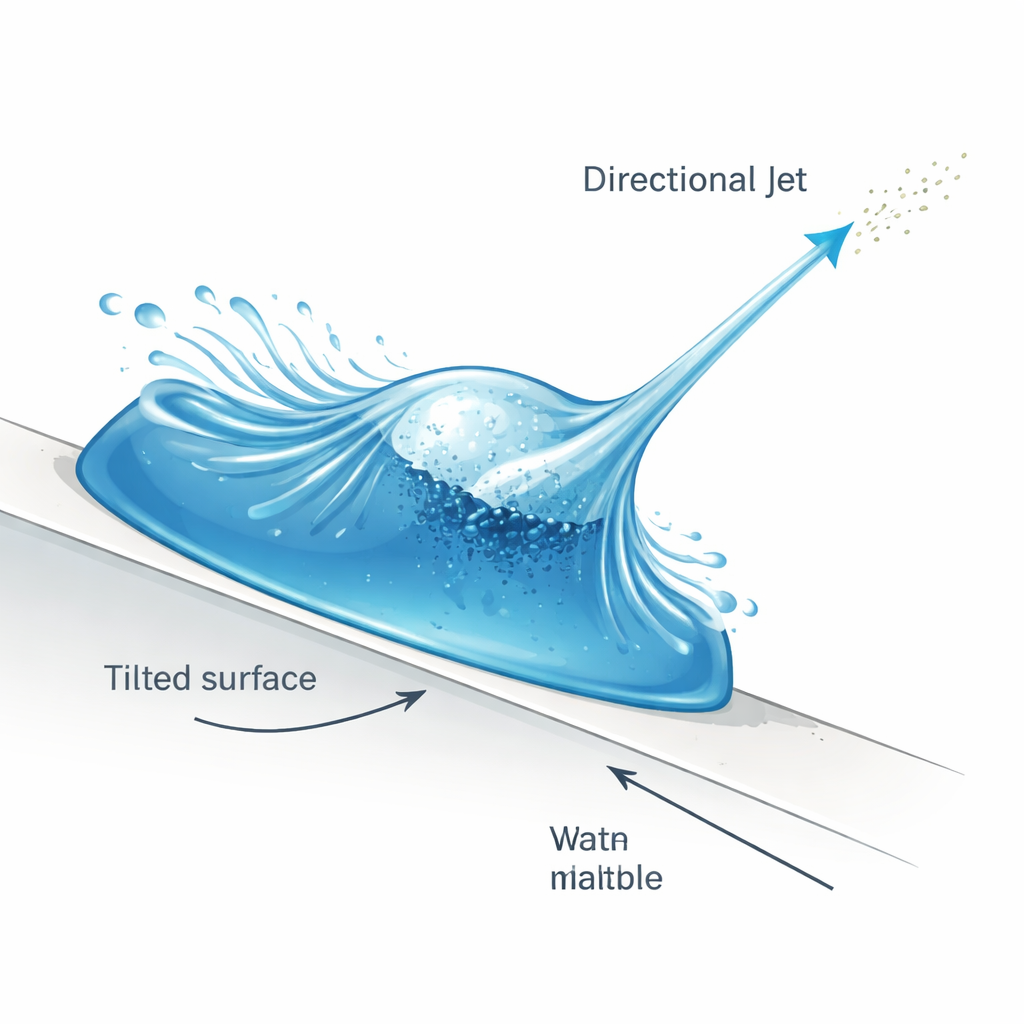
Why This Matters for Future Technologies
In everyday terms, this work shows how a tiny bubble popping inside a drop can act like a precise internal hammer, kicking even heavy puddles off a surface or launching sharp liquid jets where we want them. By uncovering how capillary waves concentrate and transfer energy so efficiently, the study breaks the long-standing size barrier for jumping droplets and introduces a passive, energy-free way to move liquids and particles. This bubble-powered approach could help design cleaner surfaces, more efficient heat exchangers and energy devices, and flexible, clog-free printing systems that use nothing more than the physics of bursting bubbles and rippling water.
Citation: Huang, W., Lori, M.S., Yang, A. et al. Bubble-burst-induced Puddle Jumping and Jet Printing. Nat Commun 17, 1818 (2026). https://doi.org/10.1038/s41467-026-69512-y
Keywords: droplet jumping, bubble bursting, superhydrophobic surfaces, capillary waves, jet printing