Clear Sky Science · en
Precise synthesis of π-conjugated [3]catenanes and Solomon link for photothermal responses via a dual-tuning strategy
Why Knotted Molecules Matter
Chemists are learning to tie molecules into tiny knots and chains, not for decoration, but to give materials new powers. This study shows how carefully linked ring-shaped molecules can turn near‑infrared light into heat with surprising efficiency. Such light‑driven heating is important for future technologies, from medical therapies and smart coatings to solar steam generation.
Designing a Family of Linked Rings
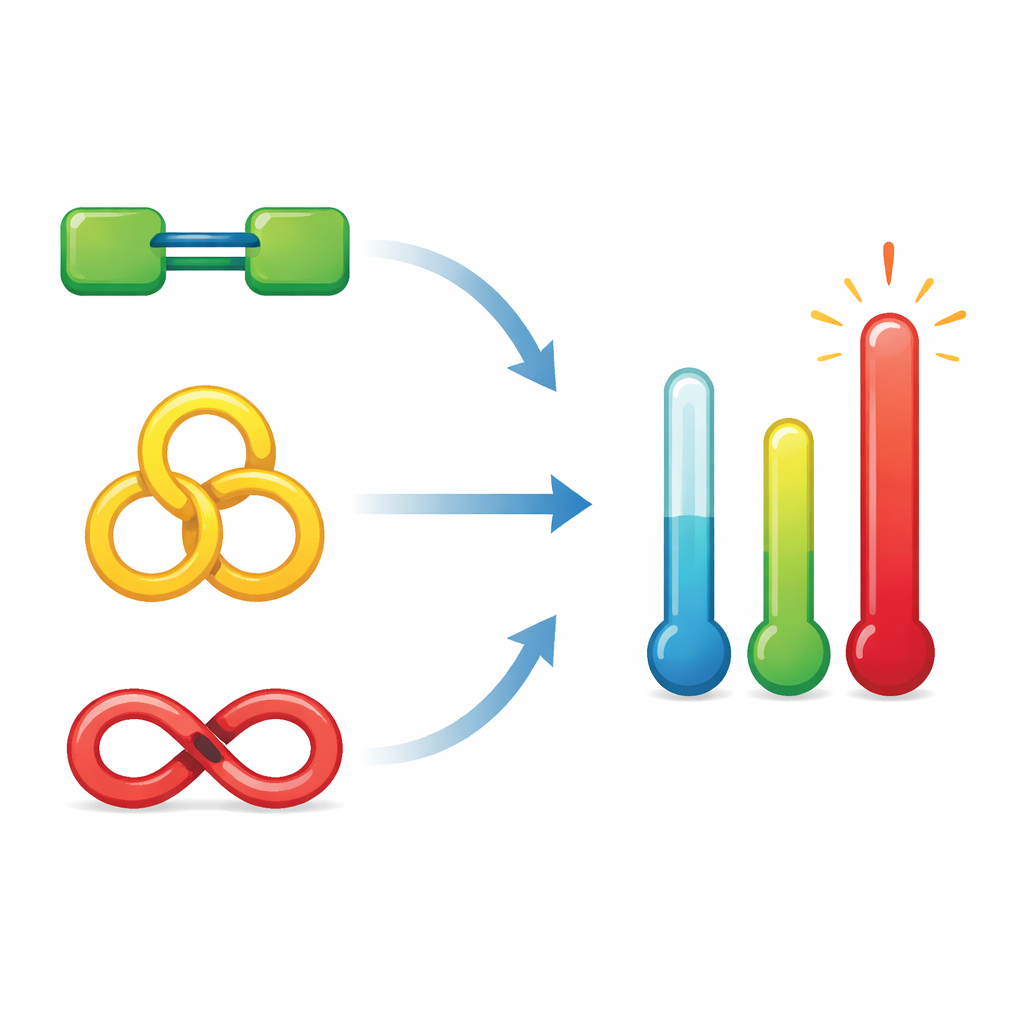
The researchers started from a single, straight molecular “rod” that naturally wants to stack with its neighbors, a bit like flat playing cards. They combined this rod with metal‑based units that act as rigid joints. By slightly changing the size, flatness, and twist of these joints, they guided the rods to weave into three distinct types of interlocked ring systems: linear chains of three rings, delicate three‑ring “Borromean” links in which all three depend on one another, and a more intricate two‑ring “Solomon” link where each ring loops through the other twice. This careful design allowed the team to change overall shape without swapping to a completely different core molecule.
From Subtle Adjustments to Big Structural Changes
The trick lay in dual tuning. First, the team adjusted how extended and flat the metal‑containing joints were, which controlled how strongly they could stack with the central part of the rod. Shorter, less strongly connected joints encouraged the rods to stack with each other, giving linear three‑ring chains. Longer, more highly connected joints shifted the stacking so that rods and joints locked together, forming the more compact Borromean rings. Second, by adding silver ions to one design, they introduced a controlled twist into the joints, allowing the rigid rods to wind around each other and close into a Solomon link. In all cases, the resulting shapes were confirmed with high‑precision structural methods, including single‑crystal X‑ray studies and solution‑based nuclear magnetic resonance tests.
Turning Light into Heat
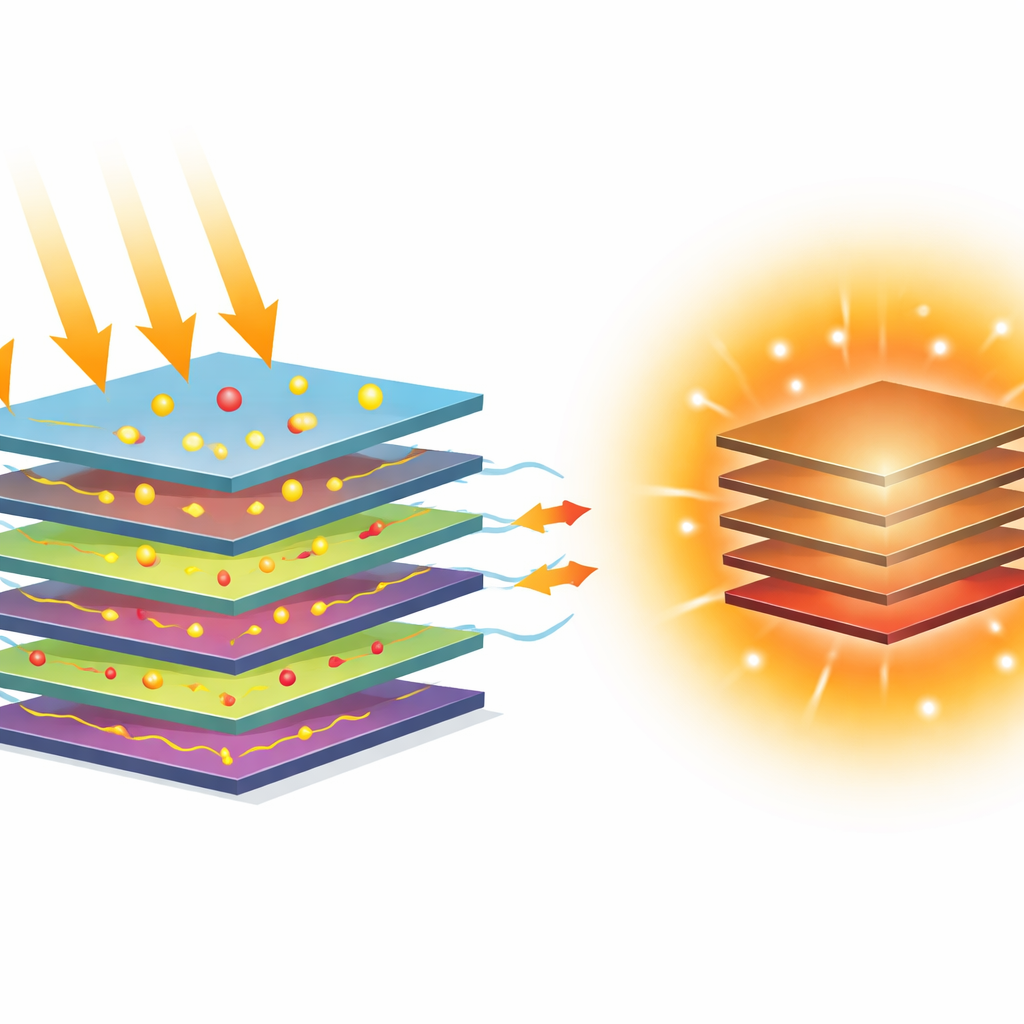
Beyond making beautiful molecular puzzles, the team asked a practical question: how well do these different shapes turn light into heat? They shone near‑infrared laser light on the materials, both as solids and in solution, and tracked temperature changes. All of the linked structures warmed up, but the Borromean ring built from the most extended, strongly stacking joints stood out. Its temperature jumped from room temperature to more than 60 degrees Celsius in solution, and its efficiency at converting absorbed light into heat reached roughly four‑fifths. Repeated heating‑and‑cooling cycles showed that the structures remained intact and kept performing, highlighting their robustness.
How Stacking and Radicals Boost Heating
To understand why some shapes heat more effectively than others, the scientists examined two key features. Strong face‑to‑face stacking between flat parts of the molecules helps them soak up near‑infrared light and funnel that energy into motion rather than glowing. In addition, the metal‑containing joints can host “free radical” character—unpaired electrons that respond strongly to light. Electron spin measurements before and after illumination revealed big increases in signal intensity, especially for the best‑performing Borromean ring, pointing to a surge of excited electrons that quickly relax and release energy as heat.
What This Means for Future Materials
By showing that tiny tweaks to building‑block size, flatness, and twist can switch both molecular shape and light‑to‑heat performance, this work provides a recipe for next‑generation photothermal materials. The message is that topology—the way parts are linked in space—matters as much as chemical composition. With this strategy, chemists can deliberately “tie” molecules into the shapes that provide the strongest light absorption, the most effective stacking, and the most responsive electrons, paving the way for compact, durable materials that convert harmless near‑infrared light into controllable heat on demand.
Citation: Yang, JX., Wan, XQ., Lu, MY. et al. Precise synthesis of π-conjugated [3]catenanes and Solomon link for photothermal responses via a dual-tuning strategy. Nat Commun 17, 2733 (2026). https://doi.org/10.1038/s41467-026-69503-z
Keywords: supramolecular topology, interlocked molecules, photothermal conversion, near infrared heating, molecular rings and links