Clear Sky Science · en
Reversible dielectric polymers with switchable conduction and insulation for electrostatic protection
Why zaps from everyday electronics matter
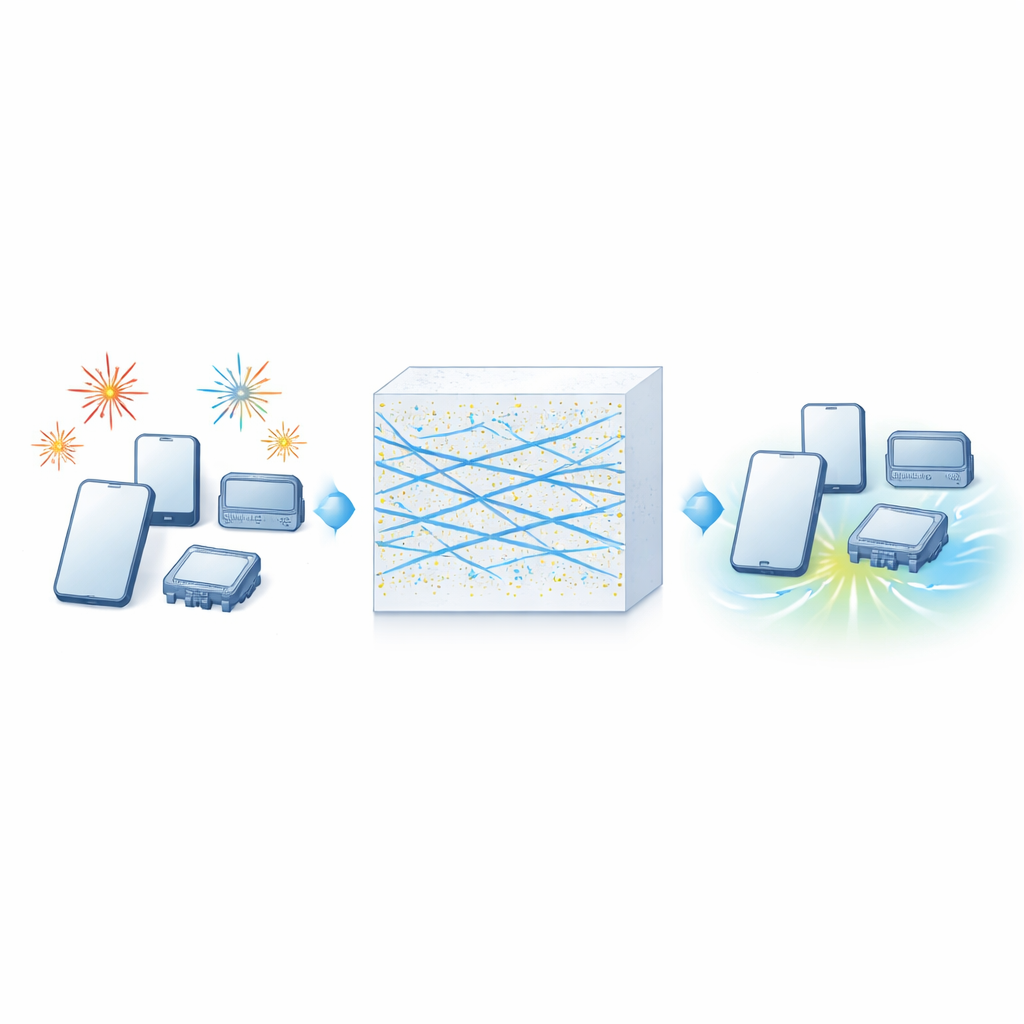
From smartphones to electric cars, modern gadgets pack more power into smaller spaces than ever before. But this progress comes with a hidden problem: tiny bursts of static electricity can punch through the protective layers meant to shield delicate chips. Today’s plastic insulators are good at blocking current, yet that very strength means electrical charges can build up and then discharge suddenly, damaging devices. This paper introduces a new kind of protective material that can behave like an insulator most of the time but briefly turns into a safe pathway for extra charge when needed, helping electronics survive harsh electrical shocks.
A smart shield that adapts on demand
The researchers set out to solve a long-standing trade-off in electronic packaging. Conventional polymers keep current out, but they cannot actively manage where high electric fields concentrate during sudden pulses, such as electrostatic discharge from a human touch or a switching event in power electronics. The team designed an "adaptive field grading" material: at everyday voltages, it behaves like a strong insulator; when the electric field crosses a tailored threshold, it smoothly becomes more conductive, steering and draining dangerous charge away before it can cause harm. Remarkably, this shape-shifting behavior is achieved with only a tiny amount of engineered filler—about three parts in a thousand by volume—dispersed inside a common epoxy resin.
Tiny fibers with hidden internal steps
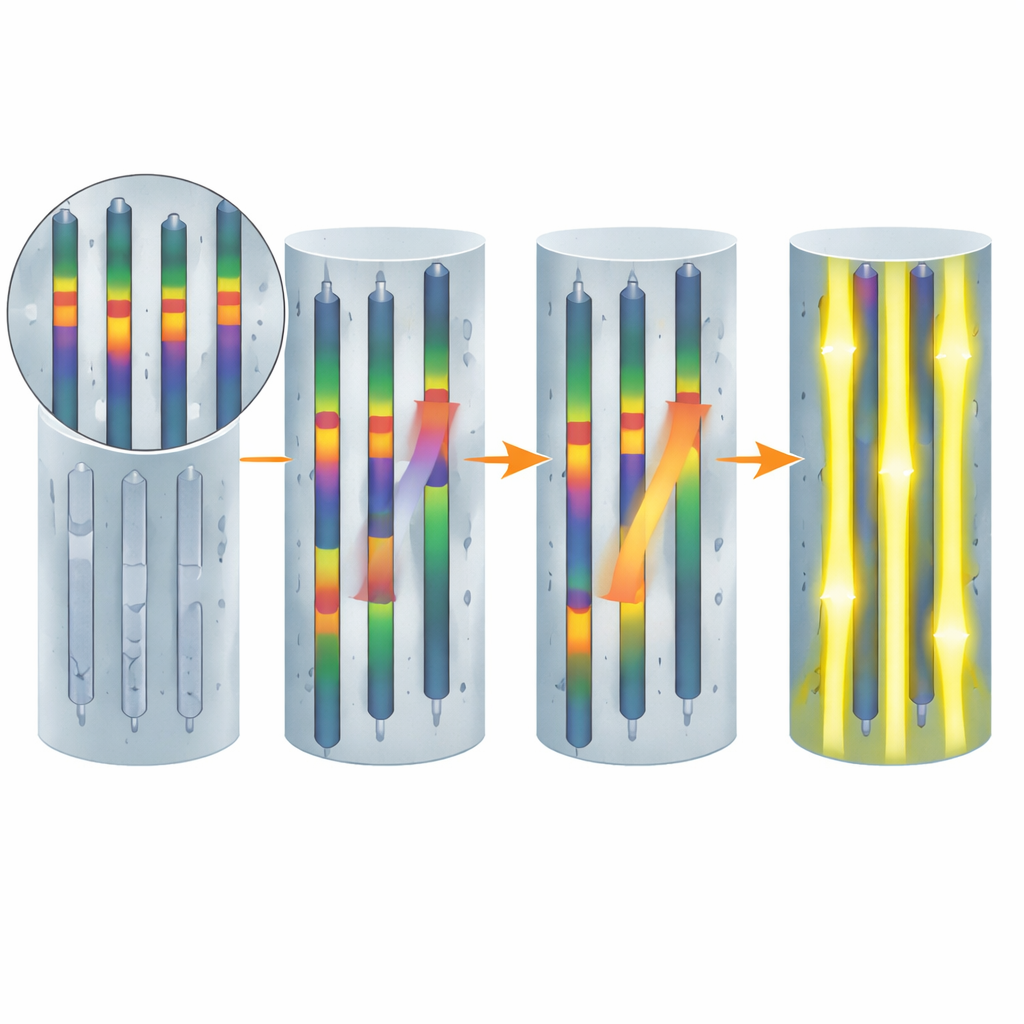
The heart of the material is a mat of ultra-thin ceramic nanofibers made primarily from silicon carbide, a semiconductor already used in high‑power electronics. These fibers are produced by electrospinning, a scalable technique where high voltage pulls a liquid into continuous threads, which are then heated to form solid fibers. During this process, the team uniformly builds in two metal oxides, gallium oxide and tungsten oxide. Inside each fiber, these three components line up to form a chain of junctions that act like a series of tiny energy barriers. Unlike traditional systems where barriers form only where particles touch, these fibers carry a carefully built "step‑by‑step" barrier along their length, giving engineers fine control over when current starts to flow.
How electric stress unlocks safe pathways
Using advanced quantum mechanical calculations and surface measurements, the authors show that differences in energy levels between the three materials cause electrons to shift and pile up at the internal junctions, creating built‑in electric fields. At low external voltage, these barriers are high and very few carriers can pass, so the composite is strongly insulating. As the electric field increases, the barriers shrink in a controlled way, like gates that open only when the push is strong enough. The team demonstrates that by changing how much of each oxide is added, they can tune both the barrier height and the exact switching field at which the material changes from insulating to conducting, while keeping the response stable in both voltage directions.
From lab fibers to real‑world protection
To turn these fibers into practical components, the researchers assemble them into large mats with different arrangements—parallel layers, vertical stacks, and rolled‑up bundles—and then fully impregnate them with an epoxy commonly used in electronics. Only when the fibers form continuous pathways do the composites show the desired nonlinear behavior, suddenly conducting more current once the electric field passes a set point. Even with just 0.3 percent of fiber by volume, the best configuration shows a sharp yet controllable transition and a breakdown strength three to five times higher than the switching field, a key safety requirement. Compared with earlier materials that need heavy filler loading, this approach keeps processing simple and preserves the mechanical integrity of the polymer.
Watching charge pulses safely fade away
To illustrate how the material works in practice, the team built a simple light‑emitting diode circuit and replaced standard resistors with their new composites. As the applied voltage rose, the LEDs connected to the adaptive material switched on sharply yet safely, highlighting the controlled onset of conduction. They also used an electrostatic discharge gun to fire charge pulses at samples while monitoring how quickly surface charge leaked away. Below the switching field, charge decayed slowly; above it, there was a rapid drop followed by a gentle tail, showing that the material opens a fast release channel only when truly needed. After repeated pulses and electrical stressing, the key parameters hardly changed, signaling robust performance under realistic conditions.
What this means for future gadgets
In plain terms, this work delivers a new kind of "smart plastic" that knows when to stay quiet and when to act. Most of the time, it behaves like a strong electrical blanket, keeping circuits safely isolated. When a sudden spike of voltage appears, hidden nanofiber networks inside the material briefly switch on to guide excess charge away and then switch off again as conditions calm down. Because the switching level and power handling can be tuned through fiber design and loading, the same concept could be adapted for everything from consumer gadgets to high‑voltage converters and space hardware. It offers a promising path to making our ever‑more‑compact electronics both more powerful and more resistant to the invisible jolts of static that threaten their reliability.
Citation: Xu, H., Xie, C., Chen, H. et al. Reversible dielectric polymers with switchable conduction and insulation for electrostatic protection. Nat Commun 17, 2690 (2026). https://doi.org/10.1038/s41467-026-69497-8
Keywords: electrostatic discharge protection, field grading polymers, nanofiber composites, silicon carbide dielectrics, adaptive insulation materials