Clear Sky Science · en
A self-regulated photothermal anti-/deicing film for all-season applications
Why stopping ice and heat matters
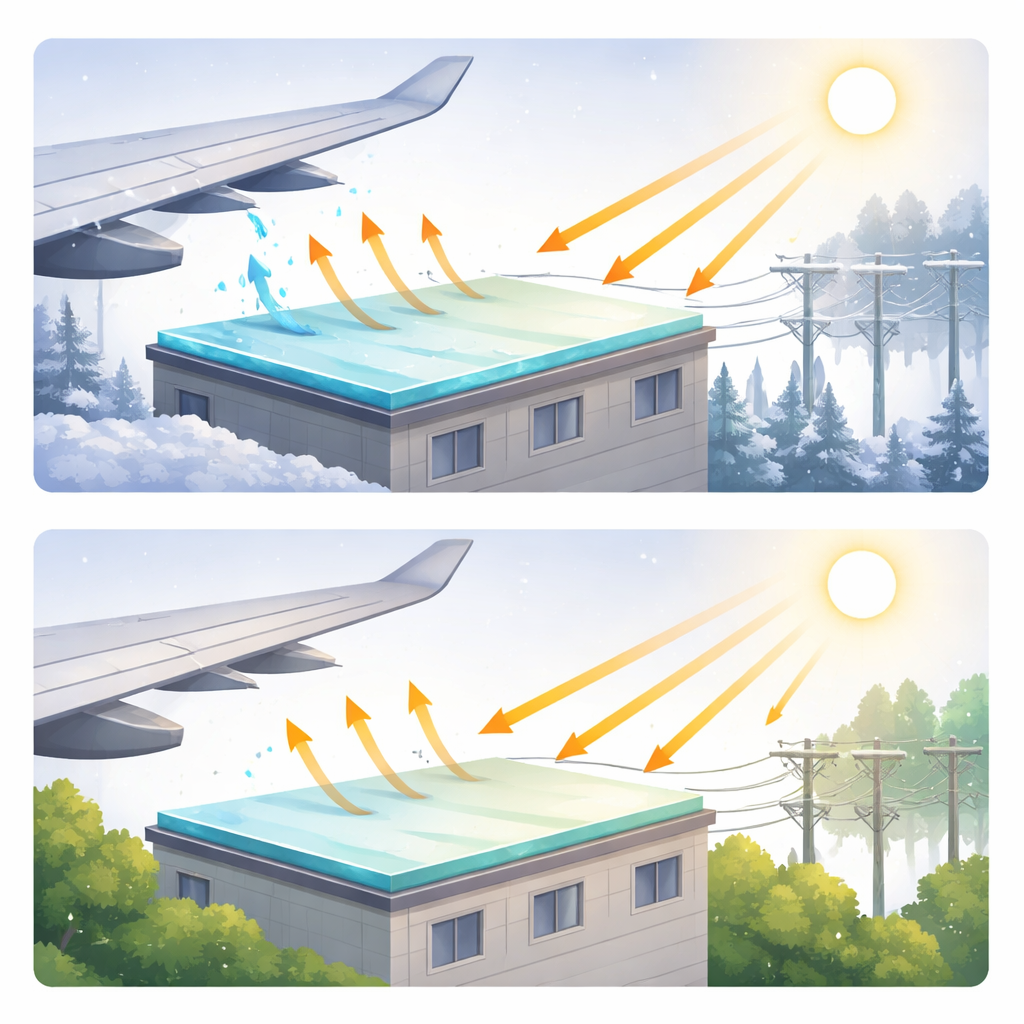
From planes and power lines to rooftop solar panels, many parts of modern life suffer when ice builds up in winter and when surfaces overheat in summer. Traditional fixes—like electric heating, chemicals, or manual scraping—consume energy, cost money, and can harm the environment. This paper introduces a smart, all-season coating that can be placed on roofs, aircraft wings, wind turbine blades, and power equipment. It automatically soaks up sunlight to fight ice in winter, then switches to reflecting sunlight and staying cool in summer, helping to cut both safety risks and energy use.
A thin film with three smart layers
The researchers designed a flexible film only a few fractions of a millimeter thick, built from three cooperating layers. The top layer is transparent and extremely water-repellent, patterned with tiny "moth-eye" bumps that make water droplets bead up and roll away, carrying dirt with them. This keeps the surface dry and clean, while still letting most sunlight pass through. The middle layer is a special gel that changes how it handles light depending on temperature: when it is cool, it stays clear and lets light through; when it becomes warm, its internal structure rearranges and it turns milky, scattering and reflecting sunlight. The bottom layer is a dark, rubbery composite filled with carbon nanotubes and liquid-like waxes that both absorb sunlight very efficiently and store heat as they melt and solidify.
How the film fights ice in the cold
In winter, when temperatures are low, the middle gel layer is transparent and the whole stack appears dark to the sun. Sunlight pours through the top and middle layers into the bottom layer, where the carbon nanotubes convert it into heat. The embedded phase-change materials melt and act as tiny thermal batteries, holding this warmth and releasing it slowly even when clouds pass or night falls. At the same time, the top surface’s extreme water repellency reduces the contact between water droplets and the cold solid beneath, making it harder for ice crystals to get started. In tests at –20 °C, droplets on a normal plastic surface froze in less than two minutes; on the new film, freezing was delayed to nearly 20 minutes—about a tenfold improvement. The stored heat also helped melt existing ice and frost under simulated sunlight, allowing ice droplets and even ice blocks on a model house to detach and slide off.
How it stays cool in the heat
In hot weather, the same film automatically changes behavior. As the temperature of the gel layer rises into the mid-20 °C range, the gel’s internal network collapses into tiny dense domains and the layer turns opaque and whitish. Now, instead of transmitting most sunlight, it reflects and scatters a large fraction of it, sharply reducing how much energy reaches the absorbing base layer. The moth-eye top layer also helps by cutting reflections in the useful solar range while blocking damaging ultraviolet light. Meanwhile, the film radiates heat away effectively in the infrared region, allowing it to cool below the surrounding air at night. Outdoor tests in humid subtropical summer conditions showed that, around midday, a simple dark solar-absorbing coating became more than 17 °C hotter than the new film, while the smart film often stayed a few degrees cooler than the air after sunset.

Durability and real-world energy savings
For any surface coating to be practical, it must survive sun, rain, dust, and mechanical wear. The moth-eye top layer withstood hundreds of abrasion and tape-peeling cycles, sand impact, acid rain, and strong ultraviolet exposure while maintaining its water-repellent and optical properties. The gel layer retained its reversible color-change behavior through many heating and cooling cycles without drying out, thanks to careful sealing. The phase-change layer repeatedly melted and solidified with almost no loss of capacity, and its design minimized leakage. Using computer simulations of a typical mid-rise apartment building in climates ranging from cold northern cities to milder regions, the authors found that adding this film to the roof could cut annual cooling energy use by more than 10% compared with a dark solar-absorbing roof, while avoiding the extra winter heating penalty often caused by always-cool, highly reflective roofs.
What this means for everyday life
Put simply, this study shows that a single, thin coating can both help keep ice off critical equipment in winter and reduce overheating and air-conditioning demand in summer, without the need for switches, power, or moving parts. By combining water-repellent texture, temperature-sensitive light control, and built-in heat storage, the film adjusts itself to the season and the weather. While challenges remain—such as finding greener replacements for some fluorinated ingredients and scaling up manufacturing—this approach points toward safer aircraft and power systems, more efficient buildings, and cities that stay a bit cooler and more resilient year-round.
Citation: Du, J., Wang, W., Fu, Y. et al. A self-regulated photothermal anti-/deicing film for all-season applications. Nat Commun 17, 2632 (2026). https://doi.org/10.1038/s41467-026-69494-x
Keywords: anti-icing surfaces, photothermal coatings, thermochromic hydrogel, radiative cooling, building energy savings