Clear Sky Science · en
Direct aluminium-alloy upcycling from entire end-of life vehicles
Turning Old Cars into a Hidden Metal Treasure
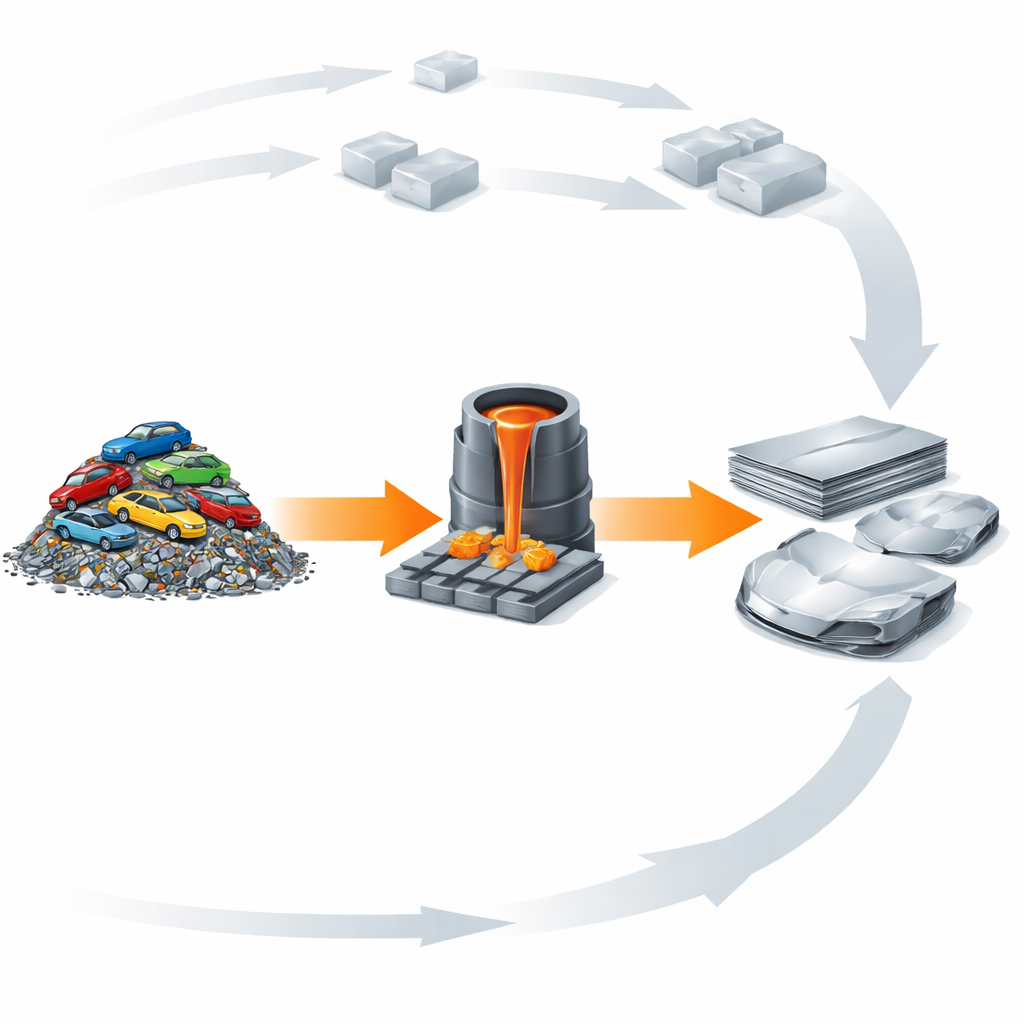
Every car eventually reaches the end of its life, leaving behind a shell of metal, plastic, and glass. Buried in that scrap is a valuable resource: aluminium, the lightweight metal that helps modern vehicles use less fuel and, increasingly, less electricity. Today, much of this aluminium is “downcycled” into lower‑value parts, wasting energy and money and adding unnecessary carbon pollution. This paper introduces a way to melt whole, unsorted end‑of‑life cars and directly turn their mixed aluminium into high‑performance material that can go straight back into new vehicles.
Why Today’s Car Recycling Wastes So Much Value
Across Europe alone, millions of tonnes of car scrap are generated each year. In principle, aluminium is endlessly recyclable, but modern vehicles use more than two dozen different aluminium alloys joined, welded, and glued together. Current recycling lines shred cars, roughly separate metals, and then struggle to sort these many alloy types. Because the mixture contains small amounts of many “tramp” elements such as iron and copper, recyclers usually dilute the melt with large amounts of freshly mined aluminium or accept a downgrade to low‑grade cast parts, like engine blocks. As engines disappear in electric cars and demand for those castings falls, this route is running out of customers, threatening to strand millions of tonnes of usable metal and adding tens of millions of tonnes of extra carbon dioxide each year.
A One‑Step Shortcut from Scrap Heap to Strong Metal
The authors propose a radical simplification: skip the elaborate sorting and dilution entirely. In their approach, all aluminium parts from an end‑of‑life vehicle are melted together in standard industrial furnaces and cast using the same direct‑chill technology already common in the aluminium industry. Instead of trying to push tramp elements out of the metal, the process is designed to live with them and even use them. The resulting chemical mix falls outside conventional alloy recipes, but the team shows that, with the right casting speeds and heat treatments, this “dirty” alloy can become a high‑quality wrought product suitable for demanding structural uses.
Making Impurities Work for, Not Against, the Metal
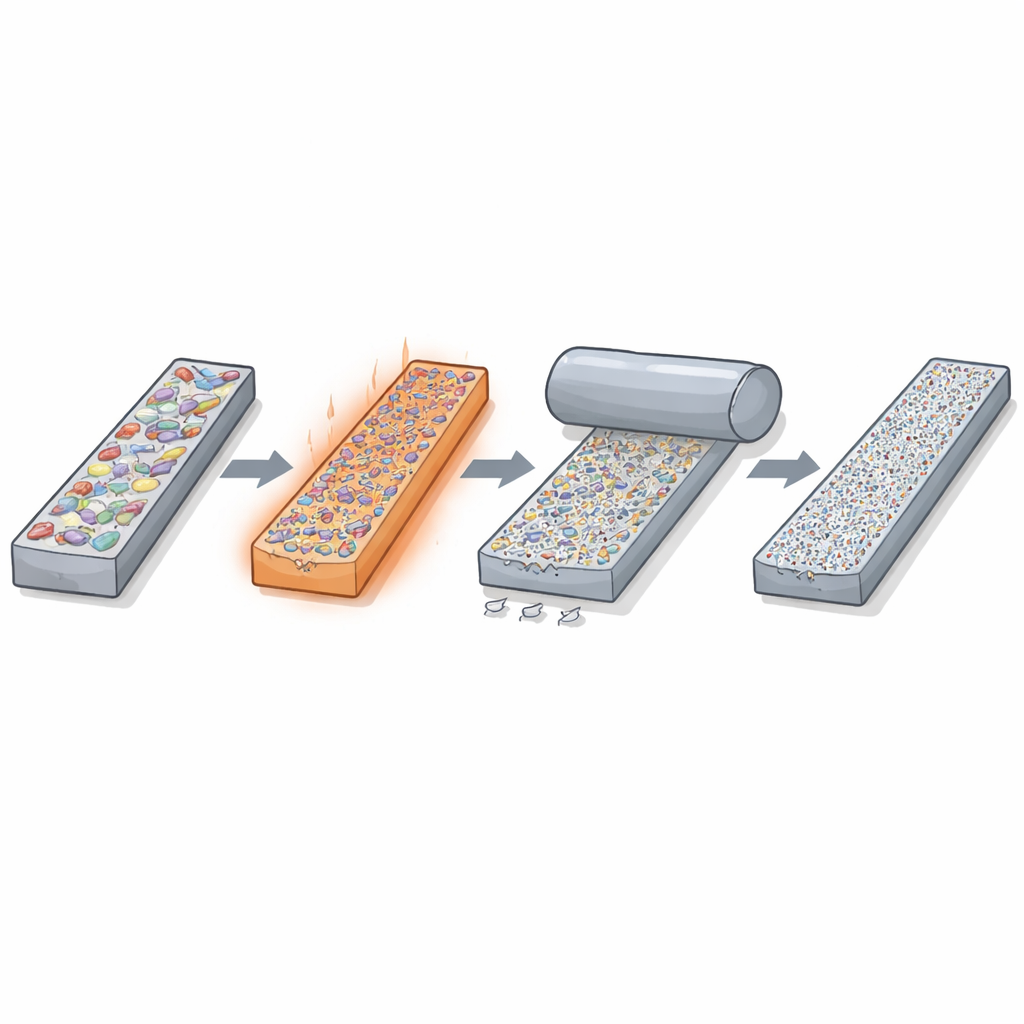
Traditionally, extra elements in recycled aluminium are seen as harmful because they form hard, brittle particles that can trigger cracks. Here, the researchers carefully control how those particles form and evolve. By solidifying the metal fast enough and then homogenising and rolling it, they break up and refine these particles to sizes and shapes that actually help the material. The particles stir up the surrounding metal during processing, creating a fine grain structure and a network of tiny internal distortions. Both effects allow the metal to stretch more before it breaks, while also making it stronger, overturning the usual trade‑off between strength and ductility for such contaminated compositions.
Heat, Stretch, and Bake: Unlocking Extra Strength
To mimic real car‑factory conditions, the team subjects their sheets to the same short heat cycles used during painting of auto bodies. They find that a smart sequence—solution heating, controlled pre‑aging, a period at room temperature, a small amount of pre‑stretching, and finally a brief paint‑bake—triggers rapid formation of ultra‑fine hardening features inside the metal. These nanoscale zones are enriched in elements such as magnesium, silicon, and copper and lock dislocations in place, boosting strength. With this route, alloys made from mixed scrap of a European passenger car or a U.S. pickup truck reach yield strengths around or above 350 megapascals while still maintaining good stretchability—values that surpass many current automotive aluminium grades produced from purer, primary metal.
What This Could Mean for Future Cars and the Climate
The study shows that entire end‑of‑life vehicles can be directly upcycled into high‑performance aluminium sheet without careful sorting or adding large amounts of newly produced metal. Because the method relies on existing industrial equipment and embraces the “messy” chemistry of real scrap, it can, in principle, be rolled out quickly and at scale. If adopted widely, such processes could turn today’s looming mountains of mixed aluminium waste into a reliable feedstock for next‑generation car bodies, cutting costs, reducing greenhouse‑gas emissions, and bringing the vision of a truly circular car industry much closer to reality.
Citation: Krall, P., Weißensteiner, I., Aster, P. et al. Direct aluminium-alloy upcycling from entire end-of life vehicles. Nat Commun 17, 2715 (2026). https://doi.org/10.1038/s41467-026-69492-z
Keywords: aluminium recycling, end-of-life vehicles, upcycling, circular economy, automotive materials