Clear Sky Science · en
Non-macrocyclic molecular design enables cavity-adaptive cocrystals with high elasticity and low-threshold lasing
Shaping Light with Tiny Flexible Crystals
Lasers are usually thought of as rigid devices made from glass, semiconductors, or metal cavities. This work shows that, instead, soft, flexible organic crystals—built from everyday carbon-based molecules—can bend like a spring and still act as powerful, efficient light sources. By teaching molecules to rearrange themselves around different guests, the researchers create tiny “smart” cavities that adapt their size, shine in bright colors, and lase with very little energy. These findings hint at future bendable photonic chips, wearable sensors, and compact light sources made from tailor‑made molecular building blocks.
From Classic Rings to Shape-Shifting Hosts
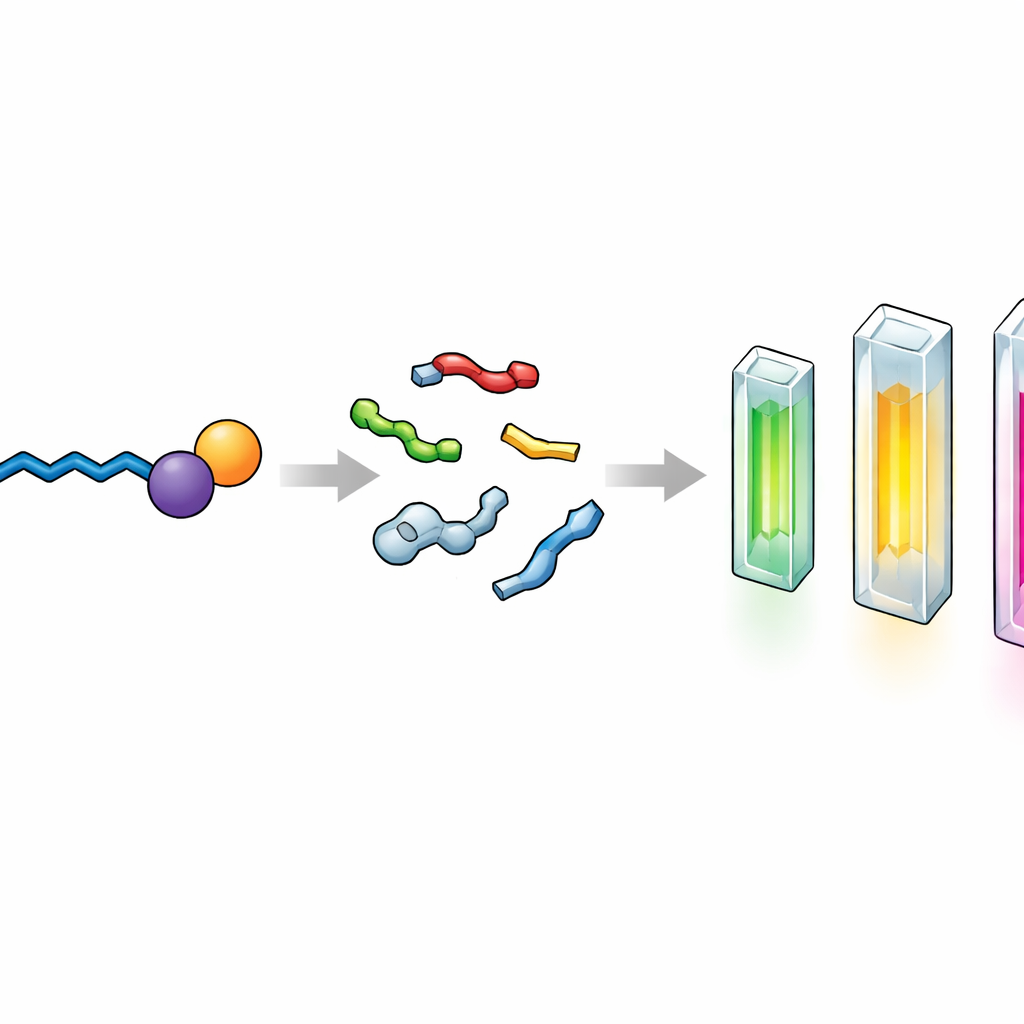
For decades, chemists have used ring-shaped molecules—called macrocycles—as tiny hosts that bind smaller guests inside their hollow centers. These hosts, such as crown ethers and cucurbiturils, have fixed cavities that work beautifully in liquids but are harder to tune in the solid state, especially when one wants strong and controllable light emission. The team behind this study set out to escape the limitations of rigid rings. Instead of a closed loop, they use a linear, rod‑like molecule with bulky end groups. At first glance this host looks too open and floppy to hold anything, yet its size, stiffness, and side‑group crowding let it fold and flatten just enough to create a cavity on demand.
Guest-Driven Cavities That Adapt on Demand
The central idea is to let the guest molecule decide the size of the cavity. When the linear host crystallizes alone, its backbone is twisted and loosely packed. But when solvent molecules or elongated aromatic guests are present, the host backbone flattens and two or more hosts arrange to surround the guest, carving out a snug molecular pocket. Smaller guests or solvents may pair up inside one cavity, while longer ones fit one‑by‑one, stretching the pocket like an adjustable sleeve. Despite these changes, the host dominates the way the material absorbs and emits light. The guests act mainly as structural spacers and subtle electronic modifiers, while the host’s rigidified backbone glows more efficiently because its motions are suppressed.
Color Tuning with Subtle Molecular Tweaks
By swapping guests of similar size but slightly different composition, the researchers can change the color and behavior of the emission without rebuilding the entire framework. Guests containing nitrogen or sulfur atoms, for example, introduce gentle charge‑transfer interactions or energy‑transfer pathways that shift the glow from cyan to yellow‑green. The same host can also be re‑engineered: altering its central backbone, while keeping the bulky ends that form the cavity, lets the team move the emission across blue, green, and red regions. All these host–guest pairings form what the authors call cavity‑adaptive cocrystals—ordered solids whose cavities and colors are tuned simply by choosing and combining molecular pieces.
Crystals That Bend Like Springs and Lase Like Cavities
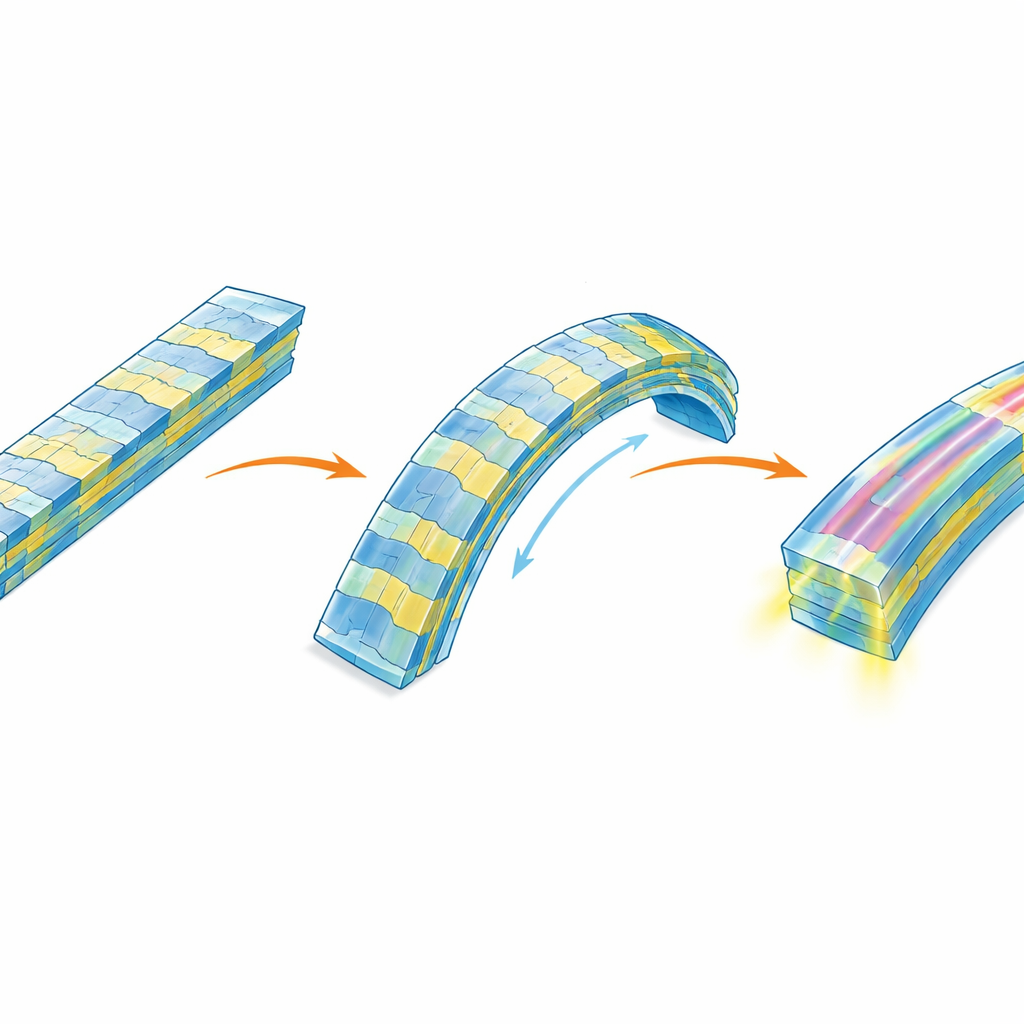
Unusually for organic crystals, many of these cocrystals bend dramatically without breaking. Under mechanical stress, long ribbon‑like crystals curve into a U‑shape and snap back when released, thanks to two intertwined structural features: strong, directional interactions within each layer that hold molecules firmly, and weaker, interlocking contacts between layers that allow them to slide slightly and recover. At the same time, the crystals exhibit very high light‑emission efficiency and extremely short lifetimes, an ideal combination for laser action. When pumped with brief ultraviolet pulses, micrometer‑sized plates and ribbons act as built‑in optical cavities, producing amplified spontaneous emission or clear lasing at remarkably low energy thresholds—far lower than the pure host alone. Larger, more conjugated guests tend to create larger cavities and stronger electronic coupling, which further lowers the lasing threshold.
Why This Matters for Future Flexible Photonics
To a non‑specialist, the outcome can be viewed as a new kind of “molecular Lego” for light. The researchers show that one can separate the job of forming a cavity (handled by bulky end groups and packing) from the job of emitting light (handled by the central backbone), and then fine‑tune each independently. The result is a library of more than ten cavity‑adaptive cocrystals that combine bright, color‑tunable emission, mechanically elastic single crystals, and low‑threshold lasing, all in purely organic solids. This approach overcomes key limits of traditional ring‑like hosts and points toward a future in which flexible, reconfigurable laser materials can be designed by mixing and matching simple molecular components.
Citation: Feng, Z., Zhu, Y., Han, C. et al. Non-macrocyclic molecular design enables cavity-adaptive cocrystals with high elasticity and low-threshold lasing. Nat Commun 17, 2663 (2026). https://doi.org/10.1038/s41467-026-69483-0
Keywords: cavity-adaptive cocrystals, flexible organic lasers, host–guest materials, elastic molecular crystals, supramolecular photonics