Clear Sky Science · en
Dielectrocapillarity for exquisite control of fluids
Electric Fields as Fluid Control Knobs
From energy storage to water purification, many emerging technologies depend on how easily tiny channels and pores can fill with liquids and gases. This paper explores a new way to steer that filling process using shaped electric fields, offering a vision of batteries, filters, and even fluid-based computers whose behavior can be tuned from the outside without changing the material itself.
Why Tiny Pores Matter
Nanoporous materials and narrow channels are the workhorses of supercapacitors, gas separation membranes, and nanofluidic devices. Their performance hinges on how much fluid they can hold, which has traditionally been set by fixed material properties: pore size, surface chemistry, and temperature. For over a century, the physics of capillarity has told us when a liquid will condense inside a pore and when it will stay out as a gas. Yet most efforts to improve devices have focused on redesigning the solid material. The possibility of actively tuning fluid uptake in place, using an external control like an electric field, has remained largely untapped.
From Uniform Fields to Electric Landscapes
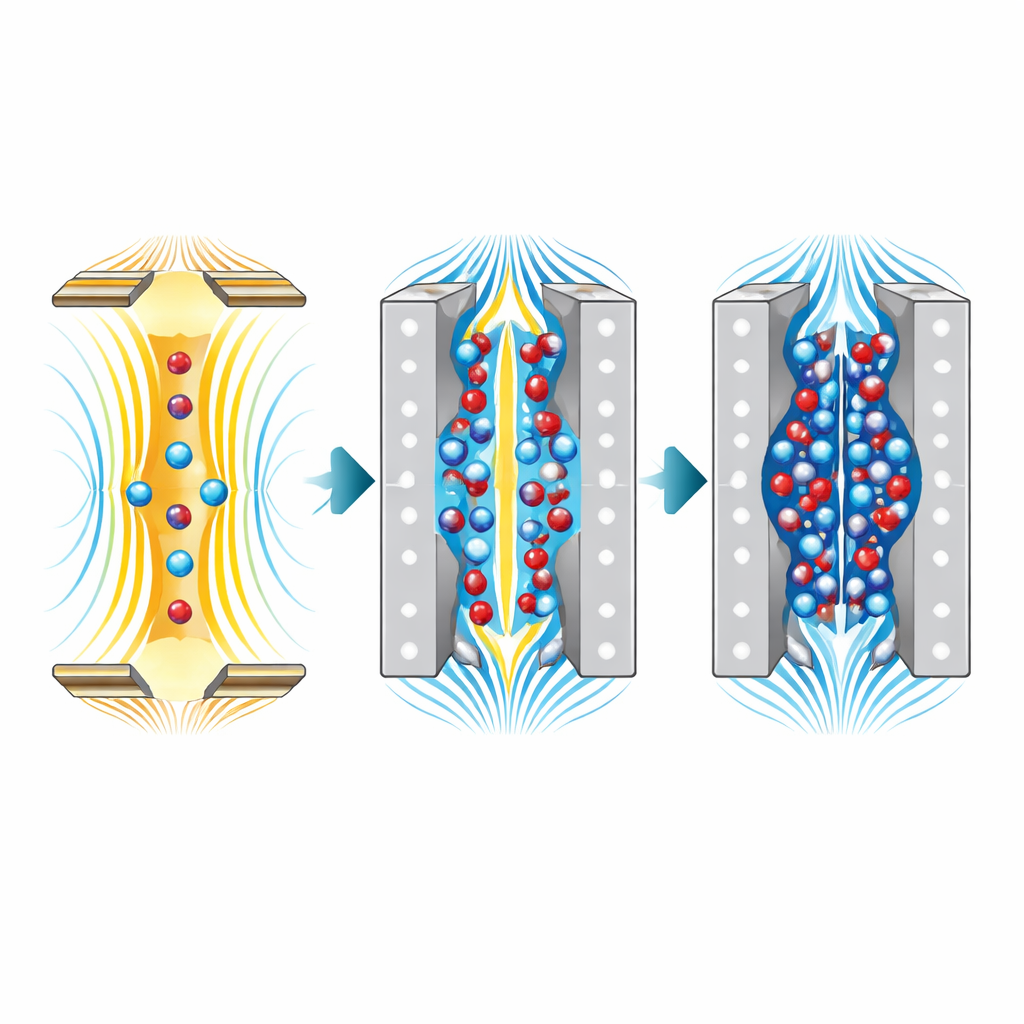
Electric fields already play a role in fluids, but in a limited way. A uniform field mainly pushes charged particles such as ions, while neutral polar molecules like water mostly reorient without being moved in bulk. The key twist in this work is to focus on electric fields that vary in space, creating gradients that exert a “dielectrophoretic” force on polar molecules, nudging them toward regions of stronger field even when they carry no net charge. The authors show, using simulations and a modern statistical theory augmented by deep learning, that these gradients can reorganize the density of polar fluids on molecular length scales. Water and simple model dipolar liquids pile up in high-field regions, whereas ionic solutions behave differently, shifting toward weaker-field zones. This distinct response reveals a powerful new handle for selectively shaping fluid structure.
A New Lever on Boiling and Condensation
When a fluid is close to boiling or condensing, small nudges can decide whether it sits as a dense liquid or a diffuse gas. The study demonstrates that electric field gradients can shift this balance. By applying sinusoidal fields that vary over distances comparable to a few molecular diameters, the authors track how regions of high and low density emerge and how the traditional liquid–gas coexistence line is altered. They find that strong gradients can lower the critical temperature at which liquid and gas become indistinguishable, effectively pushing the fluid toward a supercritical state without changing its chemical makeup. This shift is seen both in a generic dipolar fluid and in water, indicating that the effect should be broadly relevant. Crucially, the impact depends not just on the field’s strength but also on its spatial wavelength and on how long-ranged the intermolecular forces are.
Switchable Filling of Nanopores
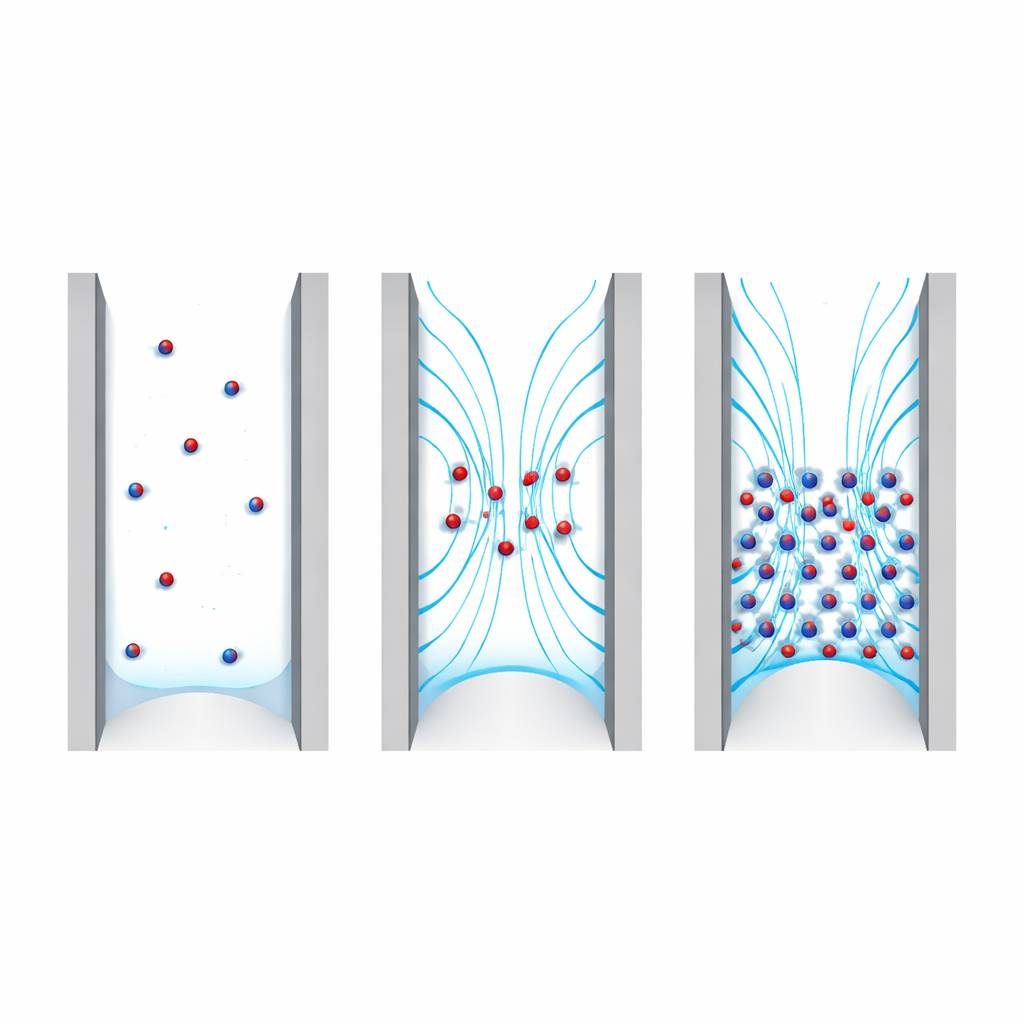
Perhaps the most striking consequence appears when a polar liquid is confined between two walls forming a slit-like pore. Normally, such pores fill abruptly via capillary condensation: as humidity or chemical potential is increased, the pore suddenly flips from nearly empty to filled, often with hysteresis between filling and emptying. By imposing non-uniform electric fields across the slit, the authors show that this behavior can be smoothly tuned. The fields draw fluid into the pore at lower humidities and at the same time shrink or even eliminate the hysteresis loop, turning a sharp first-order transition into a continuous one. This ability to regulate both how much fluid is taken up and how “sticky” the transition is introduces what the authors call “dielectrocapillarity” – the control of capillary phenomena by electric field gradients.
Bridging Droplets and Nanopores
Experiments on macroscopic droplets have already shown that patterned electrodes can make liquids spread more readily on a surface, a process known as dielectrowetting. The present work connects that large-scale picture to the nanoscale world inside pores. Using their multiscale framework, the authors mimic the decaying electric fields generated by interdigitated electrodes and show that they enhance wetting at confining walls in a way that roughly follows a modified version of Young’s law for contact angles. At the same time, they uncover subtle deviations arising from local fluctuations in density that are invisible to simple continuum descriptions. This link between microscopic structuring and macroscopic wetting laws provides a foundation for designing field-responsive materials that behave predictably across many length scales.
What This Means Going Forward
In everyday terms, the study shows that by carefully shaping electric fields—stronger here, weaker there—engineers could dial how much fluid enters tiny spaces, how quickly it does so, and whether the system “remembers” past states through hysteresis. Such control could lead to energy storage devices with tunable capacity, membranes that separate gases more selectively, and nanofluidic circuits whose conductance mimics the adaptable connections in the brain. While the current work focuses on equilibrium behavior, it lays the groundwork for exploring how these electric landscapes might steer fluid motion and pattern formation in real time, opening a path toward programmable fluids.
Citation: Bui, A.T., Cox, S.J. Dielectrocapillarity for exquisite control of fluids. Nat Commun 17, 2661 (2026). https://doi.org/10.1038/s41467-026-69482-1
Keywords: nanofluidics, electric field gradients, capillary condensation, porous materials, dielectrophoresis