Clear Sky Science · en
Sustained interfacial powering through self-generated mantle and siphon of a gelling droplet
Why tiny self-powered droplets matter
Imagine a droplet that can scoot across a water surface for more than an hour without any batteries, wires, or moving parts. Such long-lived, self-powered motion could one day drive tiny floating sensors that monitor water quality, steer drug carriers in medical treatments, or assemble microscopic materials. This paper shows how a simple, gel-forming droplet can mimic a squid’s jet propulsion to become a remarkably persistent “chemical engine” at the water’s surface, lasting hundreds of times longer than previous designs.
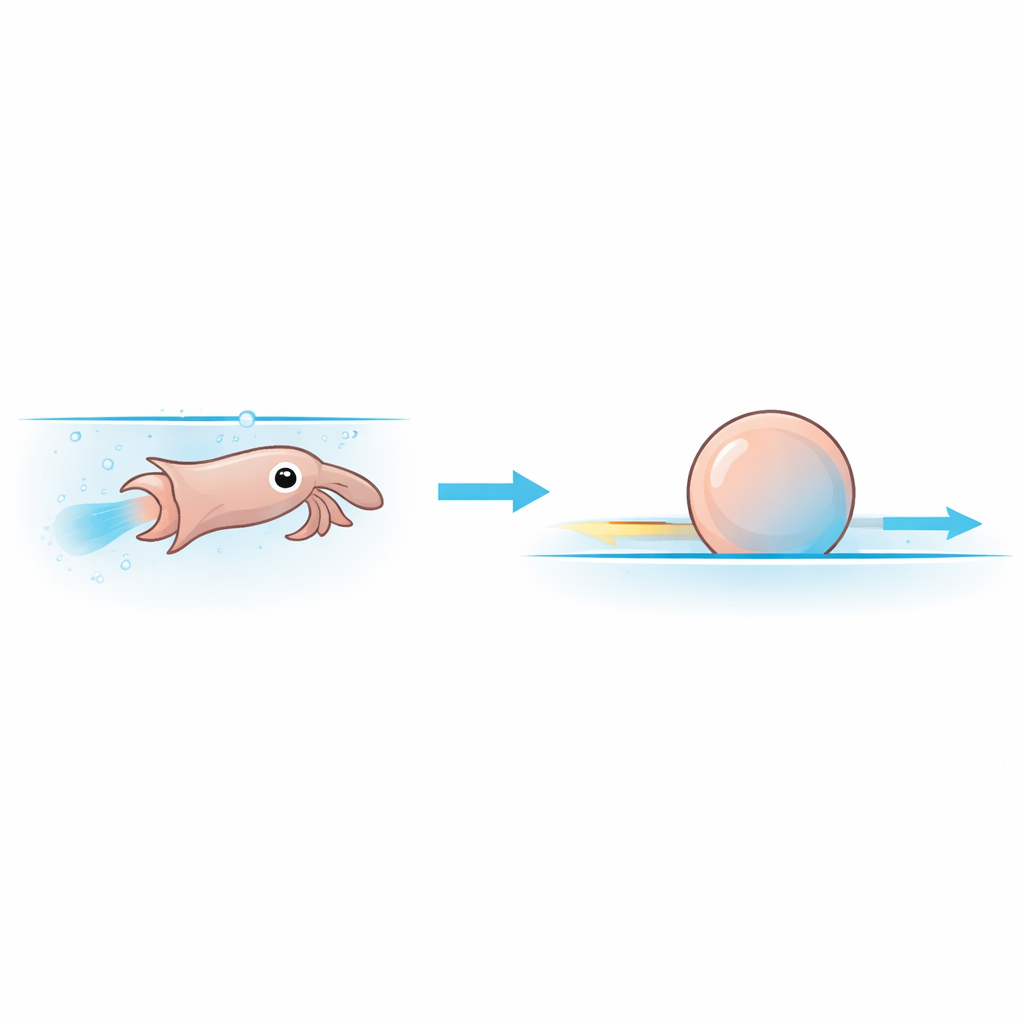
Borrowing a trick from squid
Squid move by drawing water into a muscular cavity, then squeezing it out through a narrow nozzle, or siphon, to jet forward for long periods. At small scales, researchers strive for a similar combination of power and endurance, but most “Marangoni motors” — droplets that move because they release surface-active molecules — burn out in seconds as their fuel spreads too quickly. In this work, the authors take inspiration from the squid’s mantle-and-siphon system. They design droplets that, when placed on a special liquid, automatically build their own “mantle” and “siphon” from a soft gel, turning a brief burst of surface activity into sustained, directed propulsion.
How a gelling droplet builds its own engine
The droplet starts as a mixture of water, a gel-forming polymer, and relatively large surfactant molecules that like to sit at the water’s surface. When this droplet is gently placed onto a bath containing a crosslinking agent, it first spreads into a flat lens and floats instead of sinking. Surfactant molecules rush outward, lowering the surface tension around the droplet and kicking off motion. At the same time, ions from the bath diffuse inward and begin tying the polymer chains together into a hydrogel shell, or mantle, around the droplet. This mantle slowly shrinks as it forms, squeezing the still-liquid center and raising the internal pressure.
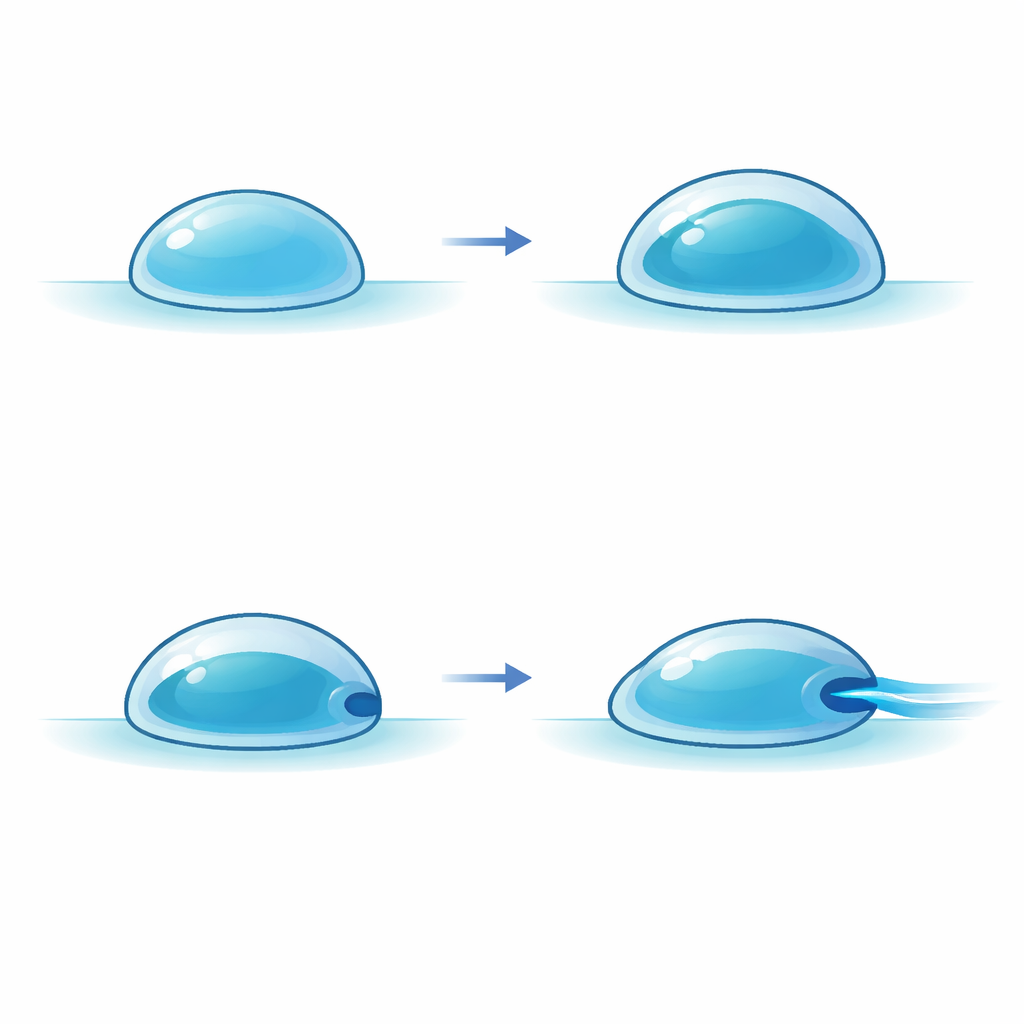
From sealed shell to one-way jet
As the shell thickens and tightens, mechanical stress concentrates near its edge. Eventually a weak spot ruptures, opening a small hole that becomes the droplet’s siphon. Pressurized liquid laced with surfactant is then expelled through this single opening as a narrow jet. The new gel mantle acts as a barrier, preventing surfactant from leaking out equally in all directions. Instead, fuel is channeled through the siphon in one preferred direction, just as a squid sends water out the back. This directional release keeps a strong contrast between “fresh” and “used” areas of the surface, preserving the driving force for motion and greatly extending how long the motor can run.
Performance of a tiny chemical motor
The researchers show that this strategy works with several common gel systems and with different kinds of surfactants. Crucially, the surfactant molecules must be big enough that they cannot quickly seep through the tiny pores of the gel; small molecules like alcohols escape too fast and give only brief motion, while short polymer surfactants maintain propulsion for around a thousand seconds. Measurements of flow around the droplet reveal circulating swirls driven by surface tension differences, and calculations connect the droplet’s speed to how quickly surfactant is pumped through the siphon. Compared to other chemical micromotors, these gelling droplets achieve both high speeds relative to their size and impressive efficiency in turning chemical energy into movement.
Turning droplets into surface machines
Because they are simple, light, and self-contained, the motors can be attached to floating devices to create basic machines at the water’s surface. The authors couple them to gears, cams, cranks, and sliders cut from thin plastic sheets, translating straight-line droplet motion into rotation, swinging, and reciprocating movements. They also tether a motor to a small, battery-free water sensor that communicates wirelessly, allowing the sensor to patrol a circular channel for nearly half an hour using just one tiny droplet of fuel. These demonstrations hint at a future in which fleets of soft, disposable motors roam interfaces, carrying out practical tasks without external power.
What this means going forward
By letting a droplet build its own shrinking shell and one-way vent, the authors show how to tame a normally wasteful surface process into a sustained, directional jet. In everyday terms, they have taught a droplet to breathe out more slowly and purposefully, much like a squid, so it can keep moving far longer on the same amount of fuel. This approach could inform smarter drug capsules that release medicines in controlled bursts, tougher microscopic containers that avoid sudden leaks, and new generations of tiny robots that glide along liquid surfaces using only simple chemistry.
Citation: Zhou, C., Liu, C., Shi, R. et al. Sustained interfacial powering through self-generated mantle and siphon of a gelling droplet. Nat Commun 17, 2566 (2026). https://doi.org/10.1038/s41467-026-69481-2
Keywords: Marangoni motor, self-propelled droplet, hydrogel mantle, interfacial microrobotics, jet propulsion