Clear Sky Science · en
Hydroclimate shapes photosynthetic sensitivity to cloud cover across global terrestrial ecosystems
Why clouds matter for life on land
Clouds may look like simple sky decorations, but they quietly manage two things plants care about most: sunlight and water. This study explores how different kinds of climates—from bone-dry deserts to soggy rainforests—change the way plants respond to cloudy skies. Understanding this hidden link helps scientists better predict how Earth’s green landscapes will absorb carbon dioxide as the planet warms.
Two main ingredients for plant growth
Plants turn sunlight, water and carbon dioxide into sugars through photosynthesis, driving the largest flow of carbon from the air into land ecosystems. But they are not limited everywhere by the same factor. In bright but dry regions, such as many arid and semi‑arid landscapes, water is the scarcest ingredient. In cool or very cloudy places like high‑latitude forests and tropical rainforests, energy from sunlight and temperature is often the bottleneck. Because clouds control both light reaching the surface and the rain that falls, they sit at the crossroads of these two basic needs.
Reading the cloud–plant signal worldwide
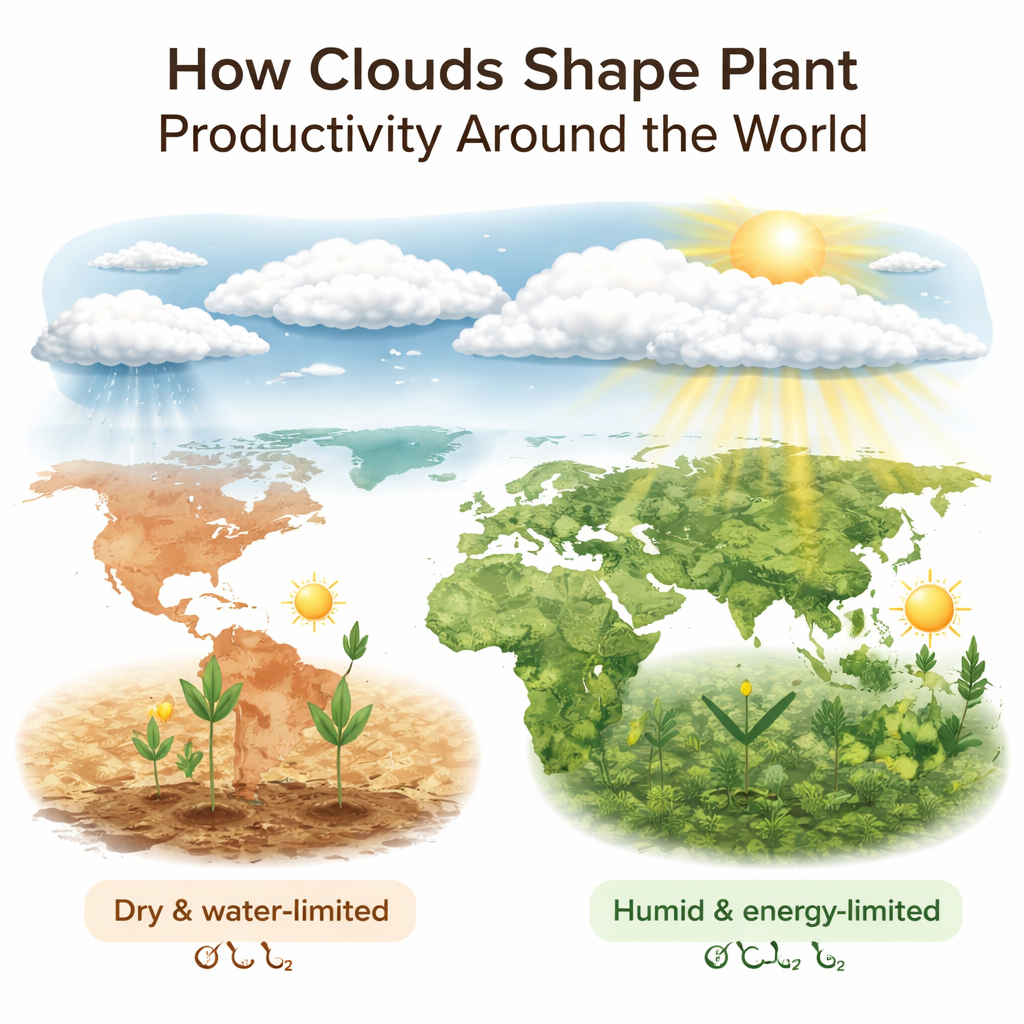
The researchers combined decades of ground measurements of plant growth from eddy‑covariance towers with global satellite data sets. They focused on gross primary productivity—the total carbon fixed by photosynthesis—and a simple cloud measure called cloud fraction, which tells what portion of the sky is covered by clouds. They also used a “humidity index,” the ratio of rainfall to potential evaporation, to sort regions along a continuum from arid (water‑limited) to humid (energy‑limited). By carefully removing seasonal patterns and long‑term trends from the data, they could isolate how short‑term ups and downs in cloud cover line up with changes in plant photosynthesis.
When clouds help—and when they hurt
The pattern that emerges is strikingly consistent across local sites, global maps and computer models. In dry, water‑limited regions, more cloud cover tends to boost photosynthesis. The reason is that clouds there are strongly tied to rainfall: when skies turn cloudy, rain often follows, wetting soils and allowing plants to grow more vigorously. The boost usually shows up with a delay of days to a few weeks, as the extra water seeps into the ground and roots. In contrast, in humid, energy‑limited regions, extra clouds usually dim the light almost immediately and cool the surface, cutting back photosynthesis even when water is plentiful.
Balancing light and rain in different skies
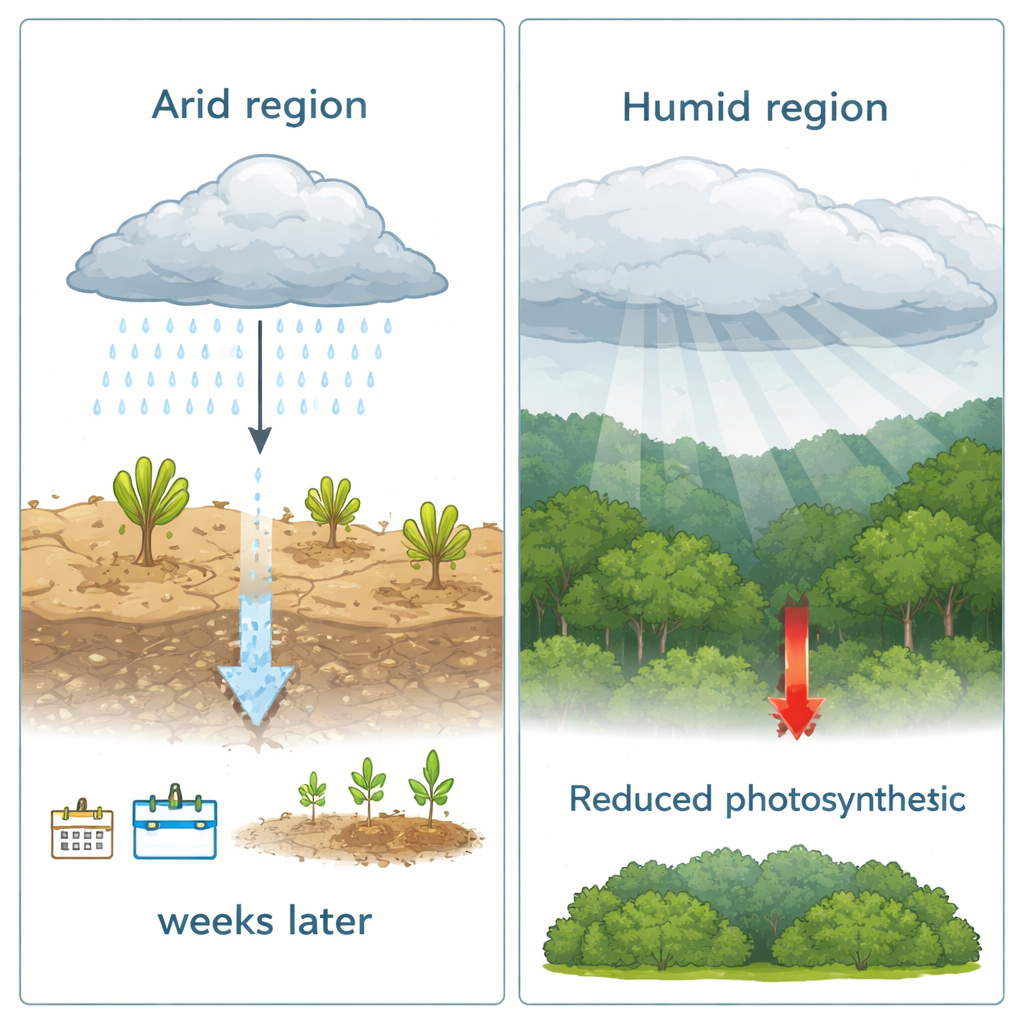
To understand the tug‑of‑war between light and water, the team separately measured how sensitive plant growth is to changes in incoming sunlight and to changes in rainfall. They found that, as climates shift from humid to arid, the importance of rainfall steadily rises while the importance of light declines. The overall effect of clouds on plants can be explained by this balance: in water‑limited climates clouds are friends because they bring moisture, while in energy‑limited climates they are foes because they block vital light. Different cloud types matter too. Thick, liquid‑rich clouds, which strongly reflect sunlight and often produce rain, drive most of the observed effects, whereas thin, high clouds play a smaller role.
What a warming climate may bring
Looking to the future, the researchers combined their sensitivity maps with observed and simulated trends in cloud cover. Multiple data records and climate models suggest that, on average, cloudiness over land is likely to decline as the world warms, especially for low‑level clouds. When they translated these cloud changes into potential shifts in plant productivity, a clear picture emerged: photosynthesis is projected to decrease in already arid regions but increase in humid ones. Globally, the total effect may roughly balance out, but carbon uptake will become even more uneven, with dry regions losing productivity and wet regions gaining it.
Why this matters for people and the planet
In simple terms, the study shows that the same cloud can be good news for plants in a dry savanna and bad news for plants in a wet rainforest. As climate change alters cloud patterns, it is likely to push plant productivity away from drier areas, where it is already low, toward wetter regions. That shift could deepen existing differences in how ecosystems store carbon and manage water, influencing everything from regional food security to the global pace of warming. By treating cloud cover as a single, powerful indicator that bundles both light and rain, this work offers a clearer, more unified view of how Earth’s changing skies will reshape life on land.
Citation: Luo, H., Bastos, A., Reichstein, M. et al. Hydroclimate shapes photosynthetic sensitivity to cloud cover across global terrestrial ecosystems. Nat Commun 17, 1646 (2026). https://doi.org/10.1038/s41467-026-69480-3
Keywords: cloud cover, photosynthesis, arid versus humid ecosystems, gross primary productivity, climate change impacts