Clear Sky Science · en
Near real-time full-wave inverse design of electromagnetic devices
Faster Design for Everyday Wireless Tech
From smartphones and Wi-Fi routers to medical scanners and radar, modern life depends on electromagnetic devices that shape and guide invisible waves. Yet designing these devices is often painfully slow, requiring days or weeks of heavy computer simulations. This article presents a new way to design such hardware in near real-time, opening the door to quicker innovation in antennas, sensors, and other components that keep our digital world running.
Why Designing Wave Devices Is So Hard
Engineers have long relied on a mix of experience, intuition, and trial-and-error simulations to sculpt metal and dielectric structures so that they bend and radiate electromagnetic waves in just the right way. In recent years, “inverse design” has promised to automate this process: instead of guessing a shape, the engineer specifies the desired behavior, and an algorithm searches for a structure that delivers it. The catch is that every step of this search typically requires a full, detailed simulation of the device, which can take many minutes or hours. For complex, three-dimensional structures, thousands of such simulations are needed, making the process so slow that many ambitious designs are simply impractical.
Limitations of Current Shortcuts
Several strategies have tried to tame this computational burden. Some algorithms follow gradients—mathematical slopes that indicate which small change improves performance—but they can get stuck in local dead ends and often struggle with discrete choices like “metal here or not.” Other approaches, such as genetic algorithms and particle swarms, explore the design space more freely but still require massive numbers of simulations. Machine-learning surrogates replace full simulations with trained neural networks that predict performance from geometry, but building these models demands huge training datasets—often tens of thousands to over a million simulations—and days to weeks of compute time. Worse, their predictions can fail in unexplored corners of the design space, meaning a structure that looks perfect on paper may behave poorly when actually simulated or built.
A Precomputed Shortcut That Remains Exact
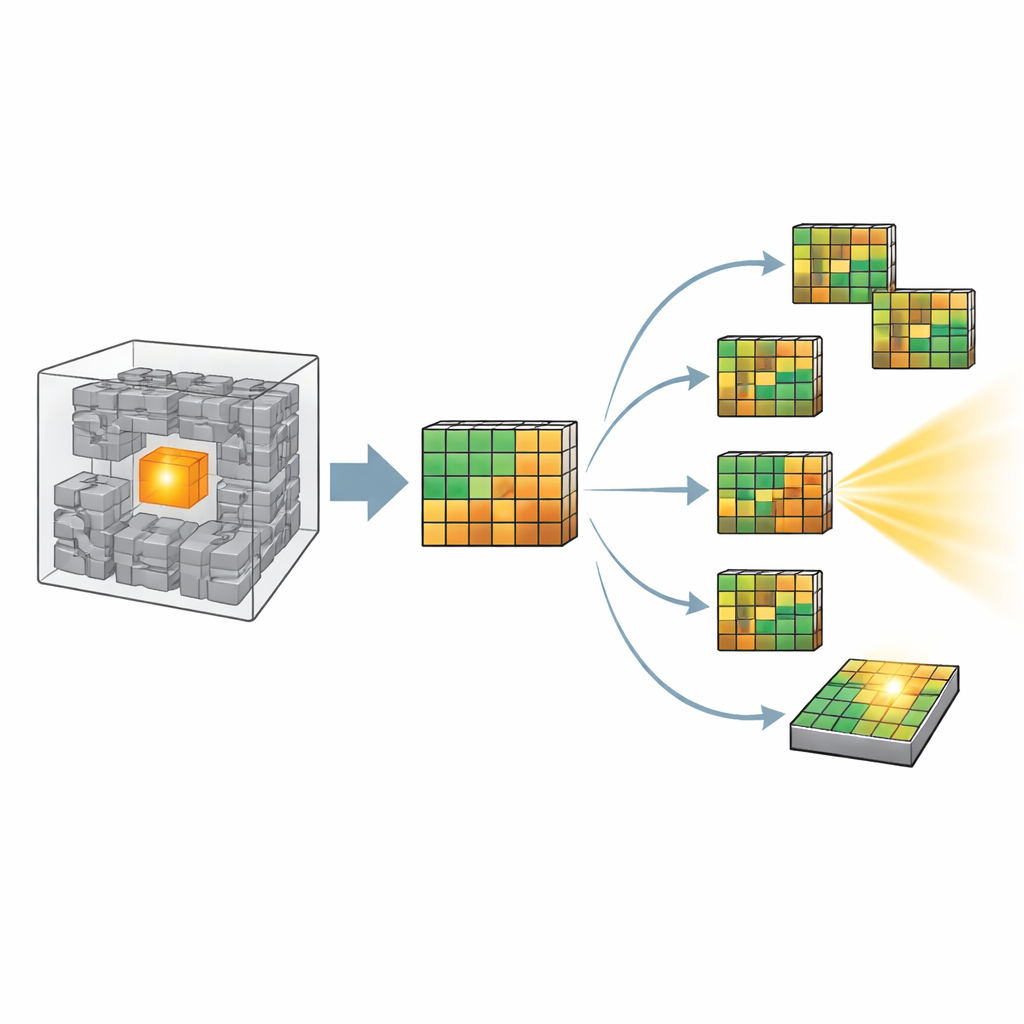
The authors introduce the Precomputed Numerical Green Function (PNGF) method, which keeps the accuracy of full-wave physics while slashing cost per design step to milliseconds. The key idea is to separate the parts of the device that never change—such as substrates, ground planes, and feeds—from the region where the design is allowed to vary. Physics guarantees that the effect of those static surroundings on the design region can be captured in a single, precomputed matrix known as a numerical Green function. After computing this matrix once with a conventional simulator, any candidate pattern of metal or dielectric inside the design region can be evaluated by solving a much smaller system of equations involving only that region, with no approximations relative to the original solver.
Tiny Local Changes, Lightning-Fast Updates
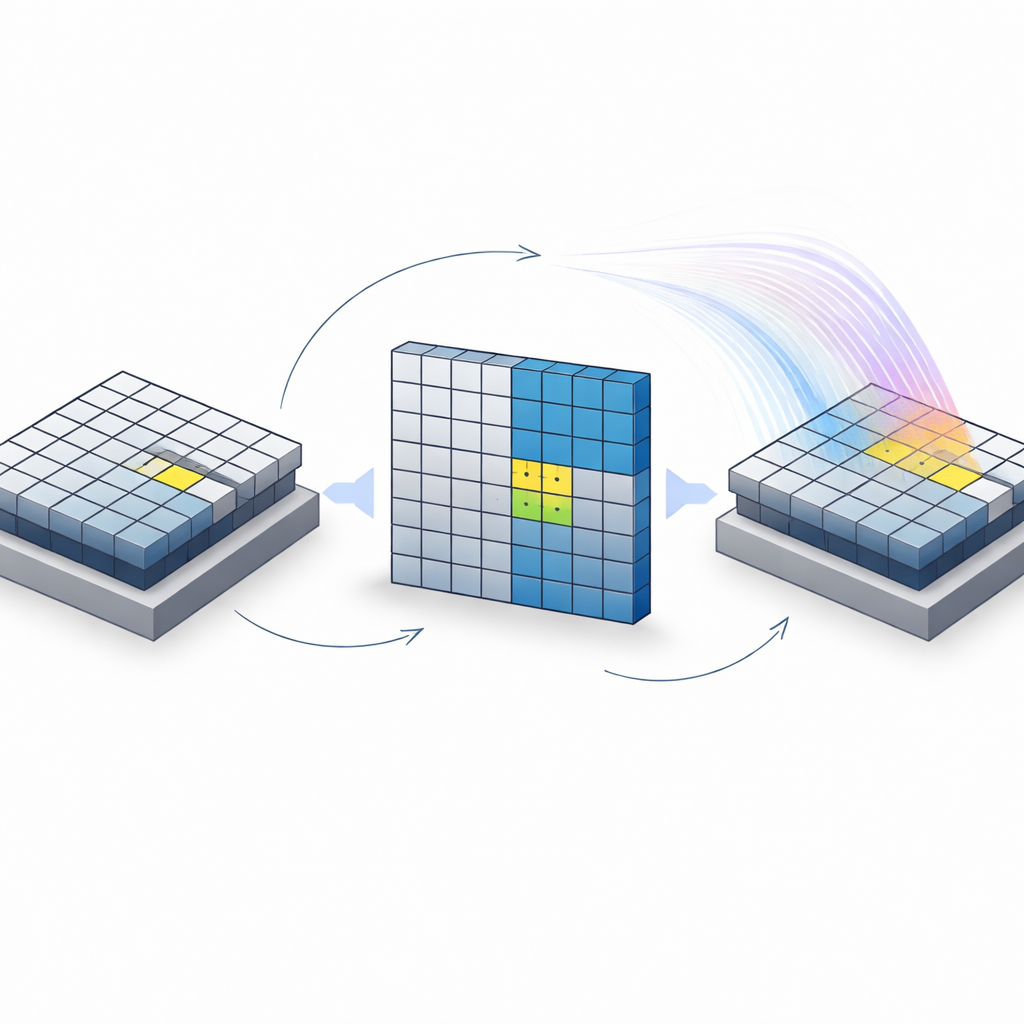
Many inverse-design algorithms, including the direct binary search scheme used here, modify only a few pixels or tiles of the design at each iteration—flipping a patch of metal on or off, for example. PNGF takes advantage of this by treating each small change as a low-rank update to its system matrix. Using a classic linear-algebra tool called the Woodbury identity, the method updates the solution without recomputing everything from scratch. This makes the time to evaluate a new candidate design grow only linearly with the number of unknowns in the design region and completely independent of the complexity of the larger electromagnetic environment. In benchmarks, PNGF achieved speedups up to 16,000 times compared with leading commercial solvers, reducing optimization times from days or weeks down to seconds or minutes while matching their results to multiple digits of precision.
Real Devices Built in Hours, Not Weeks
To demonstrate the method’s power, the researchers designed three practical microwave components. First, they created a compact 30 GHz substrate antenna with about 40% fractional bandwidth and a stable radiation pattern across its band, properties that are difficult to achieve with traditional patch designs. Second, they produced a reconfigurable switched-beam antenna that can steer its main beam by about 70 degrees using a single switch, scaled and fabricated at 6 GHz for measurement. Third, they designed a very short transition between a microstrip line and a substrate-integrated waveguide, achieving broadband, low-loss performance in a footprint more than four times shorter than a conventional tapered transition. In all cases, the PNGF-based designs agreed closely with measurements from fabricated prototypes and required total design times on the order of minutes to about an hour, including precomputation.
What This Means for Future Technologies
For a layperson, the main takeaway is that the authors have found a way to keep the full physical fidelity of the best electromagnetic simulators while making the design loop almost as fast as clicking through ideas on a laptop. Instead of waiting days to see how a new antenna shape performs, engineers can explore thousands of configurations in the time it once took to run a single simulation, without resorting to approximate machine learning shortcuts. Although developed for microwave and antenna structures, the same mathematical framework can extend to optics, acoustics, and even heat flow—anywhere waves or diffusive fields follow linear equations. As this approach spreads, we can expect faster development of smaller, more capable wireless hardware and other wave-based technologies that quietly underpin modern life.
Citation: Sun, JH., Elsawaf, M., Zheng, Y. et al. Near real-time full-wave inverse design of electromagnetic devices. Nat Commun 17, 2372 (2026). https://doi.org/10.1038/s41467-026-69477-y
Keywords: electromagnetic inverse design, numerical Green function, antenna optimization, computational electromagnetics, microwave engineering