Clear Sky Science · en
Martian ionospheric response during the may 2024 solar superstorm
When a Distant Solar Storm Shook Mars’ Skies
In May 2024, a colossal storm on the Sun not only painted rare auroras across Earth’s skies, it also slammed into Mars. This study shows how that outburst of solar energy dramatically reshaped the electrically charged upper atmosphere—or ionosphere—around the Red Planet. By catching the event almost in real time with orbiting spacecraft, scientists recorded the strongest boost ever seen in one of Mars’ key ionospheric layers, revealing new details about how solar storms can affect planets without protective global magnetic fields.
Listening Through Mars’ Air
To watch Mars’ ionosphere react, researchers used a technique called mutual radio occultation, in which one spacecraft sends a steady radio tone through the planet’s atmosphere to another spacecraft. As the signal grazes the limb of Mars, it bends and slows depending on how many charged particles it passes through. By carefully measuring these tiny changes, scientists can reconstruct a vertical profile of electron density—essentially a soundings chart of the ionosphere, from about 80 kilometers up to several hundred kilometers. Since 2020, the Mars Express and ExoMars Trace Gas Orbiter missions have been performing such measurements roughly once a week, steadily building a baseline picture of Mars’ ionospheric behavior across seasons and solar conditions.
The Superstorm Arrives
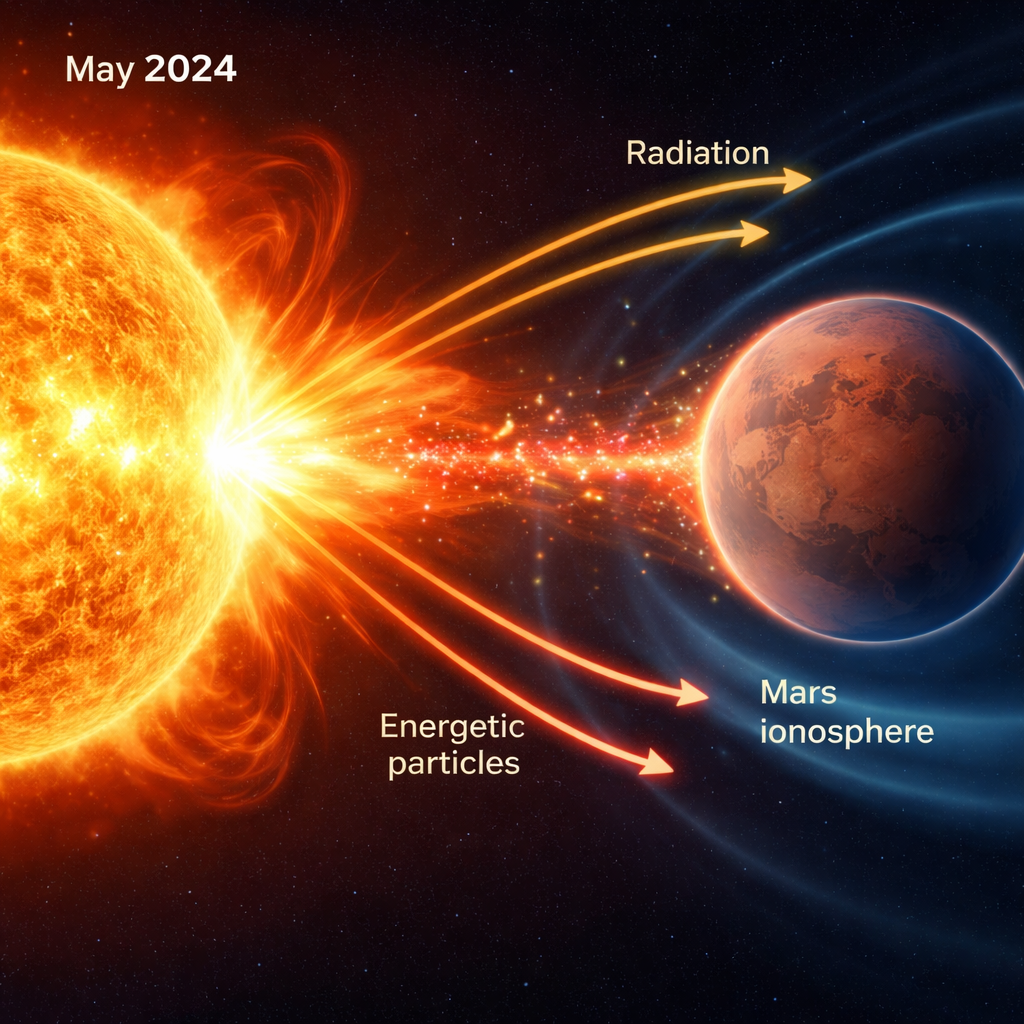
In early May 2024, the Sun unleashed a series of intense eruptions: powerful flares, bursts of high-speed particles, and a large cloud of plasma known as a coronal mass ejection. These events produced the strongest geomagnetic storm at Earth in decades and, a short time later, disturbed the space environment at Mars. On May 15, just ten minutes after an X-class solar flare’s radiation reached Mars, the two European spacecraft carried out a scheduled radio occultation over the southern region of Sisyphi Planum. That fortunate timing provided a snapshot of Mars’ ionosphere right as the storm’s radiation was peaking, allowing the team to compare this “storm profile” with dozens of earlier, calmer observations taken under similar lighting conditions.
A Record-Breaking Boost in a Hidden Layer
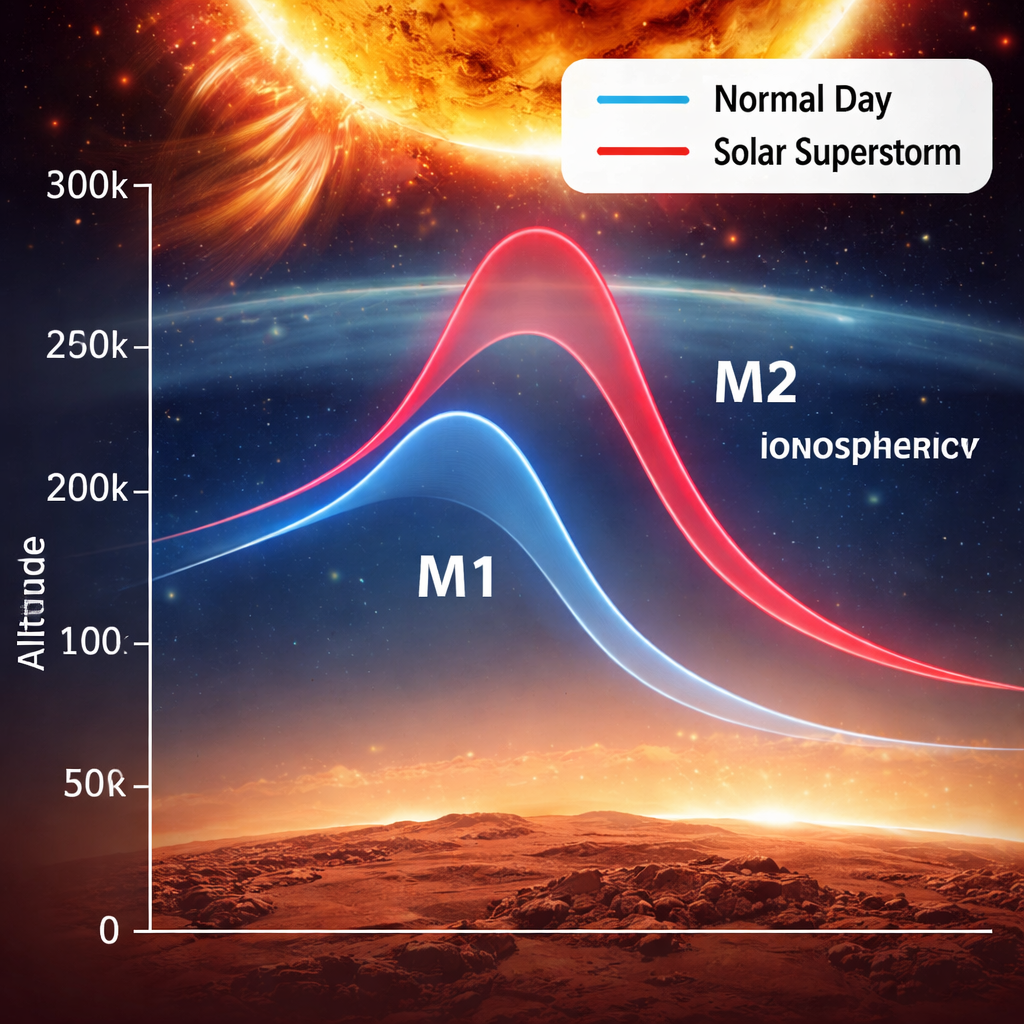
The most striking change appeared in the lower of Mars’ two main ionospheric layers, called M1, located around 90–110 kilometers in altitude. During the storm, this layer’s peak electron density swelled to about 2.8 times its normal value—the largest enhancement ever recorded—while also rising roughly 6.5 kilometers higher. The upper M2 layer, around 150 kilometers, grew only by about 45 percent and shifted upward by a similar amount. Soft X-ray measurements from NASA’s MAVEN orbiter showed that the incoming X-ray energy increased by roughly a factor of three, far less than what older theories predicted would be needed to create such a large M1 response. This mismatch suggests that earlier models underestimated how efficiently high-energy light from the Sun can trigger “secondary” ionizations, where energetic electrons set off cascades of additional collisions and ionizations in the thin Martian air.
Heat, High Altitude Ripples, and What Didn’t Change
Beyond the boosted M1 layer, the storm left other fingerprints. Both M1 and M2 peaks were shifted upward, hinting at heating and expansion of the neutral atmosphere underneath—likely a delayed effect of the coronal mass ejection and associated particle disturbances that had been jostling Mars for more than a day. A smaller but distinct enhancement appeared around 245 kilometers altitude, which the authors suggest could be related to instabilities where the solar wind brushes past Mars’ upper atmosphere, or to streams of ions flowing outward along distorted magnetic field lines. At the same time, some things stayed surprisingly stable: the upper part of the M2 layer was not strongly compressed, the lower neutral atmosphere below about 100 kilometers showed no major structural change, and the overall spacing between the M1 and M2 peaks barely shifted.
Why This Matters for Future Mars Missions
For a general reader, the key message is that Mars’ upper atmosphere is far more sensitive to solar storms than once thought, especially in its lower ionospheric layer. A burst of solar X-rays can rapidly amplify this region, not only by direct ionization but also through chains of secondary collisions, and can heat and puff up the surrounding air. Understanding these effects is crucial for planning future robotic and human missions: radio communication, navigation signals, and even atmospheric drag on spacecraft can all be altered during such storms. This study shows that with regular, high-precision monitoring, we can catch these rare events in the act and refine our models of how the Sun shapes the environments of rocky planets—Mars today, and perhaps other worlds tomorrow.
Citation: Parrott, J., Sánchez-Cano, B., Svedhem, H. et al. Martian ionospheric response during the may 2024 solar superstorm. Nat Commun 17, 2017 (2026). https://doi.org/10.1038/s41467-026-69468-z
Keywords: Mars ionosphere, solar storm, solar flare, space weather, radio occultation