Clear Sky Science · en
Ultralight soft electrostatic actuators based on solid-liquid-gas architectures
Robots That Move More Like Muscles
From warehouse floors to hospital wards, robots are increasingly sharing space with people. But most are built from rigid metal parts that can be clumsy, heavy, and unsafe in close contact with humans. This paper explores a new class of ultralight "soft muscles" for robots—flexible devices that use electric fields and cleverly arranged liquids and gases to move quickly and powerfully, more like biological muscle than like a traditional motor.
Why Soft Muscles Matter
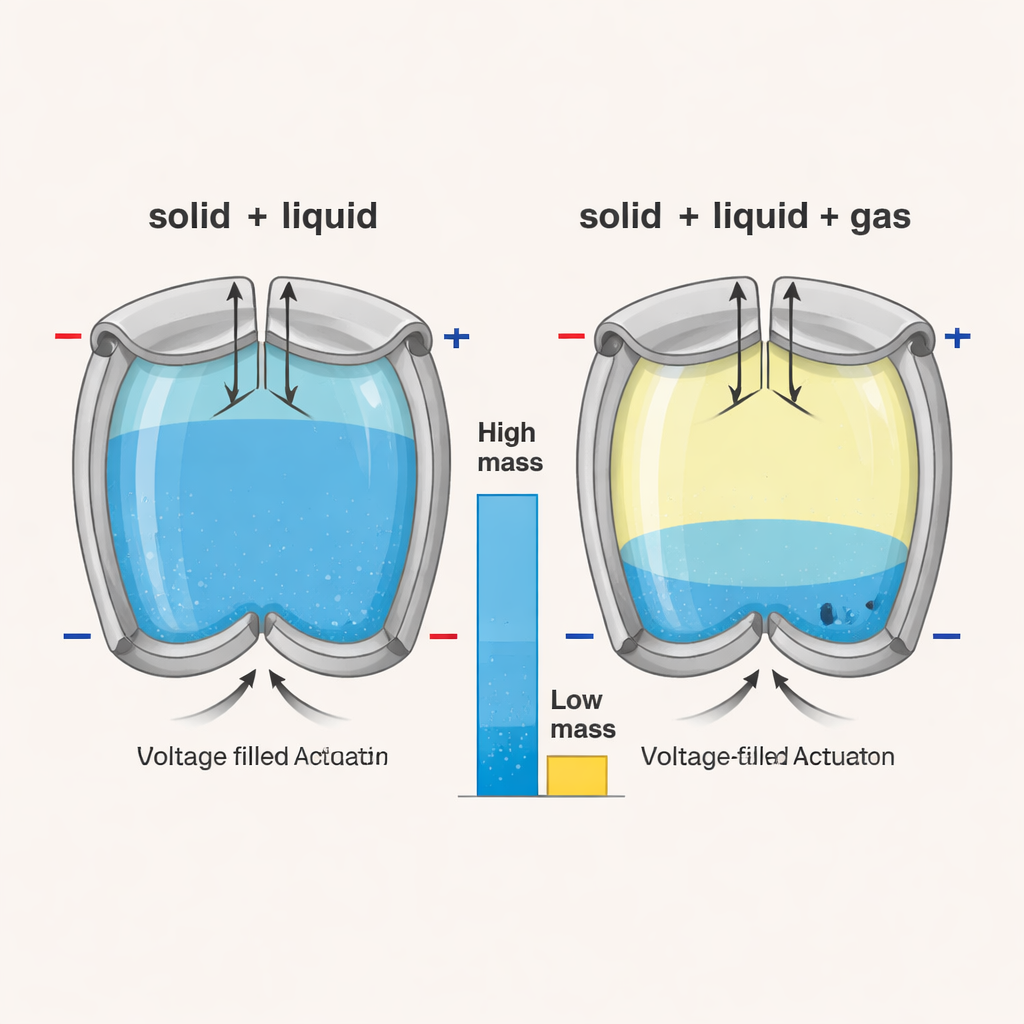
Soft robots are made of deformable materials that bend and stretch, allowing them to squeeze through tight spaces, handle delicate objects, and safely interact with people. To be useful, however, they need actuators—the components that generate motion—that are fast, efficient, and robust. A promising family of such actuators uses strong electric fields to push around a liquid sealed inside a thin plastic pouch. These electrohydraulic devices already rival natural muscle in many ways, but they carry a lot of dead weight: most of their mass is the liquid itself, which slows them down and limits how much power they can deliver per kilogram.
Adding a Third Ingredient: Gas
The authors propose a simple but powerful twist: replace most of the heavy liquid inside the pouch with a gas, creating a solid–liquid–gas architecture. The solid is a thin plastic shell with flexible electrodes, the liquid is a highly insulating oil, and the gas can be ordinary air or a specially chosen insulating gas. When voltage is applied, charged electrodes "zip" together, squeezing the small pool of liquid and pushing on the gas. Because gas is so light, this dramatically cuts the actuator’s mass while preserving the mechanism that turns electricity into force. Using a well-studied design called the Peano-HASEL actuator as their testbed, the researchers show that swapping liquid for gas can reduce actuator mass by more than 80% while maintaining similar stroke under load.
Walking the Line Before Electrical Breakdown
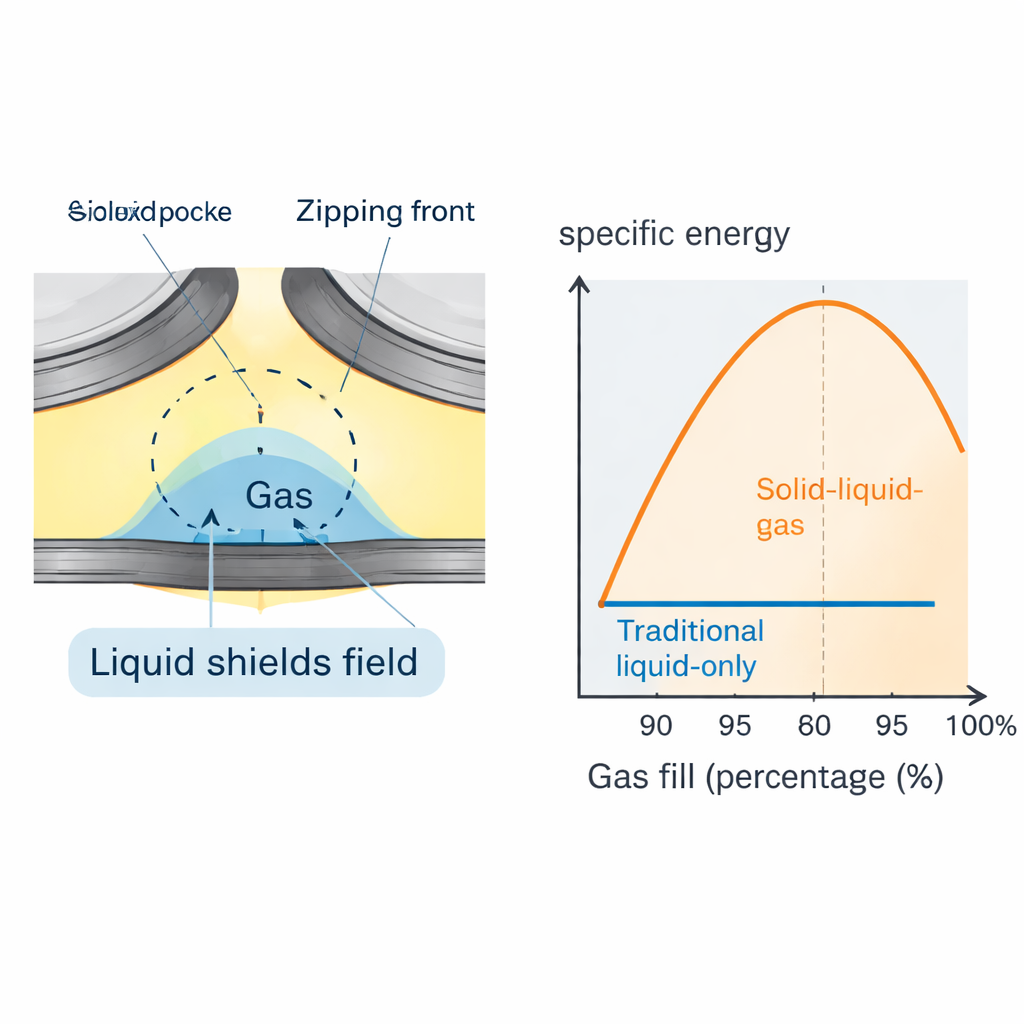
There is a catch: gases are easier to electrically "break down" than liquids, meaning that if the electric field gets too strong, a tiny spark-like discharge can form and ruin the actuation. To understand how far they can push the gas fraction without causing failure, the team combines experiments with a classic rule from high-voltage physics known as Paschen’s law. This law predicts at what combination of gas pressure, distance between surfaces, and applied voltage a gas will break down. By modeling the evolving shape of the pouch as it zips and comparing it to Paschen’s predictions, the authors identify a safe operating region where a thin layer of liquid near the active "zipping front" shields the gas from breakdown. Experiments confirm that with air, actuators work reliably up to about 90% gas fill in most orientations; beyond that, performance collapses abruptly as breakdown begins.
Lighter, Faster, and More Powerful
Within this safe window, the performance gains are striking. Because the actuators are so much lighter, each kilogram of material can now deliver far more work and power. With air as the gas, the specific energy—the work per unit mass—reaches 33.5 joules per kilogram, a fivefold improvement over the conventional liquid-only design, and the specific power climbs to about 1600 watts per kilogram, more than eleven times higher and well above typical muscle. The actuators also move faster: peak strain rates increase by up to 80%, and the frequency range over which they can respond effectively broadens. The team demonstrates these advantages in a stacked "donut"-shaped actuator that powers a jumping robot; the gas-filled version jumps 60% higher and leaves the ground roughly one-third sooner than an otherwise identical liquid-filled robot.
Boosting Performance with Better Gases
Because these actuators are sealed, the gas inside can be engineered. The authors test a mixture of two industrial gases, C4F7N and CO2, which has a much higher resistance to electrical breakdown than air but a far lower climate impact than the commonly used SF6. Filling the pouches with this high-strength gas lets them safely increase the gas fraction even further—up to about 98% in favorable orientations—while still keeping a small protective liquid layer at the zipping front. In this configuration, the specific energy rises to 51.4 joules per kilogram, surpassing the energy density of human skeletal muscle. The same design principles could be applied to many other soft actuators that use confined fluids and electric fields, opening the door to lighter exoskeletons, more agile bioinspired robots, and compact haptic interfaces.
What This Means for Future Robots
For a non-specialist, the takeaway is that the authors have found a way to make robotic "muscles" both lighter and more powerful by replacing most of a heavy liquid with gas, while using physics-based guidelines to avoid electrical failure. These ultralight actuators can deliver muscle-like energy and much higher power per kilogram, enabling soft robots that jump higher, move faster, and remain safe and flexible. As engineers refine gas choice, geometry, and control, this three-phase approach could help bring about a new generation of soft machines that feel less like rigid industrial tools and more like living, responsive bodies.
Citation: Joo, HJ., Fukushima, T., Li, X. et al. Ultralight soft electrostatic actuators based on solid-liquid-gas architectures. Nat Commun 17, 1929 (2026). https://doi.org/10.1038/s41467-026-69463-4
Keywords: soft robotics, artificial muscles, electrostatic actuators, lightweight robots, dielectric gases