Clear Sky Science · en
Inversion of magnon lifetime of ferromagnetic and exchange resonance modes in ferrimagnets
Why tiny magnetic waves could reshape future electronics
Today’s data centers, phones, and sensors burn a lot of energy shuttling electric charges around. Physicists are exploring an alternative: using ripples of magnetism—called spin waves or magnons—to carry information with far less heat. This study reveals a surprising way to make one particular kind of magnon in a special magnetic material both very fast and unusually long-lived, a combination that could help enable speedy, energy‑saving devices operating at frequencies beyond today’s mainstream electronics.
Two kinds of magnetic motion in one material
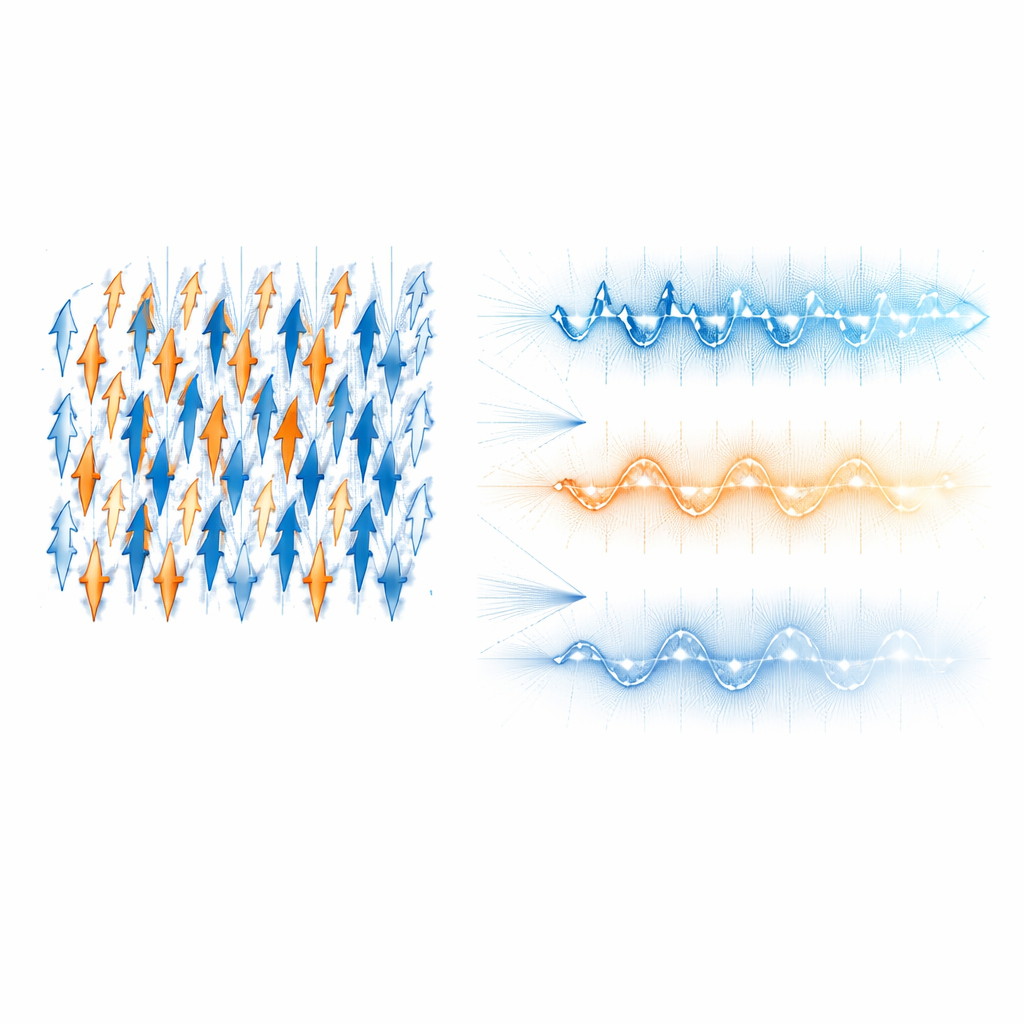
Ferrimagnets are magnetic materials built from two interlocking sub-systems of atoms whose tiny magnetic moments point mostly in opposite directions. Because these two sublattices are unequal, the material behaves partly like a standard magnet and partly like an antiferromagnet. As a result, it supports two distinct collective motions. One, the ferromagnetic resonance mode, is a relatively slow, gentle precession of all the moments together, with frequencies similar to those used in wireless communications. The other, the exchange resonance mode, is a much faster, tightly coupled oscillation where the two sublattices move largely against each other, reaching into the sub‑terahertz range, far above ordinary radio and microwave bands.
Challenging the usual trade‑off between speed and lifetime
In most physical systems, faster oscillations die out more quickly: higher frequency usually means shorter lifetime. The same expectation has held for magnons, where strong internal forces that push the frequency up also tend to make the motion more fragile. The authors examine this assumption in thin films of a cobalt–gadolinium alloy, CoGd, a well‑studied ferrimagnet. By carefully adjusting either the temperature or the chemical composition, they can tune the balance of angular momentum between the cobalt and gadolinium sublattices. At a special condition called the angular momentum compensation point, the contributions from the two sublattices cancel in a precise way, strongly affecting how the magnetic system responds to nudges.
Watching ultrafast magnetic ripples in real time
To probe these ripples, the team uses time‑resolved magneto‑optical Kerr effect spectroscopy, a technique that tracks tiny rotations in the polarization of reflected laser light as the magnetization inside the film wobbles. An ultrashort “pump” pulse briefly heats and disturbs the magnet, launching both the slow and fast modes; a delayed “probe” pulse reads out the resulting motion with picosecond time resolution. By repeating this measurement while varying the delay, the researchers reconstruct the oscillations in time and, from their decay, extract both the frequency and the lifetime of each mode over a wide temperature range and for different alloy mixtures.
A fast mode that outlives the slow one
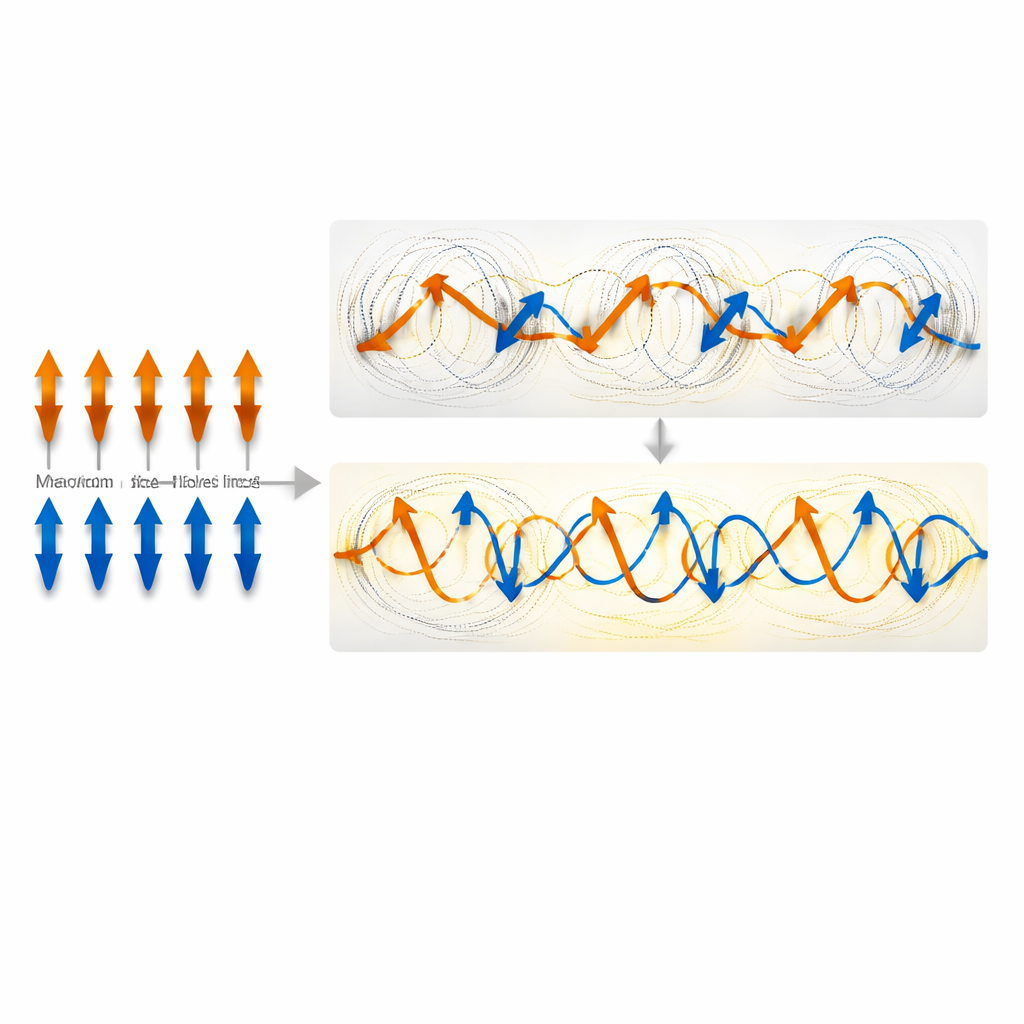
The measurements confirm the expected large gap between the slow, gigahertz ferromagnetic mode and the much faster, roughly 110‑gigahertz exchange mode. Far from the compensation point, the usual rule holds: the high‑frequency exchange mode decays more quickly than the low‑frequency ferromagnetic mode. But near angular momentum compensation, the trend flips. The exchange mode suddenly acquires a longer lifetime than the ferromagnetic mode, even though it still oscillates almost an order of magnitude faster. When the authors compute an effective damping—a measure of how quickly energy is lost—they find it is minimized for the exchange mode near this special condition, which also coincides with a peak in the estimated speed of domain walls, the boundaries between magnetic regions.
How uneven friction between sublattices flips the lifetimes
To understand this counterintuitive behavior, the researchers develop a theoretical description that treats the two sublattices and their coupled motion explicitly. In this picture, each sublattice experiences its own magnetic “friction,” or damping, and the two are not equal. The theory shows that when this imbalance is strong, an additional torque term appears that acts differently on the two modes. For the slow ferromagnetic mode, this extra torque reinforces ordinary damping, causing the motion to die out faster. For the fast exchange mode, the same term partly cancels the damping, effectively acting like an anti‑friction that lets the oscillation persist. Numerical simulations based on this model reproduce the observed crossing of lifetimes between the two modes near angular momentum compensation.
Opening a path to faster, cooler magnetic technologies
The key message of this work is that by engineering the microscopic damping of different parts of a ferrimagnet, it is possible to create magnetic waves that are both very fast and unusually long‑lived. In CoGd, this sweet spot occurs near the angular momentum compensation point, where the high‑frequency exchange mode becomes the most robust carrier of magnetic energy and information. Such a combination of speed and stability makes these modes promising building blocks for next‑generation spintronic devices, including compact oscillators and signal‑processing circuits operating deep into the sub‑terahertz regime, with far lower energy loss than conventional charge‑based electronics.
Citation: Xu, C., Kim, SJ., Zhao, S. et al. Inversion of magnon lifetime of ferromagnetic and exchange resonance modes in ferrimagnets. Nat Commun 17, 2630 (2026). https://doi.org/10.1038/s41467-026-69453-6
Keywords: ferrimagnetism, spintronics, magnons, ultrafast magnetism, terahertz devices