Clear Sky Science · en
Phase-controlled molecular beam deposition unlocks flexible MgAgSb thermoelectrics with exceptional performance
Power from Warmth on the Go
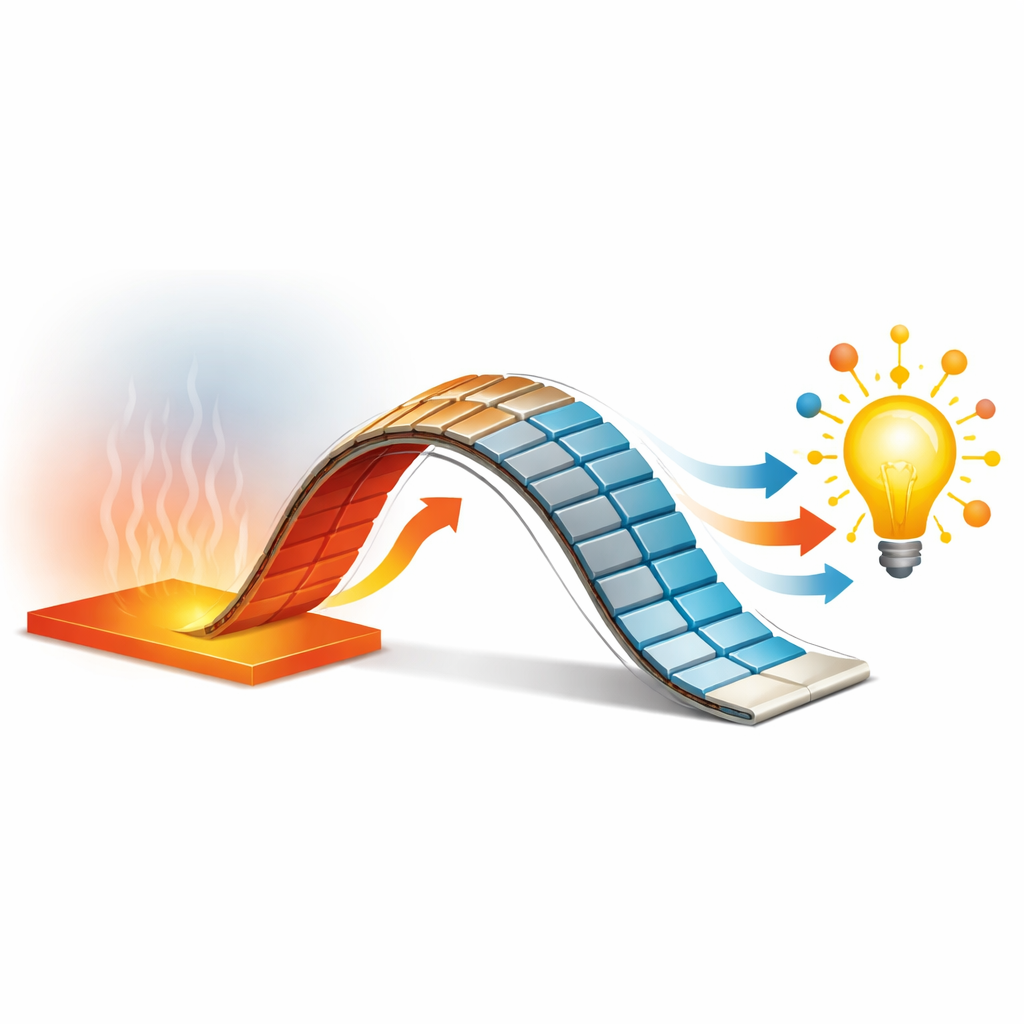
Imagine a bandage-like strip on a machine, an aircraft skin, or even a fingertip that quietly turns wasted warmth into electricity, no batteries required. This study describes a new ultra-thin, bendable material based on the compound magnesium–silver–antimony (MgAgSb) that can do just that. By carefully controlling how this compound is grown, the researchers created flexible films and devices that rival today’s best rigid thermoelectric materials, opening paths toward self-powered wearables and sensors in places too hot or cramped for conventional batteries.
Why Turning Heat into Power Is Hard
Thermoelectric materials generate electricity when one side is hotter than the other, offering an appealing way to reclaim wasted heat. For flexible electronics, these materials must do more than work well—they must bend and twist without breaking. Many soft, carbon-based films can flex easily but conduct electricity poorly, while the top-performing inorganic compounds are efficient yet brittle, toxic, or dependent on scarce elements. A long-standing favorite, bismuth telluride, works well near room temperature but degrades at higher heat and relies on tellurium, a rare and problematic element. The challenge has been to find a bendable material that is efficient, stable at elevated temperatures, and made from more sustainable ingredients.
A Promising but Stubborn Compound
MgAgSb has been known in bulk, rigid form as a strong contender for converting low-grade heat into electricity. It combines an electronic structure that favors high electrical performance with a complex crystal framework that naturally hinders heat flow—exactly what good thermoelectrics need. However, MgAgSb exists in several structural “phases” that appear at different temperatures. Only one of them, called the alpha phase, performs well; the others behave poorly and can persist once formed. The material is also brittle and extremely sensitive to tiny shifts in composition, which has made it very difficult to turn into thin, flexible films without accidentally creating the wrong phases or unwanted impurities.
Gentle Atomic Rain Builds Better Films
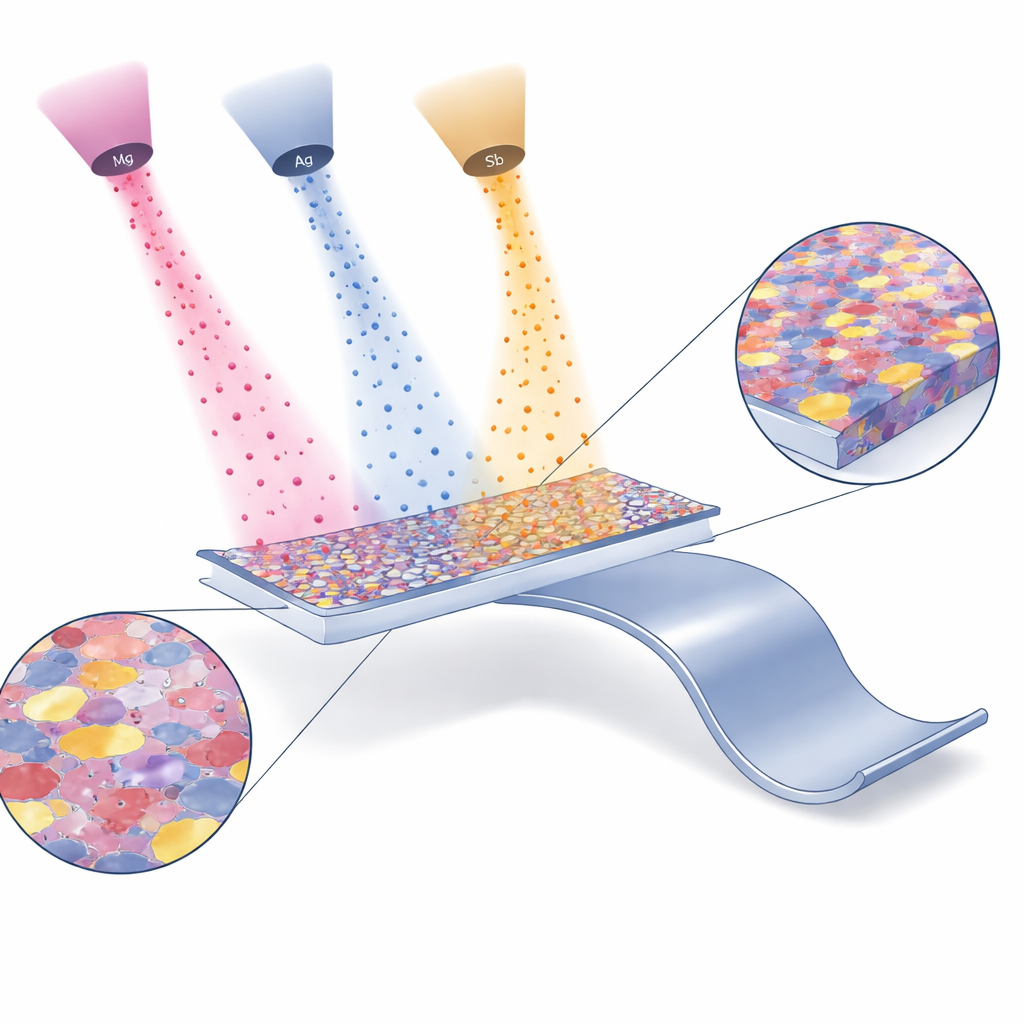
To overcome these hurdles, the team turned to molecular beam deposition, a technique that lets them “rain down” neutral atoms of magnesium, silver, and antimony onto a heated surface in a highly controlled way. Under ultra-high vacuum and carefully chosen temperature conditions, these slow, gentle atomic beams land on a flexible polyimide substrate and react almost as if they were at equilibrium. By holding the substrate at a temperature where the desired alpha phase is stable, the researchers coaxed the atoms into assembling into phase-pure alpha-MgAgSb across the film. Microscopy shows that the resulting layers are made of tightly packed nanometer-scale grains with a uniform mix of elements, an arrangement that lowers heat conduction while keeping electrical transport strong.
Finding the Sweet Spot in Composition
Because even slight imbalances among magnesium, silver, and antimony can spoil performance, the authors deliberately made films with about five percent deficiency in each element in turn. Although these off-stoichiometric films still mostly formed the alpha phase, their electrical behavior worsened: the electrical resistivity shifted, the voltage produced per degree of temperature difference changed, and the overall power output fell below that of the perfectly balanced film. Antimony deficiency was especially harmful, introducing defects and metallic pockets that disrupted current flow and increased heat conduction. These tests confirm that tight control over phase and composition is essential for getting the most out of MgAgSb in thin-film form.
Thin, Tough, and Ready to Work
The optimized film, only about 180 nanometers thick, delivers a figure of merit—a standard efficiency score for thermoelectrics—of about 0.8 at room temperature and an unusually high power factor that increases with temperature up to around 250 °C. Despite its inorganic nature, the film bends repeatedly without serious cracking, thanks to its thinness and the compliant plastic backing. After 1000 bending cycles at a modest curvature, it retains about 96 percent of its original performance, and its properties remain stable after repeated heating. Building on this, the researchers assembled a small flexible generator with nine MgAgSb strips connected in series. When one side is warmed, the device produces voltage and power densities that rank among the best reported for flexible in-plane thermoelectric generators, and it continues to work when wrapped around curved surfaces or pressed against a finger.
What This Means for Everyday Devices
This work shows that by carefully controlling how atoms land and lock together, a brittle, complex compound can be turned into a robust, high-performing, and bendable power source. The phase-pure alpha-MgAgSb films combine respectable efficiency, durability under bending, and stability at temperatures beyond typical wearables, suggesting they could power sensors in industrial, automotive, or aerospace settings as well as on the human body. With further tuning—such as growing larger grains, judiciously adding dopants, and scaling up production—these films could help make future flexible electronics truly self-powered, drawing quiet, continuous electricity from the heat that surrounds them.
Citation: Hu, Z., Li, A., Sato, N. et al. Phase-controlled molecular beam deposition unlocks flexible MgAgSb thermoelectrics with exceptional performance. Nat Commun 17, 2674 (2026). https://doi.org/10.1038/s41467-026-69451-8
Keywords: flexible thermoelectrics, waste heat harvesting, thin-film energy materials, wearable power generators, molecular beam deposition