Clear Sky Science · en
A self-powered hydrogel electronic skin with decoupled multimodal sensing for closed-loop human-machine interactions
Smart second skin for everyday life
Imagine a soft, stretchy wristband that feels like a layer of skin yet quietly tracks your temperature, pulse, and sweat while also letting you control a robot and feel what it touches. This paper reports just such a “electronic skin” made from a water-rich gel. It powers itself from your body’s own heat and motion, listens to several body signals at once, and uses artificial intelligence to keep those signals from getting mixed up, opening doors to more natural links between people and machines.
Turning soft gel into a sensing skin
At the heart of the system is a single piece of poly(vinyl alcohol) hydrogel, a jelly-like material that is more than 80% water and has a softness close to real skin. The researchers used a careful three-step solvent-swapping process to give this gel an unusual mix of strength and flexibility. First, they formed a basic gel by freezing and thawing a polymer solution. Then they replaced the original liquid with glycerol to pack the polymer chains more tightly and toughen the material. Finally, they substituted a salty water solution containing iron ions, which loosened the network just enough to bring the stiffness down into the range of human tissue while keeping the gel tough and stretchable. Microscopy, thermal tests, and X‑ray measurements confirmed that the gel preserved many tiny crystal-like regions for strength while its overall structure stayed soft and elastic.
One material, three kinds of touch
To behave like skin, the hydrogel must sense different types of stimuli without bulky stacks of separate sensors. The team designed the material and its shape so that three distinct ion-based effects happen in the same piece of gel without interfering with each other. A temperature difference between the body and the air drives a tiny but steady current through reversible reactions of iron ions, turning heat into electricity. When the gel is pressed or stretched, positive and negative ions move at different speeds, briefly upsetting the charge balance and creating a pressure-driven current. Meanwhile, salt from sweat migrates into the gel through specially treated, water-attracting channels, and differences in salt concentration give rise to another measurable current. Because these processes respond on different time scales and directions, the signals for heat, pressure, and salt can coexist and still be teased apart.
Shaping the gel for stronger signals
The researchers discovered that sculpting the hydrogel into a forest of tiny prisms dramatically boosts its sensitivity, especially to pressure. In this design, the narrow tips concentrate mechanical stress where the gel touches the skin, polarizing ions along the direction of the applied force and amplifying the current by more than a hundredfold compared with a simple block. The same structure still conducts heat and lets ions diffuse, so all three sensing modes operate together. Tests showed that the e-skin can stretch to more than eight times its original length, detect very gentle pressures, and resolve pulse waveforms from the wrist with enough detail to pick out the different peaks used in blood-pressure analysis. 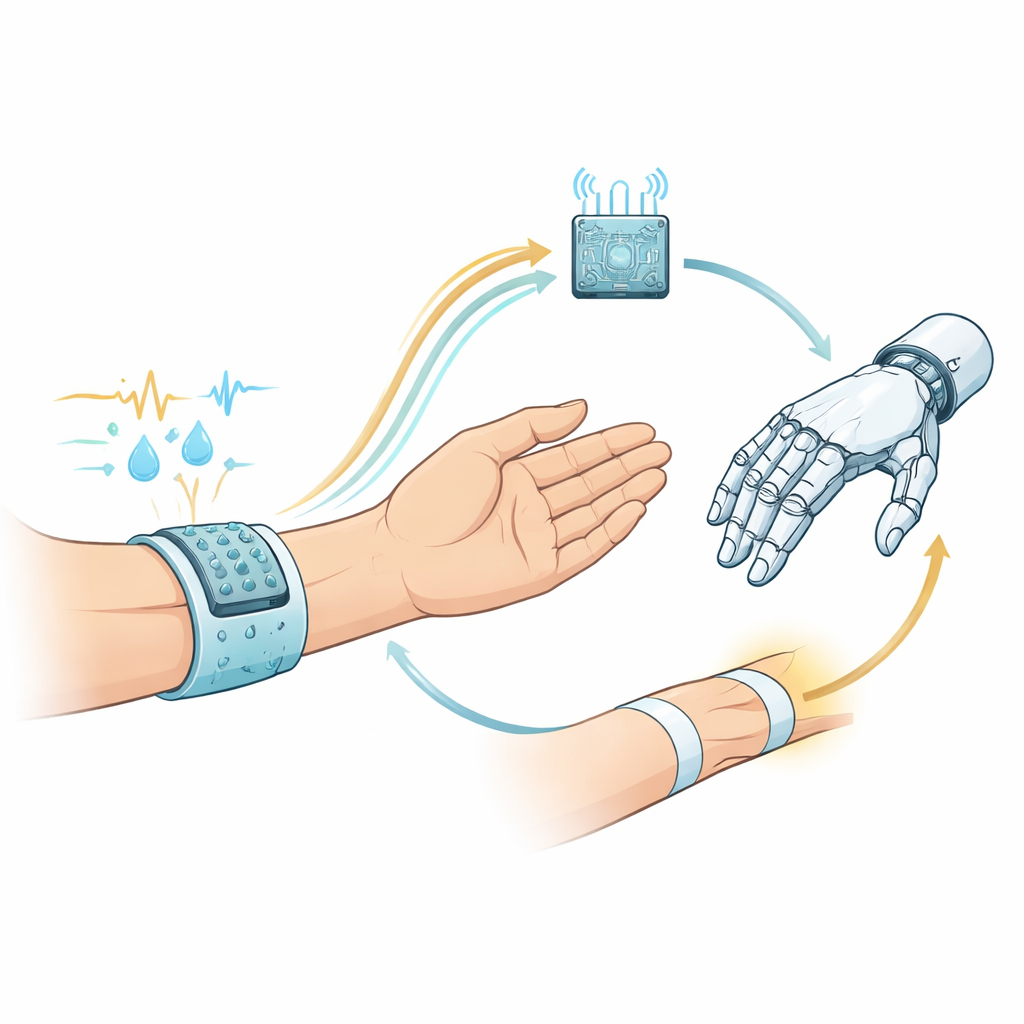
From signals to smart wristband
Building on this material, the authors created an active multimodal signal generator wristband by combining the hydrogel sensor array with flexible circuits, a signal reproduction unit, and wireless communication. The tricky part is that the three sensing modes produce overlapping electrical currents. To separate them in real time, the team trained a machine-learning model based on long short-term memory networks with an attention mechanism. This algorithm learns how the current evolves over time and assigns portions of it to temperature, pressure, or sweat. In tests that mimicked everyday states—resting, walking, running, sleeping, and fever—the decoded readings closely matched commercial thermometers, heart-rate monitors, and sweat analyzers. The same wristband could also pick up subtle pressure changes from forearm muscles during hand gestures and, with a deep-learning classifier, translate them into commands to control a robotic arm with high accuracy. 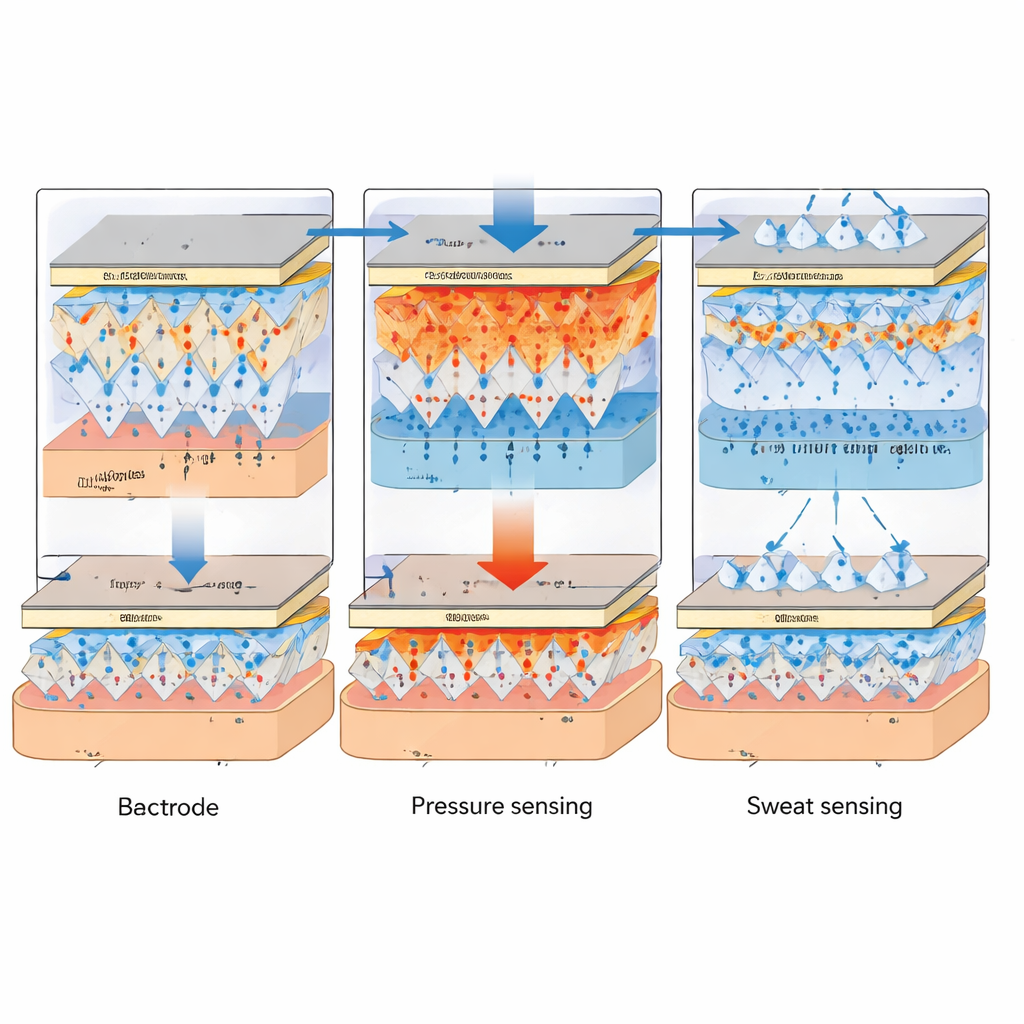
Feeling through a robot’s touch
The system goes beyond one-way control by closing the sensory loop. When another copy of the hydrogel e-skin is placed on a robotic hand, it senses the temperature and grip force as the robot handles objects. Those signals are sent back to the user’s wristband, which drives a tiny heater and vibration motor. As a result, the user can feel warmth, cold, and pressure that mirror the robot’s experience, even at a distance. Safety features built into the software can flag dangerously hot or cold surfaces and prevent the robot from crushing delicate items. To a layperson, the key message is that a single, skin-like material can now harvest body energy, read several vital signs at once, and support two-way, touch-based communication with machines, pointing toward future prosthetic limbs, soft robots, and virtual worlds that feel far more natural and lifelike.
Citation: Bai, C., Dong, X., Liu, Q. et al. A self-powered hydrogel electronic skin with decoupled multimodal sensing for closed-loop human-machine interactions. Nat Commun 17, 2675 (2026). https://doi.org/10.1038/s41467-026-69450-9
Keywords: electronic skin, hydrogel sensor, wearable health monitoring, human–machine interface, haptic feedback