Clear Sky Science · en
Functional distinctions between orbitofrontal cortex and anterior cingulate cortex subregions in decision-making and autonomic regulation
Why this research matters
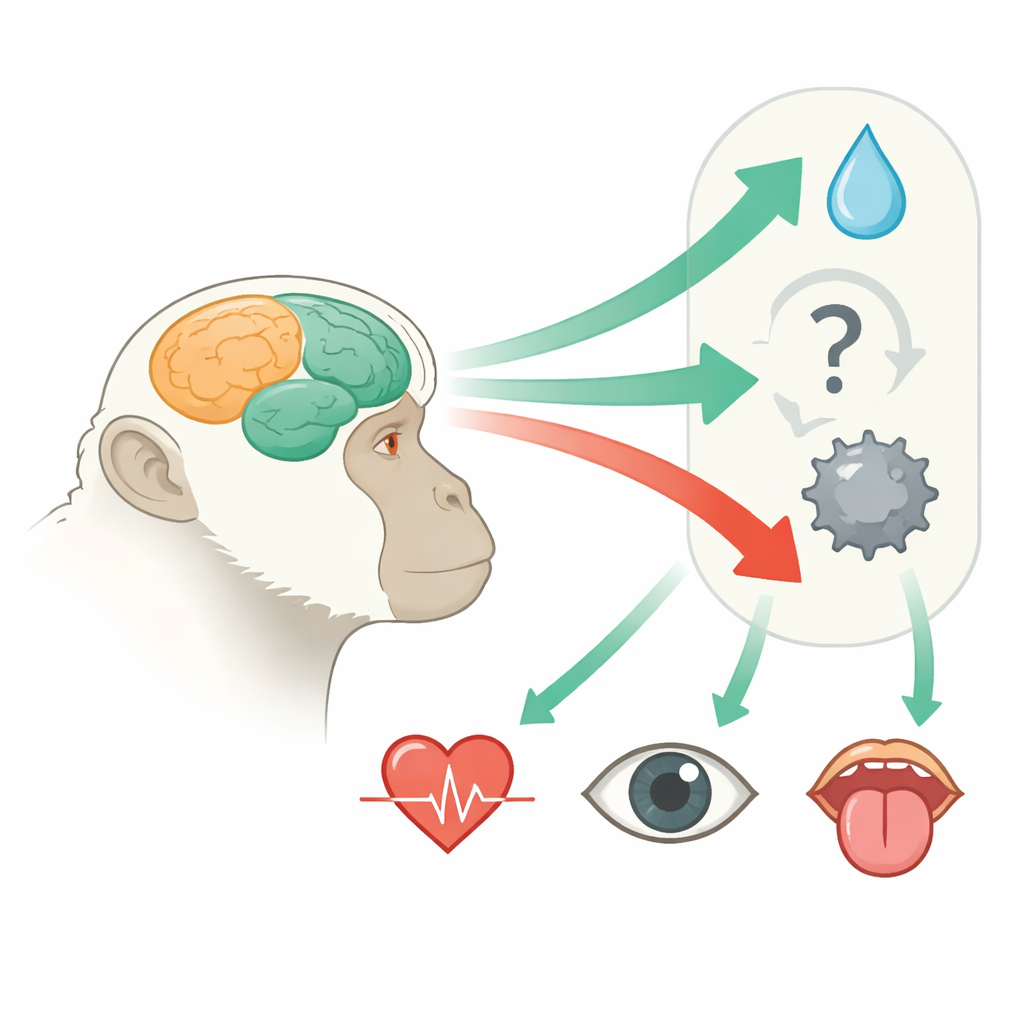
Every day, we weigh good and bad outcomes: take a risky job, eat the dessert, confront a fear. For people with mood disorders such as depression, this balance often tips toward seeing the world through a negative lens. This study in macaque monkeys asks a simple but crucial question: how do specific brain areas help tilt our decisions toward hope or toward pessimism, and how are those choices tied to changes in the body, like heart rhythms and pupil size?
Two brain hubs for weighing good and bad
The researchers focused on two neighboring regions deep in the frontal part of the brain. One, the orbitofrontal cortex (OFC), sits just above the eyes and is known for tracking rewards and punishments. The other, the pregenual anterior cingulate cortex (pACC), has been linked to mood and emotional evaluation. In mood disorders, scans often show both regions behaving abnormally, but it has been unclear how their moment‑to‑moment activity differs when an animal must choose between a tempting reward and an unpleasant cost.
A game of “take it or leave it”
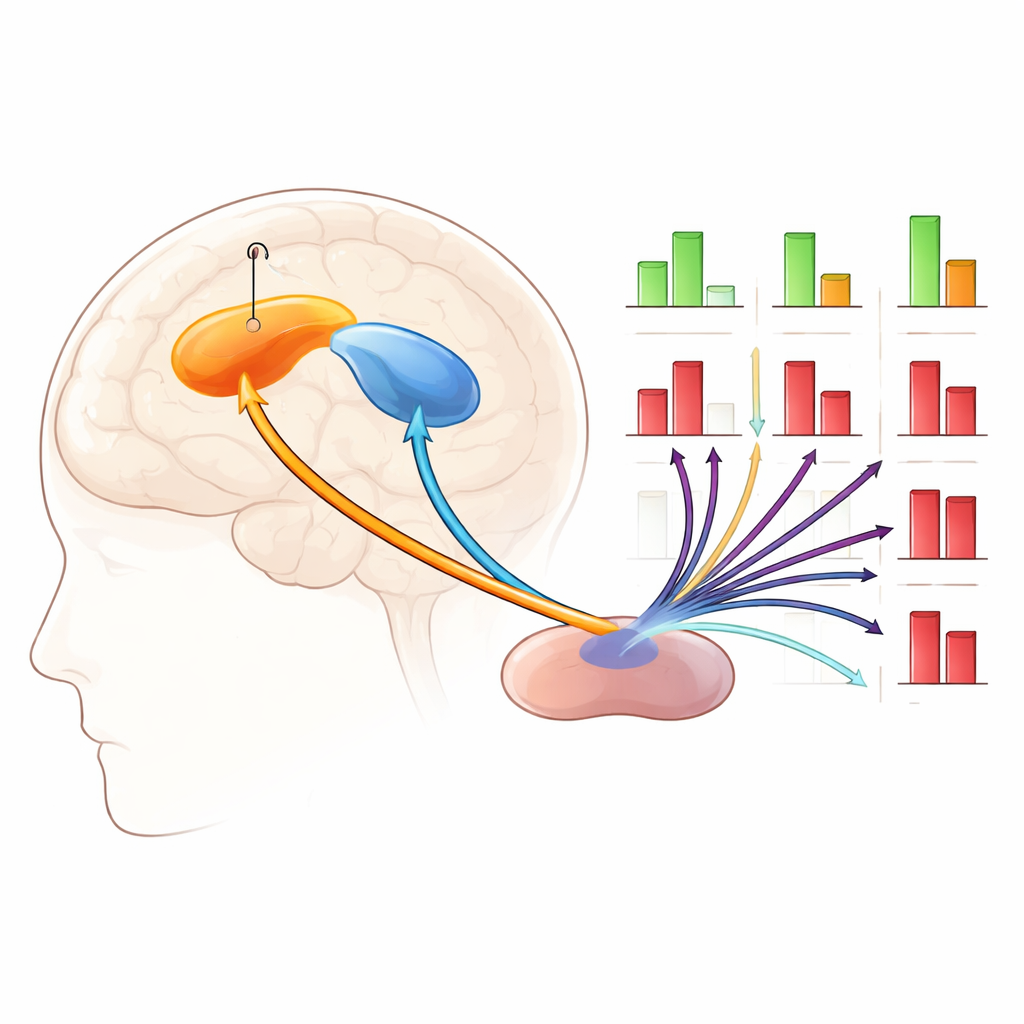
To probe these circuits, two macaques played a decision game thousands of times. On each trial, a pair of colored bars signaled how much juice they could earn and how strong an air puff to the face they might receive. A saccade to one target meant “accept the offer” (approach); a saccade to another meant “reject it” (avoid). In other blocks, both bars signaled only rewards, turning the task into a “which reward is better?” choice. The animals also experienced simpler Pavlovian trials in which a single bar predicted a fixed reward or air puff, with no decision required. Throughout, the team recorded the firing of individual neurons in both OFC and pACC, while tracking reaction times, pupil diameter, heart rate variability, and licking.
Different roles for OFC and pACC
The caudal part of the OFC (cOFC) turned out to be broadly engaged. Its neurons responded strongly when offers appeared and when rewards were delivered, with a mix of excitation and inhibition that reflected both positive and negative aspects of the offer. Activity in this region rose earlier in time than in the pACC, suggesting that cOFC may be among the first cortical nodes to register the combined value of an offer. By contrast, pACC neurons were more often suppressed during the cue period and were especially active around aversive air‑puff events. Across many task events, cOFC looked more tuned to overall outcome value, whereas pACC seemed more engaged in processing negative consequences and regulating behavior when outcomes were aversive or less goal‑directed.
Biasing choices with tiny pulses of current
The team then asked whether cOFC activity plays a causal role in shaping pessimistic choices. In separate sessions, they applied very small electrical microstimulation to cOFC while the monkeys evaluated offers. At a subset of sites, whether the current was low or high, stimulation reliably pushed behavior toward avoidance: the same combinations of juice and air puff were now more likely to be rejected. Computational models that mimicked learning in the task showed that this effect could be captured by increasing the weight assigned to aversive outcomes relative to rewards. In other words, stimulating cOFC made “bad” aspects of offers loom larger in the animals’ internal cost–benefit calculations.
Body signals track the mind’s leanings
Importantly, shifts in choice were mirrored in the body. Reaction times changed systematically with how attractive or aversive an offer was. Heart rate variability, pupil size, and licking all varied with approach versus avoidance decisions and with reward and air‑puff size. For example, heart rhythms and pupil changes tracked how strongly the animals were engaged, and licking reflected anticipatory behavior around expected rewards or unpleasant air puffs. These patterns suggest that the brain regions under study are embedded in a broader brain–body loop in which emotional decisions, autonomic arousal, and somatic actions rise and fall together.
What this means for mood and mental health
Overall, the work paints a picture in which the caudal OFC rapidly integrates good and bad aspects of a situation, passes this information to the pACC and related circuits, and together they help determine whether an animal approaches or avoids a mixed outcome. Artificially boosting activity in cOFC nudges this system toward pessimism, favoring avoidance even when rewards are available, while body signals such as heart rate and pupil size shift in tandem. Because similar brain regions are implicated in human depression and anxiety, these findings suggest that imbalances in this network—and in the linked bodily responses—may contribute to persistent negative bias in mood disorders, and they point to circuit‑specific targets for future therapies.
Citation: Papageorgiou, G.K., Amemori, Ki., Gibson, D.J. et al. Functional distinctions between orbitofrontal cortex and anterior cingulate cortex subregions in decision-making and autonomic regulation. Nat Commun 17, 2774 (2026). https://doi.org/10.1038/s41467-026-69447-4
Keywords: decision-making, orbitofrontal cortex, anterior cingulate, mood disorders, brain-body interactions