Clear Sky Science · en
Millimeter-wave dielectric tunability driven by topological polar structure switching in PbTiO3/SrTiO3 superlattices
Shaping Future Wireless Signals
Our phones, cars, and sensors are steadily moving to higher and higher radio frequencies to carry more data and see objects in finer detail. But at millimeter-wave frequencies—the bands targeted for advanced 5G, 6G, and high-resolution radar—today’s materials struggle to flexibly adjust, or “tune,” how they respond to these fast electric fields. This study explores an unusual class of engineered crystals whose internal electric patterns can be reconfigured by modest voltages, potentially offering compact, fast, and energy-efficient building blocks for next-generation communication and sensing hardware. 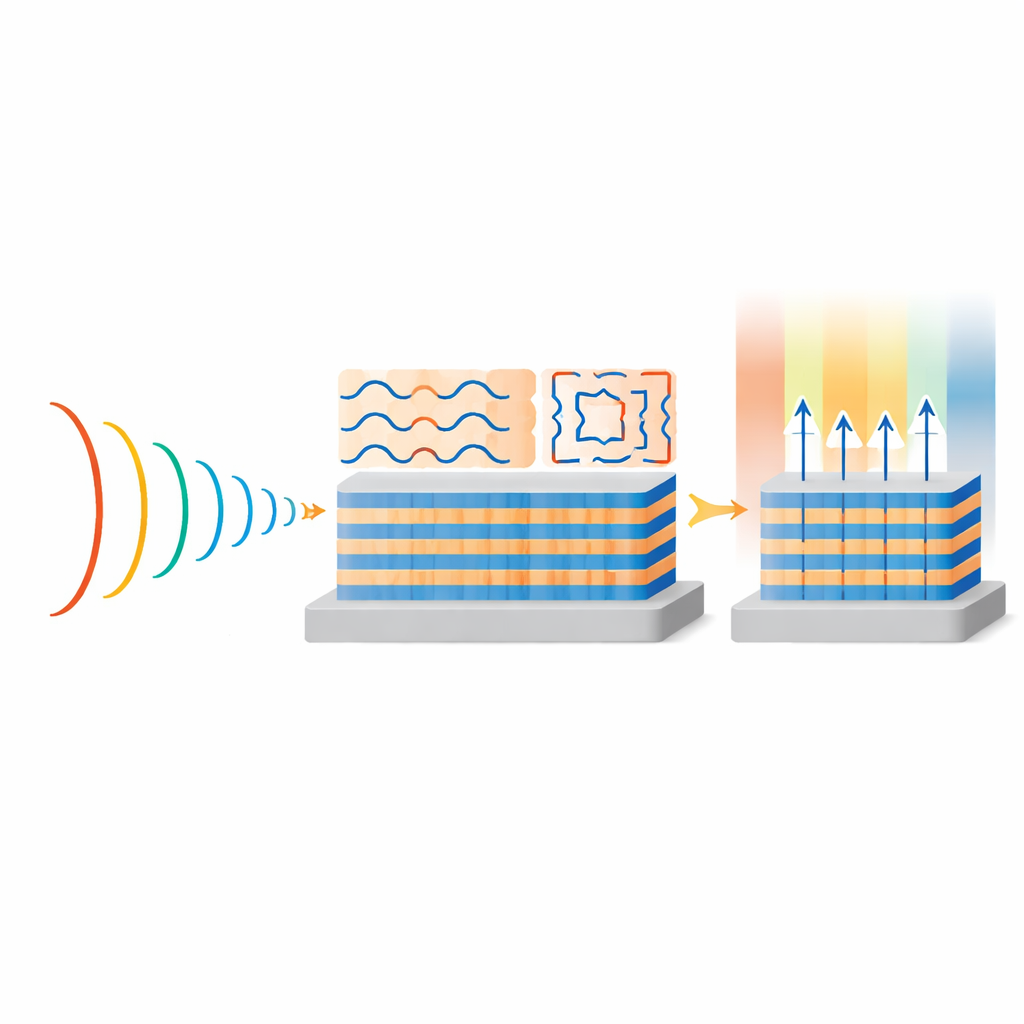
Stacking Materials Into Tiny Electric Landscapes
The researchers work with superlattices: artificial crystals made by stacking extremely thin layers of two oxides, lead titanate and strontium titanate, in a repeating pattern only a few billionths of a meter thick. Within these stacks, the electric dipoles—tiny arrows representing positive and negative charge separation—do not simply point up or down. Instead, they can arrange into intricate topological patterns, such as smooth, wave-like modulations (dipole waves) or closed loops bounded by sharp domain walls (flux closures). By carefully choosing how many lead titanate layers to include in each repeat, the team can stabilize either of these patterns, creating a kind of electric “micro-landscape” that can, in principle, be reshaped by an external field.
Watching Dipoles Switch and Structures Morph
To understand how these internal patterns respond when a voltage is applied in the plane of the film, the team combines several powerful probes. Electrical measurements show that all the superlattices possess a net in-plane polarization that can be switched, much like flipping a ferroelectric memory bit, and that the switching field grows as the internal pattern’s spacing increases. High-resolution electron microscopy reveals how the dipoles are arranged in real space, while advanced X-ray diffraction and second-harmonic optical imaging track how the structures evolve during switching. In dipole-wave samples, the applied field can nearly wipe out the wavy topology, driving the structure toward a more uniform in-plane state. In flux-closure samples, by contrast, the closed-loop patterns largely survive, indicating they are more topologically “protected” and harder to reorganize.
Measuring High-Frequency Tuning Power
The central question is how these structural changes translate into tunability at millimeter-wave frequencies, between 2 and 110 gigahertz. Using specially patterned coplanar waveguides on top of the films, the researchers send high-frequency signals along the surface while applying a direct-current bias. From how the signal slows and weakens, they extract the effective dielectric constant and how strongly it can be changed by the electric field. Superlattices with flux-closure patterns show only modest tunability—around 2 percent under fields of 30 kilovolts per centimeter—because their internal dipoles move mainly in narrow regions near domain walls. Dipole-wave superlattices, however, stand out: one composition reaches about 20 percent tunability at 20 gigahertz and still exceeds 15 percent at 70 gigahertz and 8 percent at 110 gigahertz under the same moderate field, an impressive level for such high frequencies. 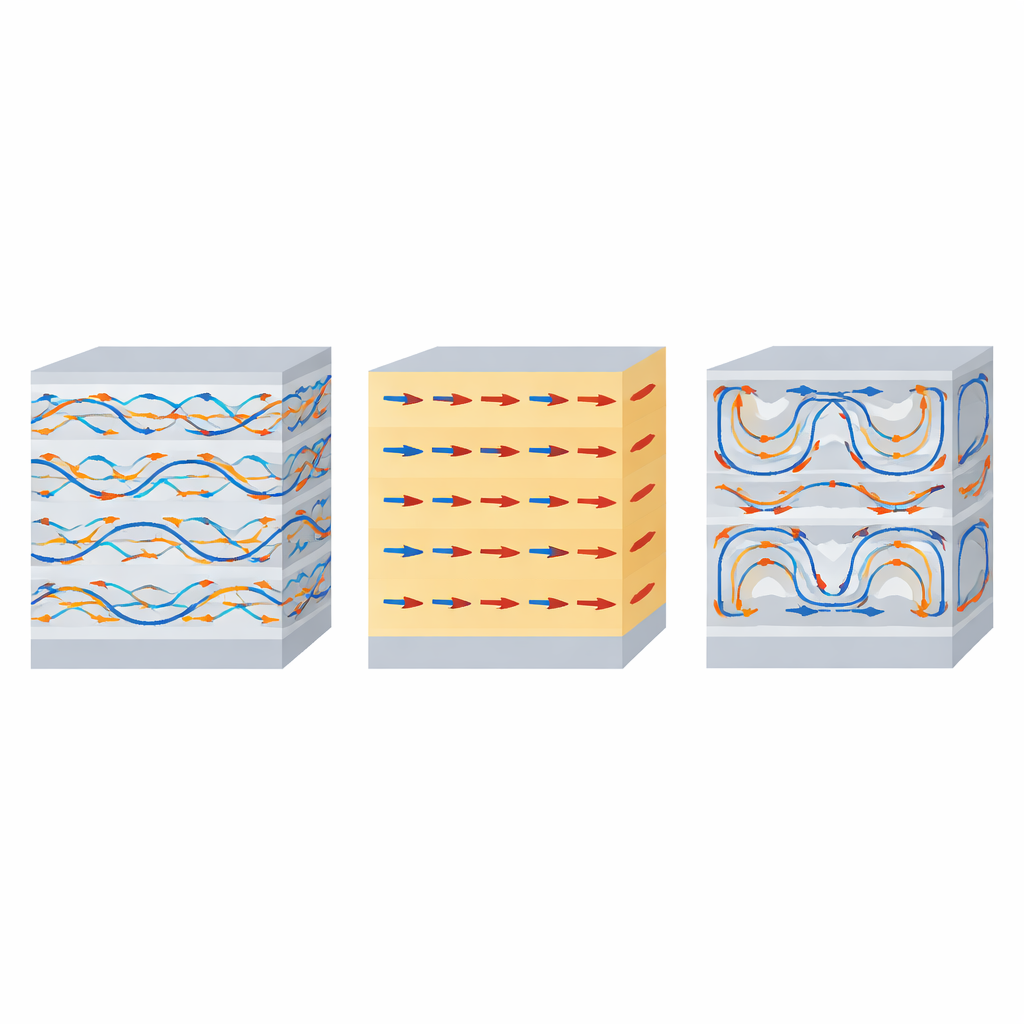
Linking Microscopic Motion to Macroscopic Response
To connect this behavior to microscopic motion, the authors run molecular dynamics simulations with machine-learning-based force fields tailored to these oxides. The simulations show that in dipole-wave structures, large regions with mixed in-plane and out-of-plane polarization are poised to rotate collectively when a fast field is applied, producing substantial net polarization changes and hence a large dielectric response. In flux-closure structures, significant motion is confined near domain walls, while the interior of each loop responds only weakly, leading to a smaller overall effect. The calculations further suggest that dipole waves host collective oscillation modes and resonant switching between different in-plane orientations, both of which enhance tunability around tens of gigahertz.
Pathway to Smarter High-Frequency Devices
For a non-specialist, the take-home message is that by engineering the internal “pattern of arrows” in these ultra-thin oxide stacks, scientists can create materials whose ability to store and release electric energy remains highly adjustable even at very high radio frequencies. Among the patterns studied, smooth dipole waves are especially promising, offering strong, field-controlled tuning that could be boosted further at higher voltages. Such behavior is attractive for compact phase shifters, agile filters, and reconfigurable antennas integrated on chips for future millimeter-wave communication and sensing systems. In short, clever nanoscale design of electric order may help unlock more flexible and powerful high-frequency electronics.
Citation: Wang, S., Yang, J., Gao, H. et al. Millimeter-wave dielectric tunability driven by topological polar structure switching in PbTiO3/SrTiO3 superlattices. Nat Commun 17, 2725 (2026). https://doi.org/10.1038/s41467-026-69440-x
Keywords: millimeter-wave dielectrics, ferroelectric superlattices, topological polar structures, dielectric tunability, wireless communication materials