Clear Sky Science · en
Unlocking carrier confluence in covalent organic frameworks for efficient photoreduction of dilute nitrate to ammonia
Turning Water Pollution into a Valuable Resource
Nitrate pollution in rivers, lakes, and groundwater is a growing threat to drinking water and ecosystems, yet nitrate is also a rich source of nitrogen, the same element farmers buy as fertilizer. This study explores a way to use sunlight and a smartly designed solid material to turn tiny amounts of nitrate dissolved in water directly into ammonia, a useful chemical for fertilizers and fuels. By doing so efficiently even when nitrate levels are low, the work points toward future systems that could clean contaminated water while recovering valuable nutrients instead of wasting them.
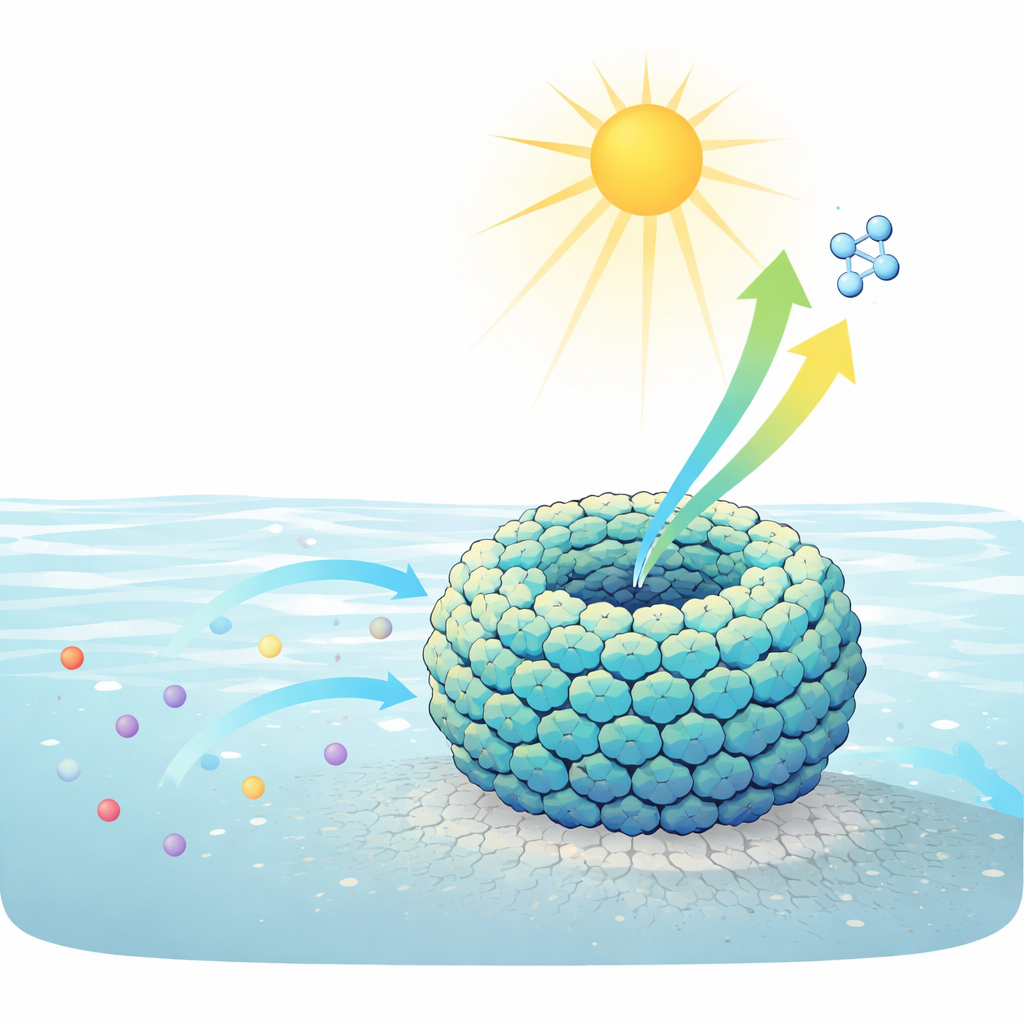
Why Dilute Nitrate Is Hard to Clean Up
Nitrate is common in industrial wastewater, farm runoff, and contaminated groundwater, but it often appears at relatively low concentrations. At these trace levels, only a few nitrate ions are near the surface of a catalyst at any given moment, making it hard for reactions to proceed quickly. On top of that, turning nitrate into ammonia is a complicated job that needs many electrons and protons to arrive in the right order. Many existing photocatalysts work only when nitrate is artificially concentrated, which is costly and impractical for real-world water treatment. The authors argue that to solve this, a catalyst must both move electrical charges efficiently inside itself and grab and activate sparse nitrate and water molecules at its surface.
Building a Layered Material with Built-In Direction
The team focused on a class of porous, crystalline solids known as covalent organic frameworks. They built two related versions: a baseline material called PI and an improved one called PIS, which includes strongly polar sulfonyl groups. These building blocks are arranged into sheets that stack like flat hexagonal tiles to form coral-like spheres full of tiny channels. In PIS, the distribution of polar groups is intentionally uneven, giving each sheet a strong internal pull on charges and, when layers stack, creating channels that favor one-way movement of electrons and holes. Advanced calculations and microscopy show that PIS has a larger dipole moment, stronger internal electric fields, and unusual “longitudinal polarization,” meaning charges prefer to flow along well-defined paths rather than wander randomly and recombine.
Guiding Charges and Molecules Along Low-Resistance Paths
Because of this engineered polarity, PIS moves charge carriers much more effectively than PI. Ultrafast spectroscopy reveals that electrons and holes in PIS live longer and travel farther before meeting and canceling each other. The material also has lower effective masses for both electrons and holes, smaller charge-transfer resistance, and stronger photocurrents, all signs of easier charge motion. At the same time, the polar sulfonyl and carbonyl groups on the surface create distinct active spots that attract both nitrate ions and reactive hydrogen species formed from water. Computational studies show that nitrate and hydrogen bind more favorably at the sulfonyl sites, which stretch and weaken specific nitrogen–oxygen bonds, making them easier to break. Measurements of water structure at the surface indicate that PIS disrupts the normal hydrogen-bond network, speeding up water splitting and proton transfer so that hydrogen is delivered right where nitrate is being reduced.
From Trace Pollution to Ammonia Under Sunlight
To test real-world relevance, the researchers challenged both materials with water containing only 0.99 millimolar nitrate, similar to urban wastewater or contaminated groundwater. Under visible light, PIS produced ammonium at a rate about 8 times higher than PI and converted nitrate to ammonia with over 90% selectivity, while keeping nitrite, an undesirable by-product, below regulatory limits. The apparent quantum yield reached a few percent at a violet wavelength, showing effective use of incoming photons. PIS remained structurally stable over many reaction cycles and continued to perform well when mounted on large carbon-paper supports and exposed to natural sunlight in a lab-scale outdoor reactor. In that setting, it consistently generated substantial amounts of ammonium while lowering nitrate to acceptable discharge levels.
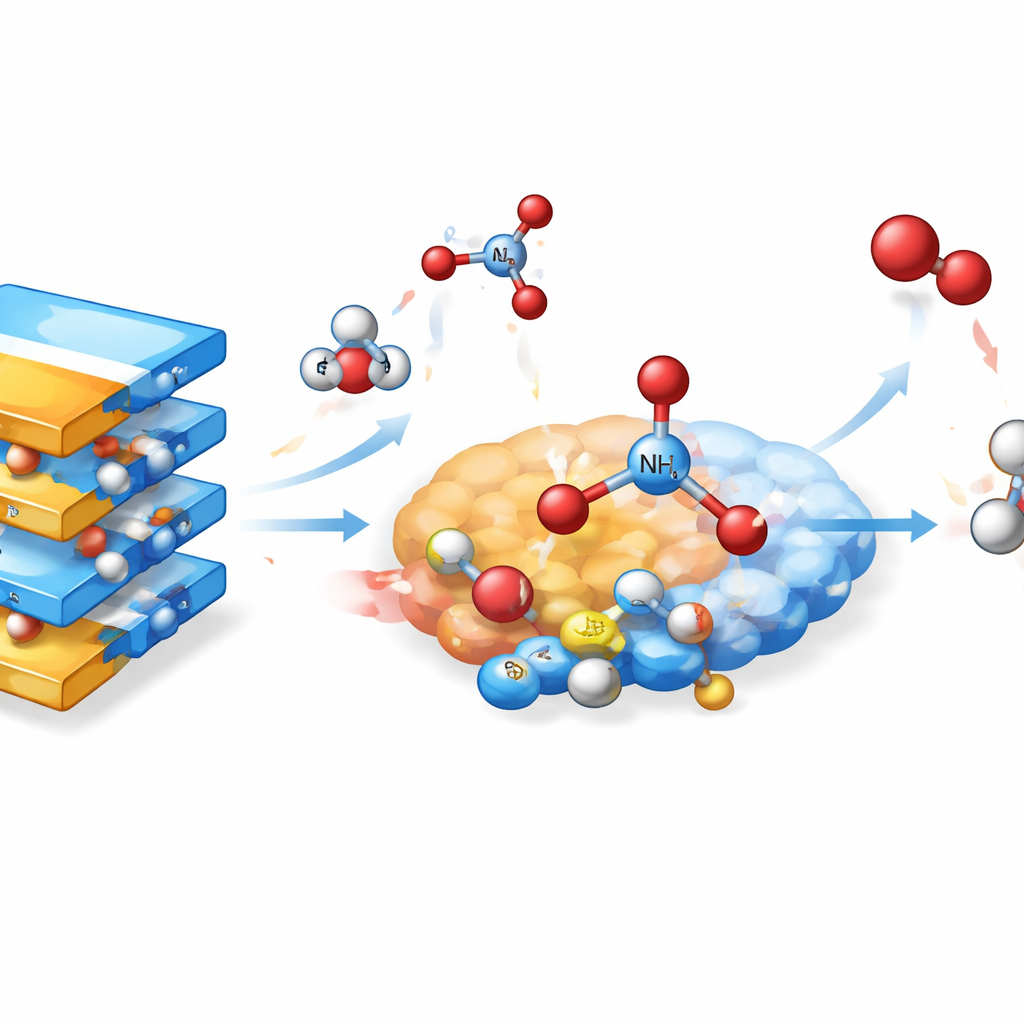
What This Means for Cleaner Water and Greener Nitrogen
In everyday terms, the study shows how careful control of “which way is downhill” for electric charges inside a solid can dramatically improve its ability to use sunlight to drive difficult chemistry. By weaving strongly polar groups into a layered organic framework, the authors create built-in charge highways and highly active surface sites that work together to turn dilute nitrate pollution into valuable ammonia efficiently, without added metals or sacrificial chemicals. While more work is needed to scale the system and fully capture the complexity of real waters, the design concept—using asymmetric polarity to manage both charge transport and interfacial reactions—offers a promising route toward technology that purifies water and recycles nitrogen at the same time.
Citation: Su, Y., Wang, Z., Deng, X. et al. Unlocking carrier confluence in covalent organic frameworks for efficient photoreduction of dilute nitrate to ammonia. Nat Commun 17, 3141 (2026). https://doi.org/10.1038/s41467-026-69439-4
Keywords: nitrate pollution, photocatalysis, covalent organic frameworks, ammonia production, water treatment