Clear Sky Science · en
Deciphering hippocampal place codes in weak theta rhythms
Finding Maps in Noisy Brain Waves
When a rat runs through a maze, certain brain cells in a region called the hippocampus fire in patterns that mark where it is, like a built-in GPS. Those patterns are usually studied when a strong, steady brain rhythm called theta is present. But real life is messy: when the animal pauses to drink or look around, this rhythm becomes weak and irregular. Many scientists assumed that, in those moments, the brain’s position signals were too jumbled to read. This study shows that assumption is wrong: even when the rhythm is faint and noisy, the brain still carries a surprisingly precise internal map—if you know how to look for it.
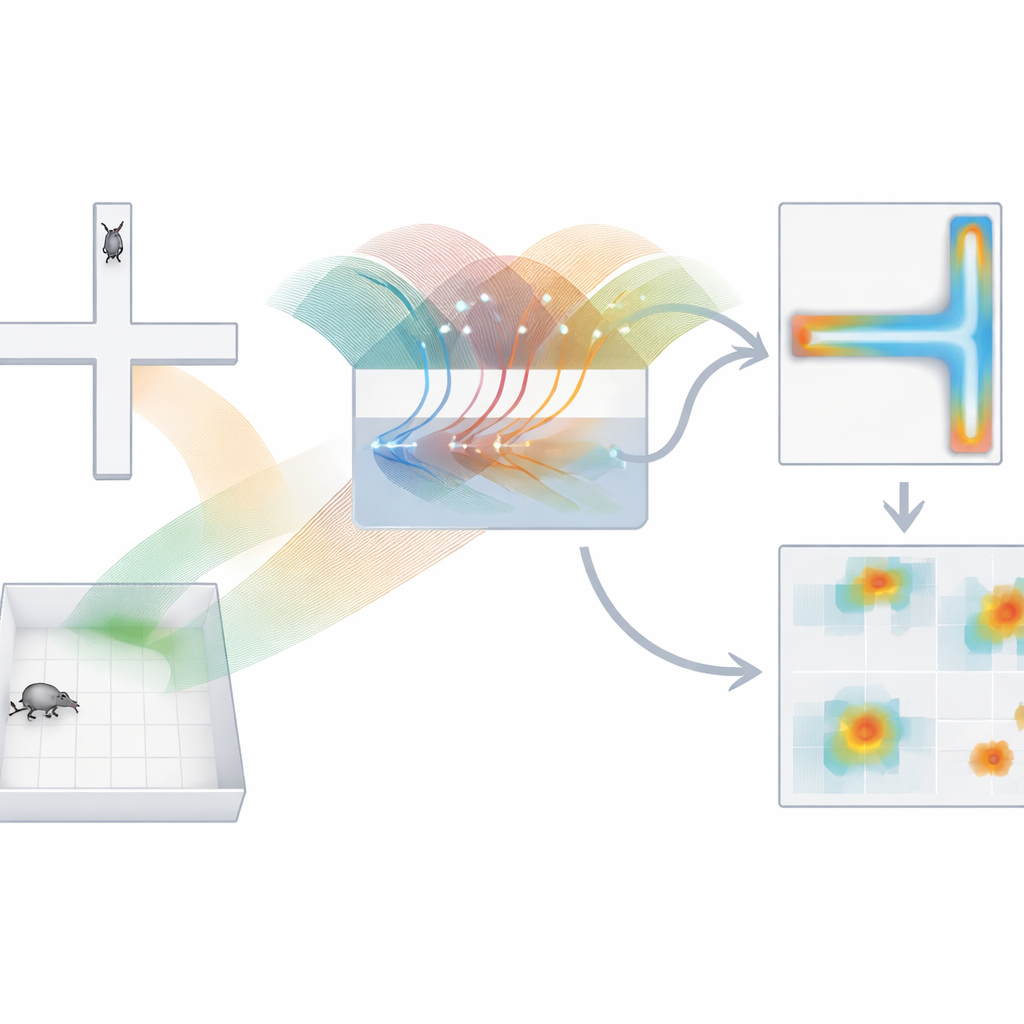
Brain Waves as a Hidden GPS
Electrical recordings from the brain, known as local field potentials, are like listening to the hum of thousands of neurons at once. In the hippocampus, a prominent hum is the theta rhythm, a regular wave that appears when an animal moves. Individual “place cells” fire at specific locations, and their spikes march through the phases of this theta wave, effectively laying out a miniature sequence of the animal’s path during each cycle. This has led to the view that theta acts as a master clock, organizing both the firing of single cells and the collective signal seen in field potentials. However, when the animal stops moving, theta weakens and becomes patchy. The common belief has been that, under those conditions, the wave is too unreliable to support a meaningful position code.
When the Clock Gets Noisy
The authors first confirmed that traditional decoding methods struggle when theta is weak. Using arrays of electrodes in rats running a three-armed maze, they tried to read out which arm the animal was on by treating theta as a single carrier wave, much like a radio station that carries information in its phase. During running, when theta is strong, this carrier-based method could reliably tell where the rat was. During pauses at the reward ports, when theta power dropped, decoding accuracy fell sharply. A computer model showed why: if all neurons’ phases are jostled together by shared fluctuations, the relationship between their firing and the main theta wave is distorted. Methods that insist on referencing everything to one dominant rhythm become fragile under this kind of shared noise.
Letting the Data Speak for Itself
To get around the limitations of a single carrier, the team built a new type of artificial neural network called TIMBRE. Instead of being told what theta looks like, TIMBRE takes in the raw, complex-valued field potentials from many electrodes and learns patterns that are both rhythmic and tied to behavior. Each hidden unit in the network discovers its own “place-tuned theta” component—a rhythmic pattern whose strength rises and falls at particular locations. Crucially, TIMBRE then discards the exact phase of these rhythms and focuses on how strong each pattern is at each moment. This makes the readout insensitive to shared shifts in phase that would throw off a carrier-based approach.
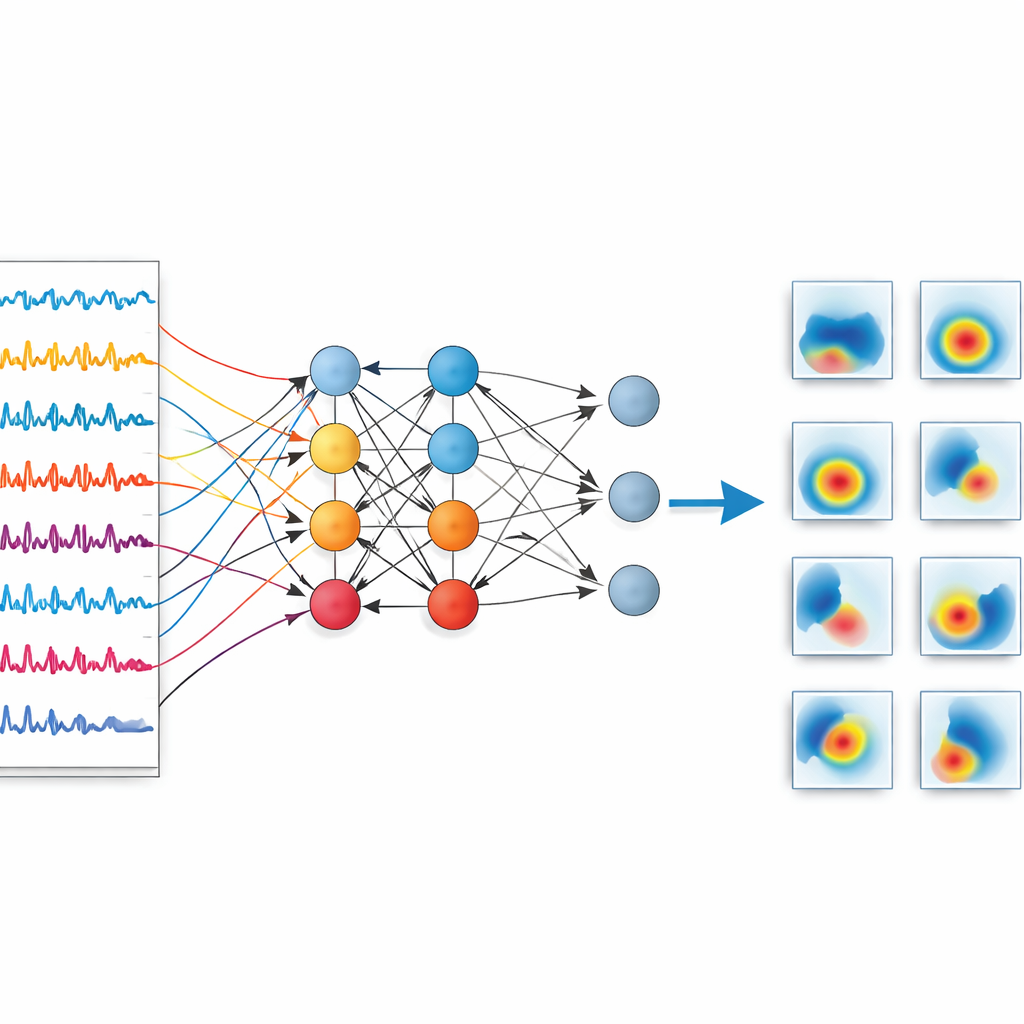
Maps Hidden in Weak Rhythms
When applied to the maze recordings, TIMBRE uncovered a rich set of place-tuned rhythms that tiled the track, activating one after another as the rat moved. During running, these components behaved much like the classic theta-organized place code, and both traditional and new decoders performed similarly. During stillness, however, TIMBRE’s carrier-free approach far outperformed the carrier-based method and nearly matched the accuracy of decoders that used the spikes of individual neurons. The same strategy worked in a different setting where rats foraged freely in an open arena: TIMBRE’s components were tuned not only to position but also to head direction, and field-potential-based decoders could sometimes estimate direction even better than spike-based ones. The study also showed that these place-tuned rhythms are distinct from the dominant theta wave: they explain little of the overall signal power but carry most of the location information and are more closely linked to the activity of position-sensitive cells.
Why This Matters for Reading the Brain
For a layperson, the main message is that the brain’s internal maps are more robust than they appear when viewed through a single, obvious rhythm. Even when the prominent theta wave looks weak and messy, subtler rhythmic patterns still track where the animal is and where it is facing. By using information-focused tools like TIMBRE instead of relying only on the biggest, most regular oscillations, researchers can tap into these hidden codes. This work suggests that low-frequency brain waves, long thought to be too coarse to reveal detailed computations, can in fact carry information rivaling that found in precise spikes—especially when decoded with methods designed to find structure in weak and overlapping rhythms.
Citation: Agarwal, G., Akera, S., Lustig, B. et al. Deciphering hippocampal place codes in weak theta rhythms. Nat Commun 17, 2735 (2026). https://doi.org/10.1038/s41467-026-69438-5
Keywords: hippocampus, theta rhythm, place cells, neural decoding, local field potentials