Clear Sky Science · en
Hyperbolic localized plasmons and twist-induced chirality in an anisotropic 2D material
Twisting Light in Ultra-Thin Materials
Imagine steering light the way you might steer water through a maze of channels—guiding it to flow in just one direction, twist as it moves, or respond only to a particular spin of a wave. This paper shows how an ultra-thin, crystal-like material can do exactly that. By carving and stacking sheets of a special two-dimensional compound, the researchers found a new way to trap, guide, and twist light on a scale much smaller than the width of a human hair, opening doors for compact sensors, secure communications, and quantum technologies.
A Crystal That Prefers One Direction
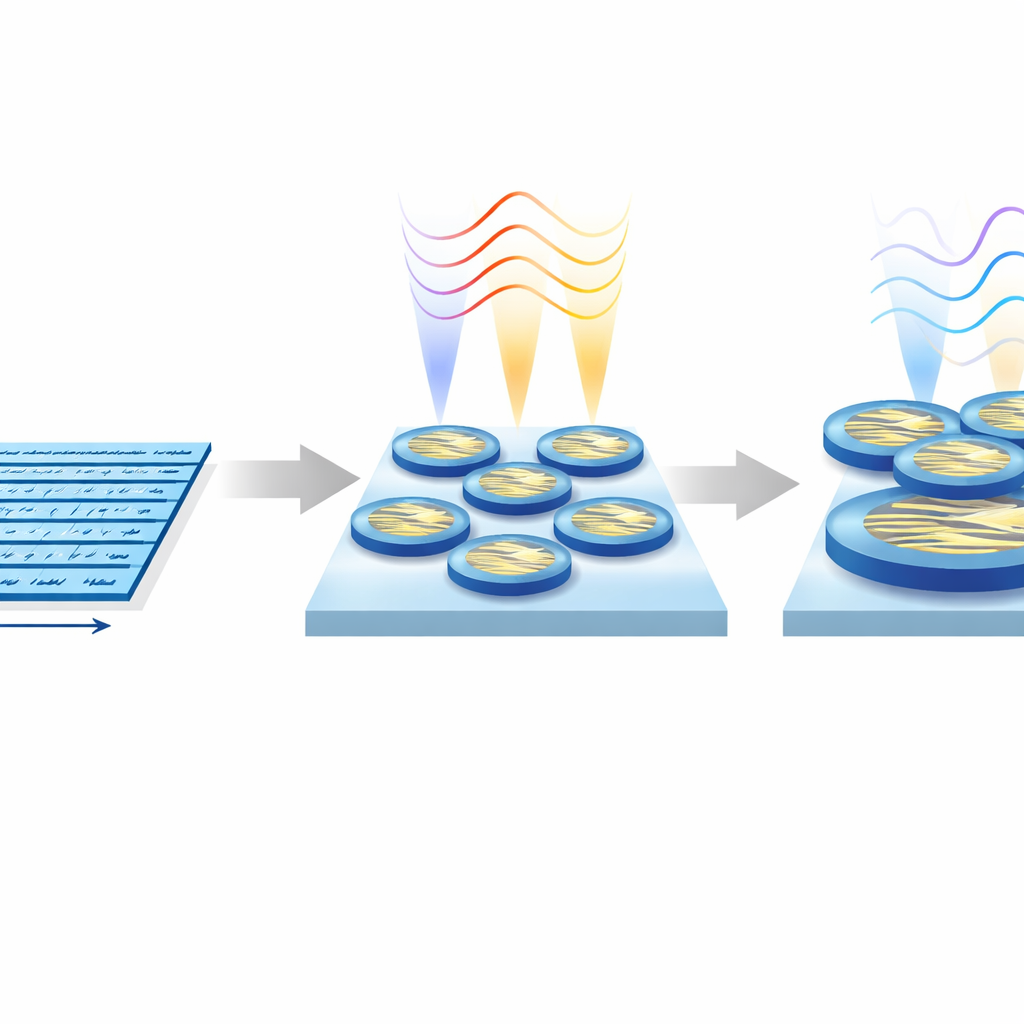
The study centers on MoOCl₂, a layered material only a few atoms thick that behaves very differently along two directions in the plane. Along chains of molybdenum and oxygen atoms, it acts like a metal, easily hosting mobile charges, while at right angles it behaves like an insulator. This built-in directional preference means that when light hits the material, it doesn’t spread out evenly. Instead, it follows special paths inside the crystal, allowing light waves to be squeezed and guided in unusual ways compared with conventional metals like gold or silver.
New Kind of Nanoscale Light Trap
To harness this behavior, the researchers etched MoOCl₂ into tiny circular islands—nanodisks—arranged on a glass surface. In ordinary metals, such disks trap light in patterns that reflect the disk’s circular shape. Here, however, the trapped light patterns stubbornly remain one-dimensional: the resonance appears only for light polarized along the metallic chain direction and disappears for the perpendicular direction, even though the disks themselves are perfectly round. Experiments using both standard optical spectroscopy and a powerful imaging method called photoemission electron microscopy confirmed that the strongest fields are confined along a single in-plane axis, and that the energy spreads through the volume of the disk rather than only skimming its surface. This behavior defines a new class of states the authors call “hyperbolic localized plasmons,” combining the extreme confinement of surface plasmons with the directional flow characteristic of hyperbolic materials.
Stable Performance in Complex Stacks
The team then embedded the disks in a metal–insulator–metal sandwich: MoOCl₂ disks separated from a gold mirror by a thin insulating layer. In typical metal stacks, the color (or wavelength) at which the structure resonates is extremely sensitive to the thickness of this gap, shifting dramatically if the spacer layer changes by just a few nanometers. That sensitivity makes large-scale manufacturing difficult. In sharp contrast, the MoOCl₂ structures barely changed their resonance wavelength when the spacer thickness was varied almost tenfold. This unusual stability arises because MoOCl₂ and the insulating layer have closely matched optical properties in the vertical direction, preventing the formation of ultra-sensitive “gap” modes. In practical terms, this makes it far easier to build reproducible, multilayer optical devices.
Twisting Layers to Create Optical Handedness
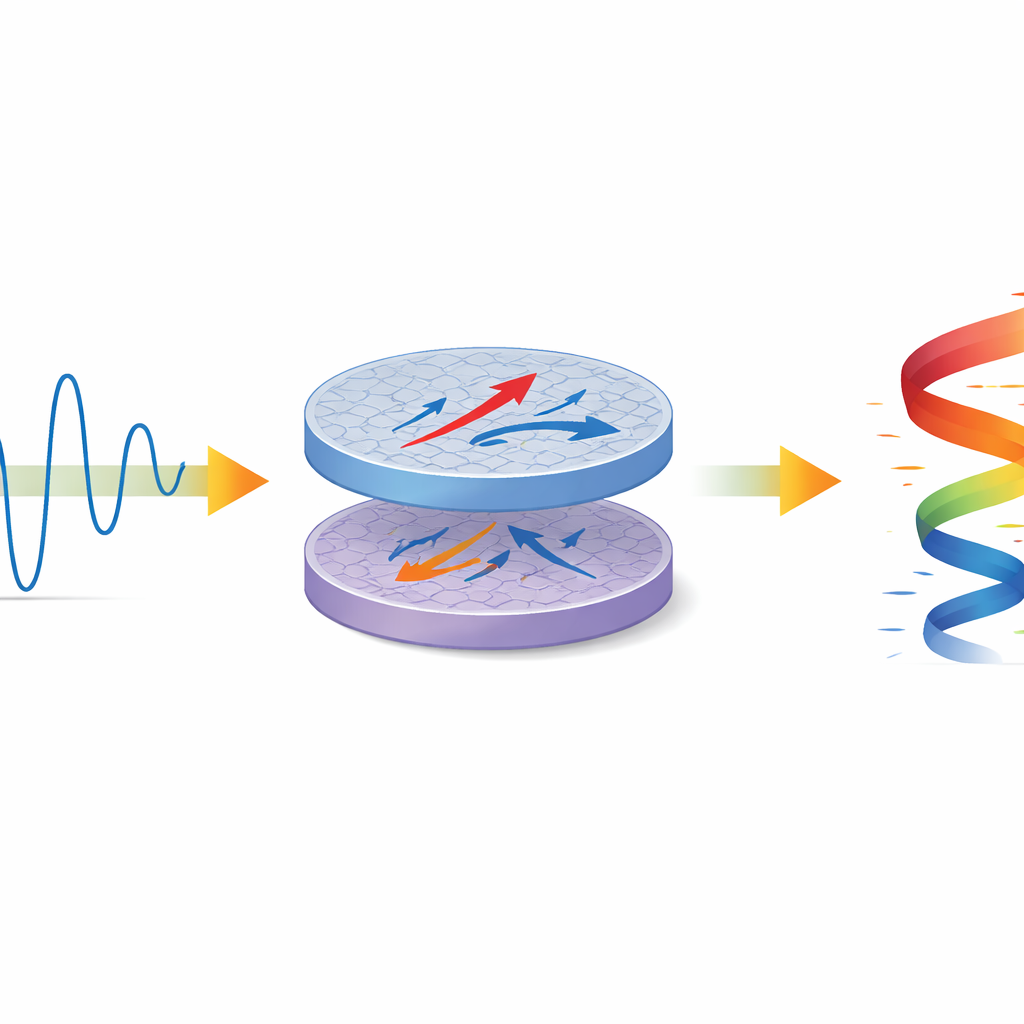
Finally, the researchers explored what happens when two MoOCl₂ nanodisk layers are stacked on top of each other with their preferred directions rotated relative to one another. Although each disk remains perfectly circular, the combined structure now treats left- and right-twisting light differently—a property known as chirality. By shining circularly polarized light, which carries a definite sense of rotation, through the twisted stack, they observed large differences in transmission between left- and right-handed light and strong shifts in the resonance color. Remarkably, this chiral response remained robust even when the disk thicknesses or spacing were not perfectly controlled, and could be tuned over a broad range of colors simply by adjusting the twist angle and disk arrangement.
From Fundamental Physics to Future Devices
For non-specialists, the key takeaway is that the authors have discovered a new way to trap and twist light using the natural directional preferences of an ultra-thin crystal, rather than relying on complex, asymmetrical shapes. Their “hyperbolic localized plasmons” concentrate light in a single direction inside round nanostructures, are insensitive to tiny fabrication errors in layered stacks, and become strongly chiral when twisted in pairs. These combined features point toward compact devices that can detect molecular handedness, control the polarization of light on a chip, or interface efficiently with quantum light sources, advancing the quest to miniaturize and precisely control optical technologies.
Citation: Li, Y., Shi, X., Zhang, Y. et al. Hyperbolic localized plasmons and twist-induced chirality in an anisotropic 2D material. Nat Commun 17, 2716 (2026). https://doi.org/10.1038/s41467-026-69435-8
Keywords: nanophotonics, plasmonics, chiral metasurfaces, anisotropic 2D materials, polarization control