Clear Sky Science · en
Dynamic guanidinium sulfate salt for selective carbon dioxide adsorption with negative pressure inflexion
A smart salt that pulls carbon dioxide out of gas
Cutting carbon dioxide (CO2) from smokestacks and the air is central to slowing climate change, but most current capture methods are energy-hungry and complex. This study introduces a surprisingly simple material—an ordinary-looking salt called guanidinium sulfate—that behaves in an extraordinary way when it meets CO2. It not only soaks up large amounts of the gas, it does so through a built‑in “self‑pumping” effect that can actually lower gas pressure inside a closed space, opening new possibilities for compact CO2 capture and pressure‑control devices.
Why this salt matters for cleaner air
Guanidinium sulfate (GS) is made from cheap, abundant ingredients and held together by hydrogen bonds, the same gentle attractions that shape water and DNA. Because these bonds are flexible, the crystal structure of the salt can rearrange when pushed by heat or gas pressure. The authors discovered that GS can exist in at least three solid forms, called phases α, β, and γ, which differ in both stability and how much empty space they contain. Under mild conditions, these forms can selectively host CO2 while ignoring nitrogen, suggesting that this unassuming salt could compete with cutting‑edge porous materials used for gas separation.
How the material changes shape to grab more gas
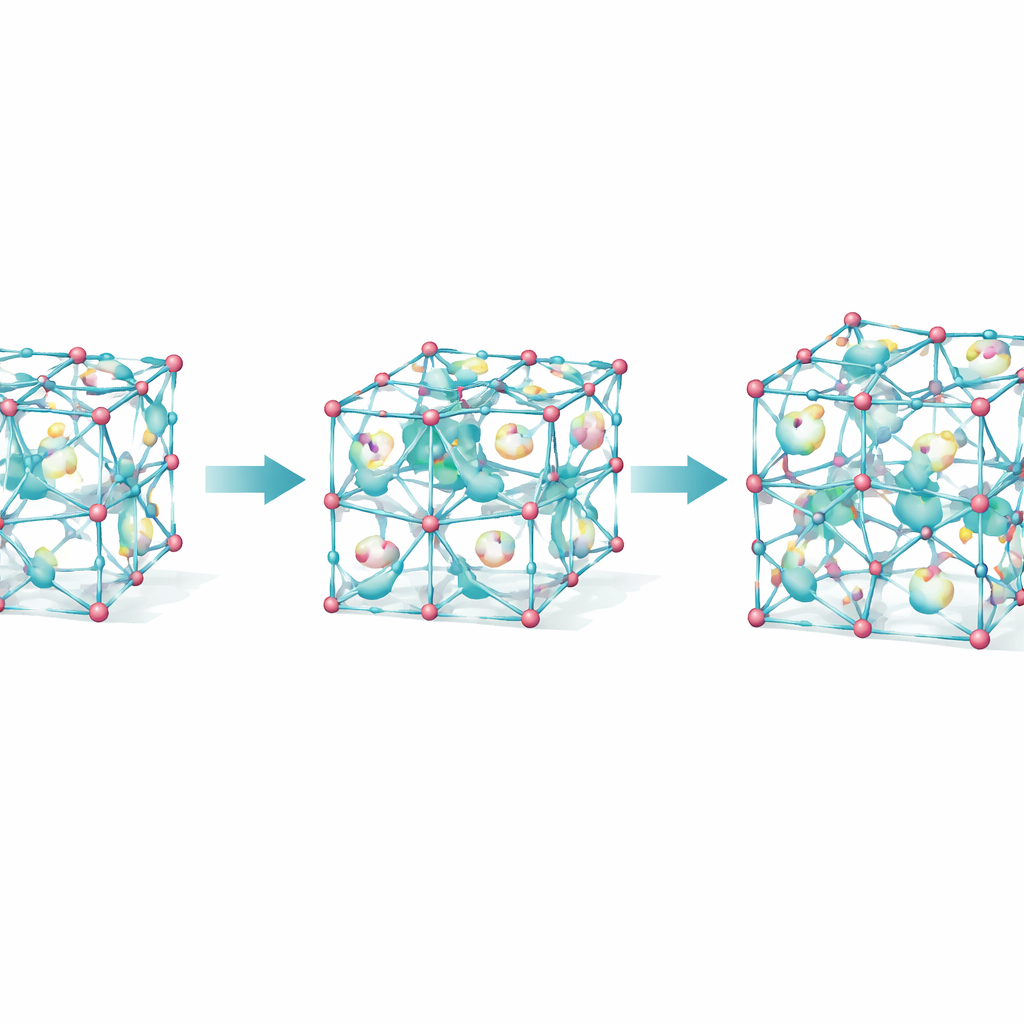
In careful measurements of how much CO2 the salt absorbs at different pressures, the team found that the β form of GS does something rare. At first, almost no CO2 enters; the tiny internal cavities are effectively closed until the gas pressure crosses a threshold “gate.” Once this point is reached, CO2 begins to seep into isolated pockets inside the crystal. As pressure rises further, the amount of CO2 taken up increases steadily—until a critical pressure, where the material undergoes a sudden, deeper transformation into a more open γ form with larger pores that can host many more CO2 molecules.
A strange pressure dip with a simple explanation
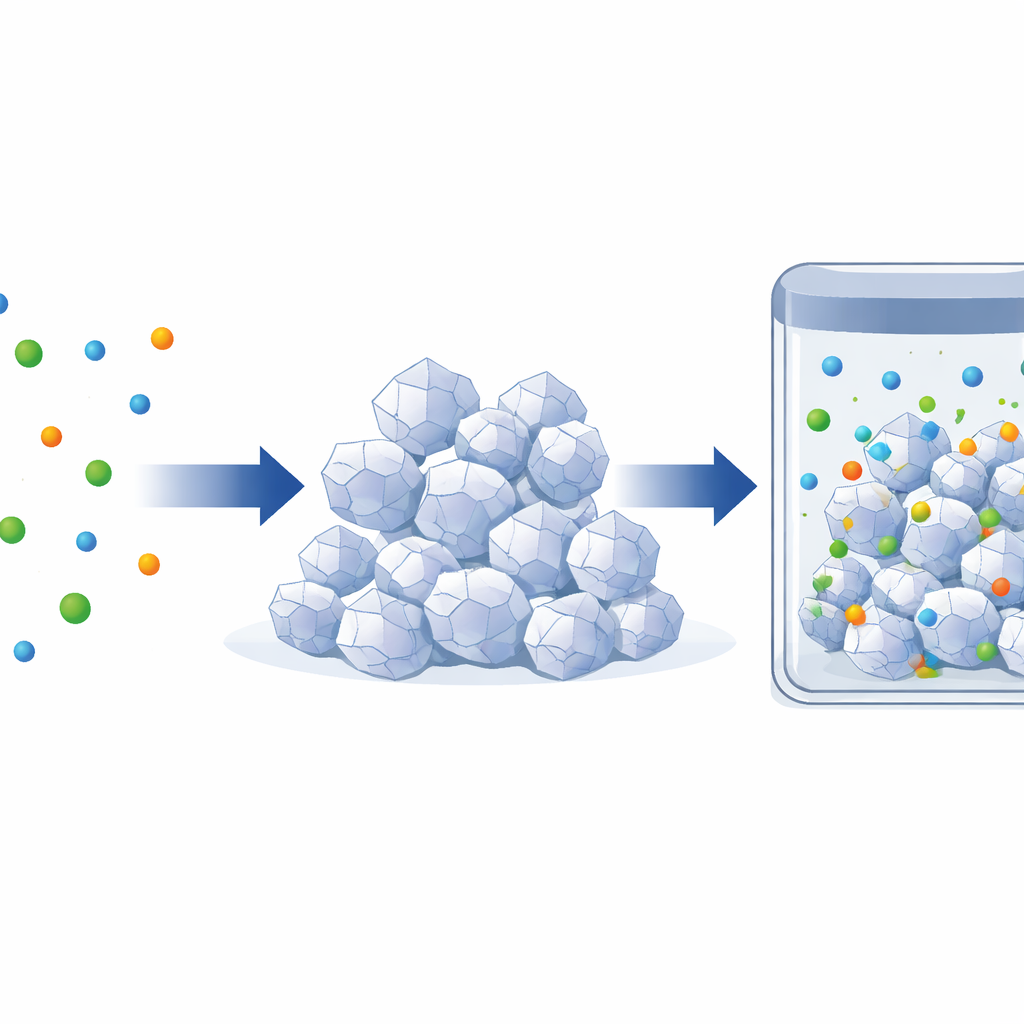
In a closed test cell, that sudden extra capacity leads to a counter‑intuitive effect the authors call negative pressure inflexion. Instead of the pressure in the cell rising as more CO2 is fed in, it briefly drops. The reason is that the crystal’s internal restructuring acts like opening hidden storage rooms: the salt absorbs so much additional CO2 so quickly that CO2 molecules vanish from the free gas phase faster than they are supplied, temporarily lowering the overall pressure. This is the opposite of an earlier phenomenon known as negative gas adsorption, where a framework squeezes out gas and raises pressure. Here, the material effectively “swallows” gas and eases pressure.
Peering under the hood of the crystal
To understand these odd jumps in behavior, the researchers combined X‑ray measurements with computer simulations that map the energy landscape of possible crystal packings. They confirmed that α‑GS is the most stable form at rest, β‑GS is slightly higher in energy, and γ‑GS is the most open but also the least stable unless CO2 is present. Calculations showed that as more CO2 fills the pores, γ‑GS becomes energetically favored, driving the β‑to‑γ switch. Simulations also revealed brief “breathing” motions in the β structure, where small channels momentarily connect otherwise isolated cavities, allowing CO2 to diffuse in and trigger the wholesale rearrangement.
From lab curiosity to practical CO2 sponge
The work goes beyond a curiosity in gas‑solid physics. The γ form loaded with CO2 holds about 17 percent of its weight in the gas (around 4.2 millimoles per gram at near‑freezing temperatures and everyday pressures) and releases it cleanly when gently heated, without the heavy energy cost of boiling water in standard amine solutions. The salt remains stable over many capture‑and‑release cycles and strongly prefers CO2 over nitrogen in mixed gases, a key requirement for real‑world flue gas treatment. In plain terms, this dynamic salt behaves like an adaptive sponge that opens, reshapes itself, and even briefly lowers pressure to pull in CO2, offering a promising route toward simpler, more efficient systems for capturing, storing, and transporting this climate‑warming gas.
Citation: Zhao, L., Zhao, C., Liu, C. et al. Dynamic guanidinium sulfate salt for selective carbon dioxide adsorption with negative pressure inflexion. Nat Commun 17, 2628 (2026). https://doi.org/10.1038/s41467-026-69433-w
Keywords: carbon dioxide capture, porous salts, gas adsorption, hydrogen-bonded frameworks, phase transitions