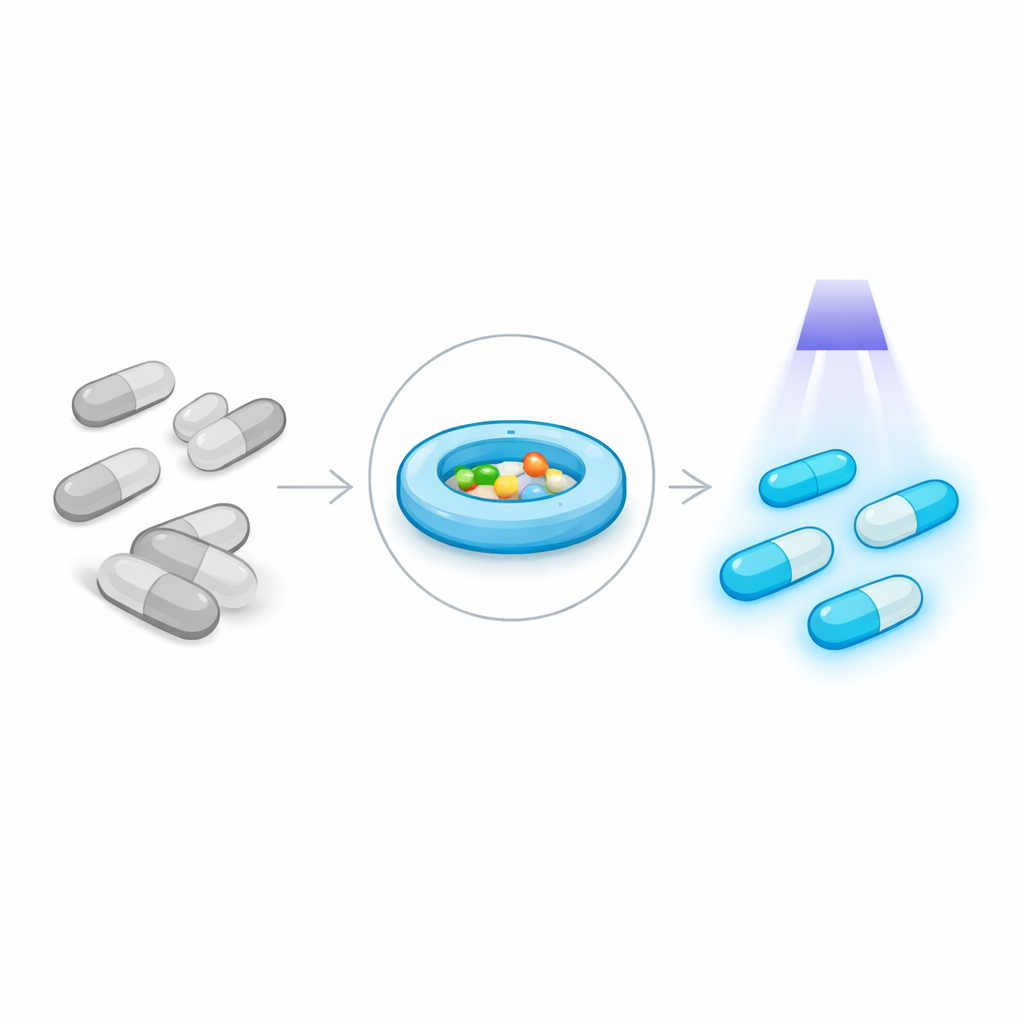
Fake and substandard medicines are a hidden danger around the world, especially in regions with limited resources. This study introduces a new way to help tell real pills from counterfeits by making medicines themselves briefly glow after exposure to ultraviolet light. The glow comes from safe, edible ingredients that can be mixed into or printed onto tablets and capsules, turning each dose into its own built‑in authenticity check.
Why Counterfeit Drugs Are So Hard to Catch
Traditional tools for spotting fake medicines often rely on high‑end lab equipment, skilled technicians, or tamper‑proof packaging. But criminals can refill genuine packages with fake pills, and many clinics and pharmacies cannot afford complex tests. A more reliable strategy is to mark each individual pill or capsule in a way that is hard to copy but easy to check with simple light. The challenge is to find luminescent materials that are bright, long‑lasting, robust in air and moisture, and safe enough to be eaten.
A Safe Glow from Common Food Ingredients Figure 1.
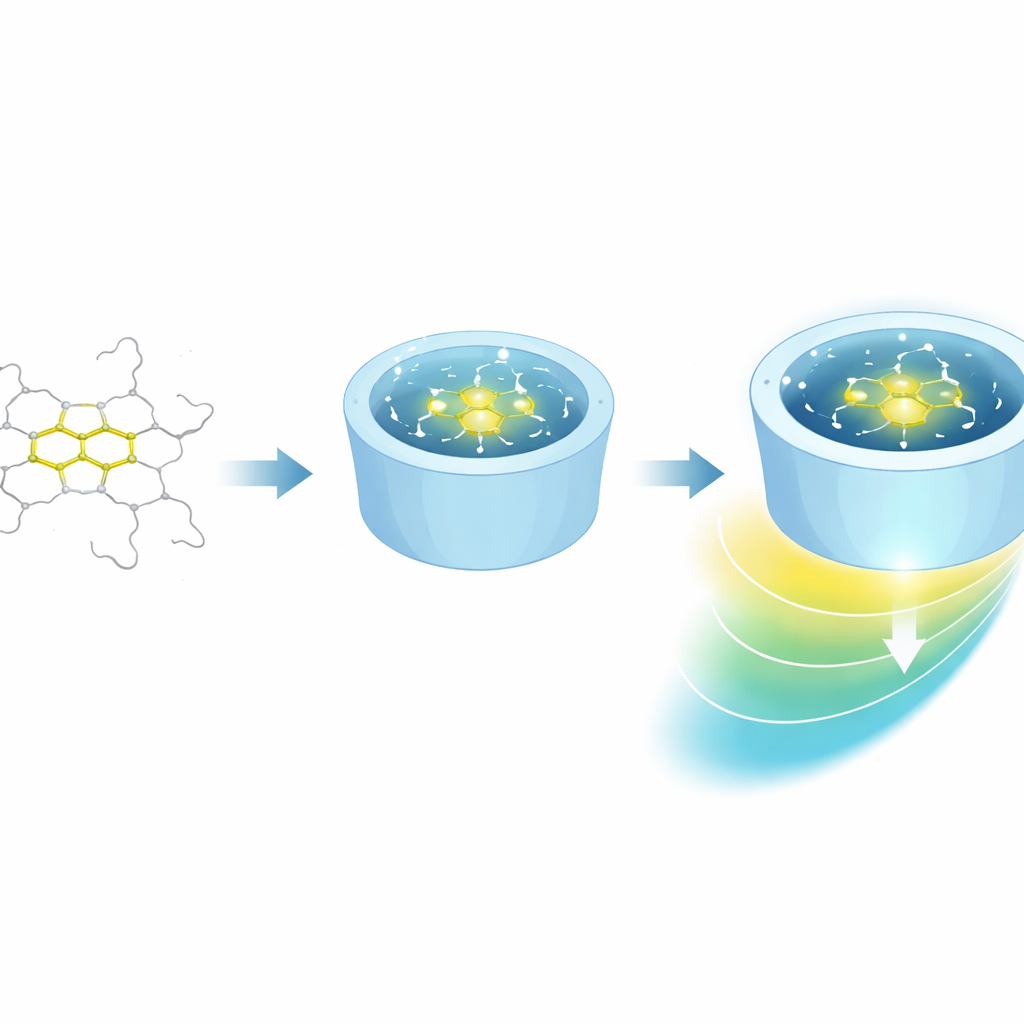
The researchers solved this by combining two familiar components: a form of vitamin B (vitamin B10) and ring‑shaped sugar molecules called cyclodextrins, which are already widely used as food and drug additives. When vitamin B10 is alone, it glows only weakly under ultraviolet light. But when it is physically trapped inside the hollow center of cyclodextrin rings, the combined structure forms a tight "host–guest" pair that shines with a bright blue afterglow once the light is switched off. These edible complexes can be made simply by grinding the ingredients with a little water or by letting them crystallize from an aqueous solution, producing materials with very high light output and glow times approaching a full second.
How a Molecular Cage Switches On the Afterglow
To understand why this simple pairing works so well, the team used detailed computer simulations alongside a range of lab techniques. X‑ray crystallography and nuclear magnetic resonance measurements confirmed that vitamin B10 sits deep inside the cyclodextrin cavity and is held in place by many hydrogen bonds. This snug fit shelters the light‑emitting vitamin from quenching by oxygen, water, and other molecules and isolates each vitamin in its own microscopic pocket. Calculations then revealed that the surrounding sugar ring subtly reshapes the energy landscape of the excited vitamin: it changes the order of closely spaced excited states and makes a key crossing point between two types of states easier to reach. This crossing funnels energy into a long‑lived state that can release light slowly, creating strong room‑temperature phosphorescence instead of a short flash.
Tuning Structure for Better Security Features
The authors explored how small changes affect the glow. By swapping parts of the vitamin‑like molecule or moving its functional groups around the ring, they found that only certain shapes, especially those with groups placed opposite each other, gave strong afterglow when encapsulated. Similarly, cyclodextrins of the right size (the α and β forms) worked well, while a larger version (γ) did not bind tightly and produced no useful glow. These tests showed that both a proper molecular fit and firm binding inside the cavity are essential for switching on phosphorescence. Some of the resulting complexes even emit circularly polarized light, adding another layer of optical uniqueness that is difficult to forge.
Marking Medicines from the Outside In Figure 2.
Because these glowing complexes are edible, inexpensive, and stable in air and moisture, the team demonstrated several practical anticounterfeiting schemes. In one approach, an aqueous solution of the complex is used as an invisible ink to draw symbols on pills or capsules; they become visible only under ultraviolet light and glow more clearly after the lamp is turned off. In another, small amounts of the powder are mixed directly into the tablet or capsule, so that every fragment of a broken pill still shows the same blue afterglow. A third method splits the two components between the pill and a spray solution, so that only when the correct spray is applied does the medicine light up. Together, these strategies make it far harder for counterfeiters to copy both the recipe and the visual response of authentic drugs.
What This Means for Safer Medicines
In essence, the study shows that everyday, food‑grade molecules can be arranged into tiny cages that give vitamins a long‑lasting, eye‑visible glow. This glow can act as a built‑in security mark for individual pills, checked with simple ultraviolet light rather than complex instruments. By explaining in detail how the molecular cage reshapes the energy pathways that control light emission, the work also offers a general design playbook for future glow‑in‑the‑dark materials. If adopted widely, such edible phosphorescent systems could become a powerful extra safeguard against counterfeit medicines, helping patients and health workers quickly spot fakes before they do harm.
Citation: Wu, WT., Deng, CY., Zhang, ZY. et al. Phosphorescent supramolecular systems for medicine anticounterfeiting.
Nat Commun17, 2635 (2026). https://doi.org/10.1038/s41467-026-69431-y
Keywords: medicine anticounterfeiting, edible phosphorescence, cyclodextrin host–guest, glowing security inks, drug authenticity