Clear Sky Science · en
PanMETAI - a high performance tabular foundation model for accurate pancreatic cancer diagnosis via NMR metabolomics
Why catching this cancer early matters
Pancreatic cancer is one of the deadliest cancers largely because it is usually found too late, when surgery and other treatments have little chance of success. Current blood tests miss many early cases or give false alarms. This study describes a new, noninvasive blood test called PanMETAI that combines advanced chemistry and artificial intelligence to spot pancreatic cancer earlier and more accurately, using just a small sample of blood.
Turning blood chemistry into a cancer fingerprint
The researchers focused on pancreatic ductal adenocarcinoma (PDAC), the most common and lethal form of pancreatic cancer. Instead of looking at one or two traditional markers, such as the widely used CA19-9, they took a panoramic view of the blood. Using high-resolution proton nuclear magnetic resonance (1H NMR) spectroscopy, they recorded thousands of signals from small molecules and blood fats circulating in the serum. These invisible chemical patterns, together with age, CA19-9, and a protein called Activin A, form a metabolic “fingerprint” that can distinguish people with PDAC from high-risk but cancer-free individuals. 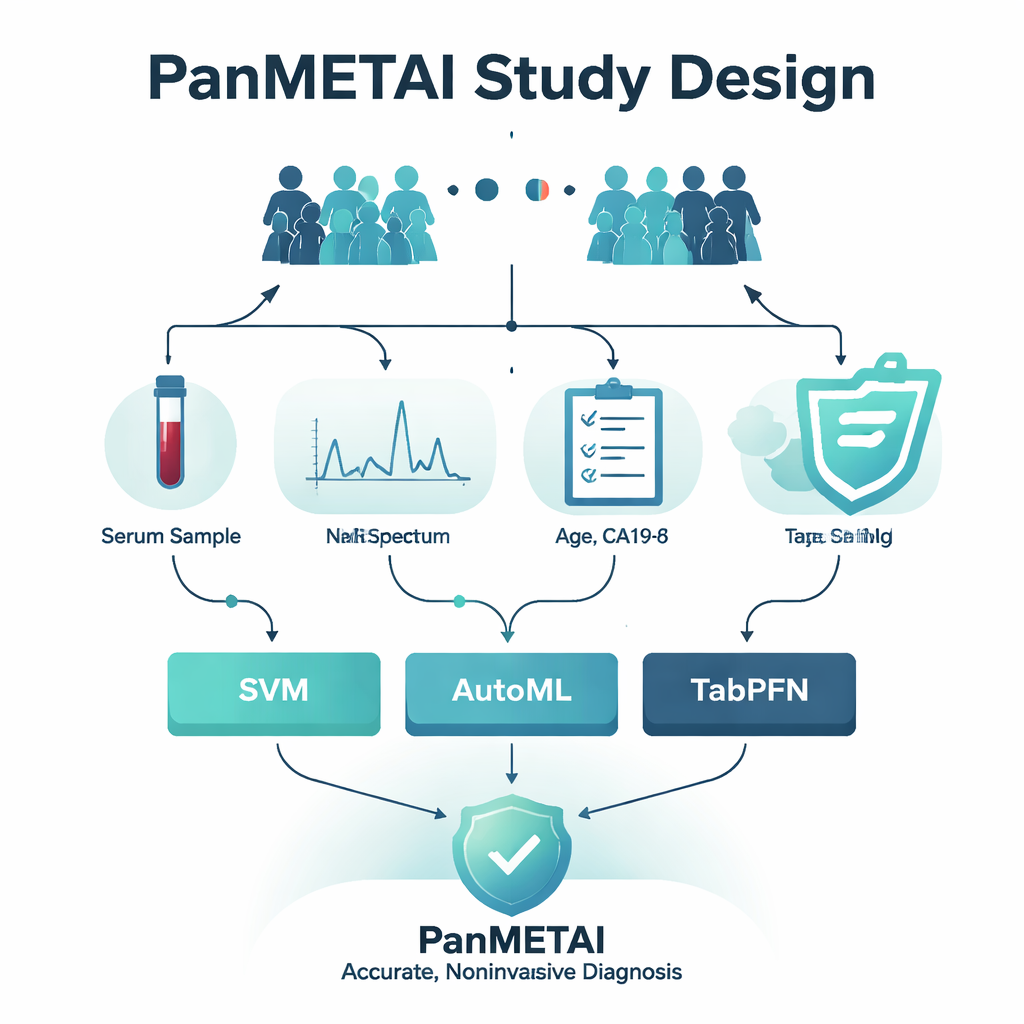
Teaching a smart model to read the signals
To make sense of this massive data, the team compared several machine-learning approaches, including support vector machines, an automated model suite called AutoGluon, and a new transformer-based system known as TabPFN. They trained and tuned the models on blood samples from 350 people in Taiwan, carefully splitting the data into training, development, and blind test sets to mimic real-world diagnosis. While all methods performed well, TabPFN stood out. The final TabPFN-based model, named PanMETAI, integrated selected NMR signals, age, CA19-9, and Activin A into a single decision, reaching near-perfect ability to separate cancer from non-cancer in the Taiwanese cohorts.
High accuracy across stages and countries
PanMETAI achieved an area under the curve (AUC) of 0.99 in the Taiwanese blind test set, indicating extremely high diagnostic accuracy. Importantly, it was not only effective for advanced cancers but also for early-stage (I/II) disease, where detection is most valuable. The model was then tested on an independent group of 322 people from Lithuania, a population with different lifestyles and healthcare systems. There, it still reached an AUC of 0.93, with strong sensitivity and specificity, and maintained good performance even when only early-stage patients were considered. The system also worked surprisingly well when trained on relatively small numbers of patients, suggesting it could be adopted by hospitals that do not have access to very large datasets. 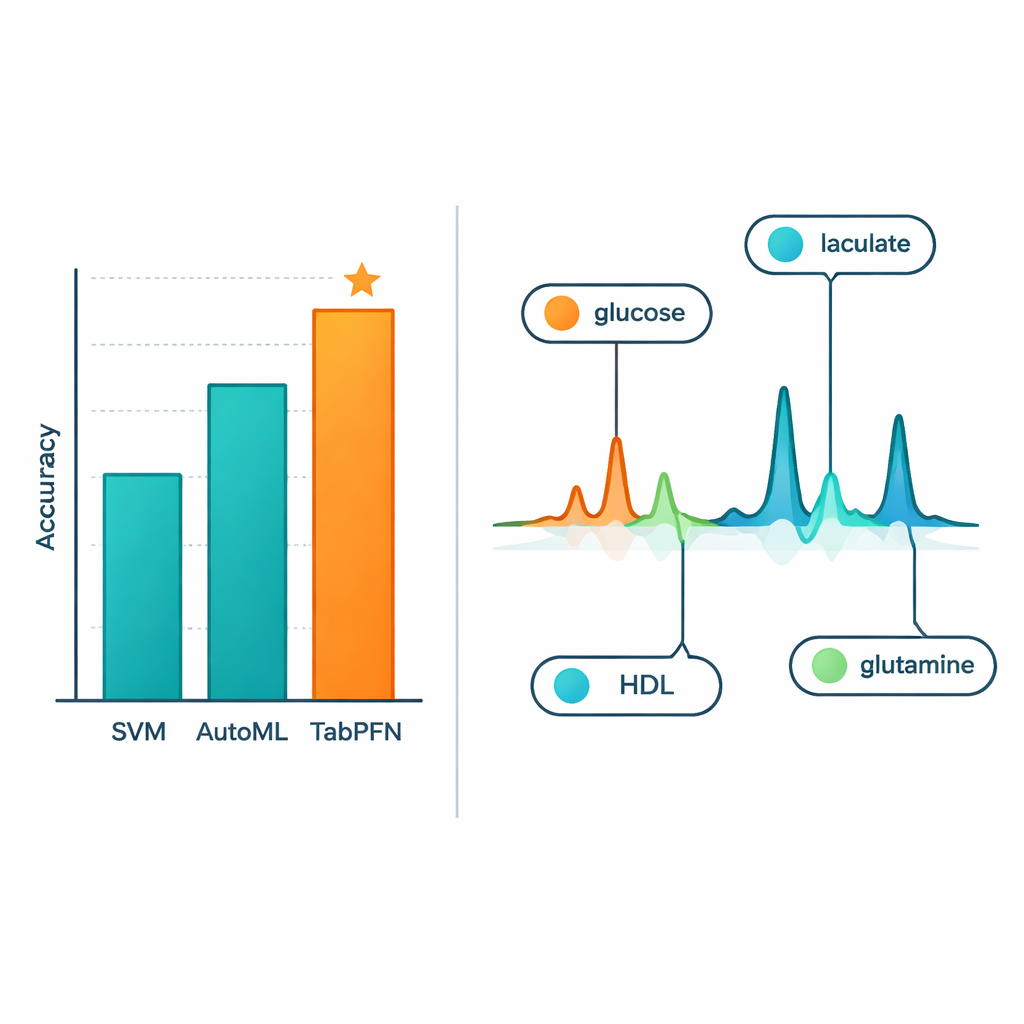
What the blood chemistry reveals about the disease
Beyond raw accuracy, the scientists asked which parts of the blood fingerprint mattered most. By examining the NMR peaks the model relied on, and applying an explanation tool called SHAP, they highlighted specific metabolites and lipoproteins that shift in cancer. Early-stage patients showed lower levels of “good” HDL cholesterol and the amino acid glutamine, along with higher levels of glucose, lactic acid, glutamic acid, ornithine, and the compound TMAO. These changes map onto energy and amino acid pathways that cancer cells tap to grow and survive. Network and pathway analyses confirmed that altered sugar use, fat handling, and amino acid metabolism are tightly linked to pancreatic cancer biology, lending biological credibility to the AI’s choices.
A step toward practical early screening
For a non-expert, the key message is that PanMETAI turns a routine blood draw into a rich chemical snapshot and uses a powerful AI model to read that snapshot like a bar code for pancreatic cancer. It performs better than current blood tests, works across different countries, and can be trained with modest patient numbers. While larger, prospective studies are still needed before it can be widely used, this approach points toward future screening tools that could catch pancreatic cancer earlier, when life-saving treatment is still possible.
Citation: Wu, DN., Jen, J., Fajiculay, E. et al. PanMETAI - a high performance tabular foundation model for accurate pancreatic cancer diagnosis via NMR metabolomics. Nat Commun 17, 1595 (2026). https://doi.org/10.1038/s41467-026-69426-9
Keywords: pancreatic cancer, early detection, metabolomics, artificial intelligence, blood test