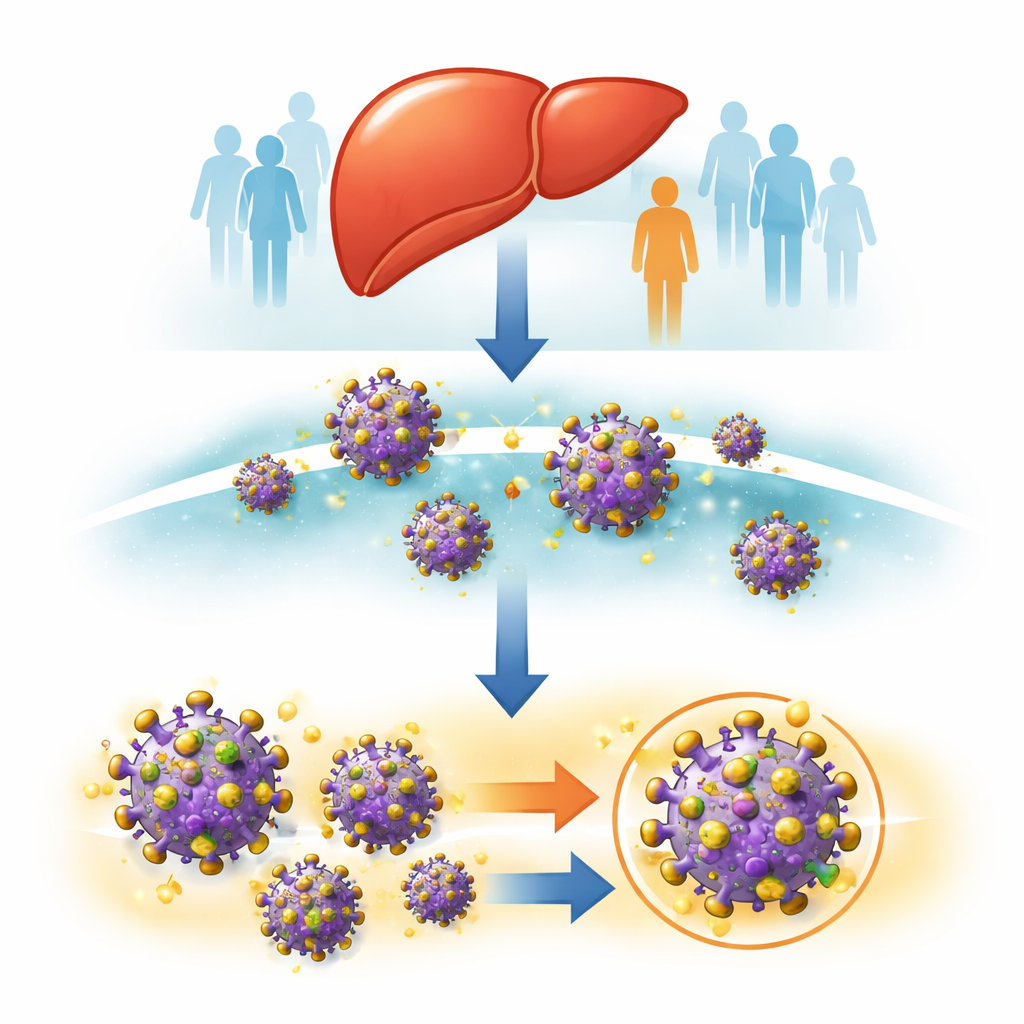
Hepatitis C is a silent infection that can slowly scar the liver for years before symptoms appear, leading to cirrhosis and liver cancer. Today’s drugs can cure most infections, but they are expensive, do not stop people from getting infected again, and cannot undo existing liver damage. This study describes a new vaccine strategy that aims to block the virus at the doorway, using precision‑engineered viral proteins mounted on tiny protein particles to train the immune system to recognize and neutralize hepatitis C before it takes hold.
Targeting the Virus’s Molecular Key
Hepatitis C enters liver cells using a pair of surface proteins called E1 and E2, which together act like a molecular key. These proteins are the main targets of “broadly neutralizing antibodies” – immune molecules that can block many different strains of the virus. However, E1 and E2 are naturally floppy, heavily coated in sugars, and extremely diverse from strain to strain, which has made it hard to build a vaccine version that looks and behaves like the real thing. Earlier attempts could not reliably stabilize this fragile pair in a form that exposes the most protective antibody targets.
Engineering a Stable Viral Decoy
Guided by recent high‑resolution images of the hepatitis C surface, the researchers redesigned the E1E2 pair to make a soluble, vaccine‑friendly “decoy” that still mimics the real virus. They trimmed flexible tail regions that normally sit near the viral membrane and deleted a floppy loop in E1 that tended to cause clumping. Then they fused E1 and E2 onto a specially designed protein scaffold, called SPYΔN, that locks the two partners together like a safety pin. This design produced a clean, stable E1E2 pair that stayed mostly in the desired form, resisted falling apart, and bound strongly to several well‑characterized human antibodies known to neutralize diverse hepatitis C strains.
Supercharging the Immune Signal with Nanoparticles Figure 1.
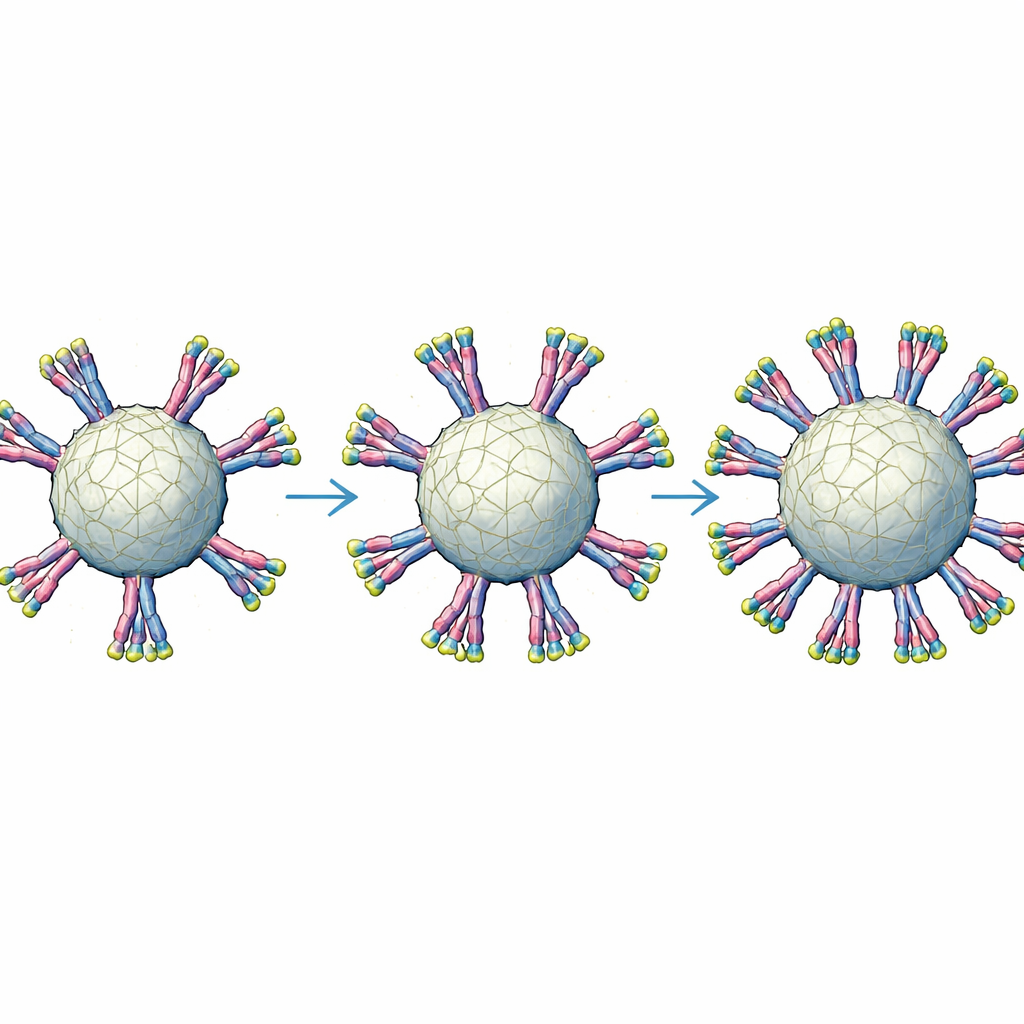
To boost the immune response, the team attached dozens of these stabilized E1E2 pairs to self‑assembling protein nanoparticles, creating virus‑like spheres bristling with identical spikes. They used two carrier particles: a smaller 24‑subunit ferritin shell and a larger, multilayered 60‑subunit design. Chemical tweaks were used to control the pattern of sugars on E1E2 so that it more closely resembled the natural “glycan shield” of the virus, which can influence how antibodies see and bind the surface. Laboratory tests showed that arranging E1E2 on nanoparticles greatly enhanced binding to many protective antibodies and to CD81, a cell receptor that hepatitis C uses to enter liver cells, indicating that key features of the viral surface were faithfully reproduced.
Testing Protection in Mice Figure 2.
The researchers then immunized mice with either the free E1E2 pair or the nanoparticle‑displayed versions, with or without sugar modifications. Blood from vaccinated animals was tested against a panel of hepatitis C “pseudoviruses” representing several genotypes and levels of resistance. Nanoparticle vaccines consistently produced stronger and faster neutralizing antibody responses than the free E1E2 protein, and the larger 60‑subunit particles were especially good at generating antibodies that worked across multiple viral strains. Modifying the sugars to enrich simpler, virus‑like forms provided an additional but modest boost. The team also observed that female mice mounted stronger responses than males, and that the type of cell line used to manufacture the proteins could subtly shift the breadth of protection.
How This Work Moves Vaccine Design Forward
This study delivers a practical recipe for building “native‑like” hepatitis C surface proteins and displaying them on orderly protein nanoparticles. By locking the E1E2 pair into a stable, virus‑mimicking shape and arranging many copies on a single particle, the researchers created vaccine candidates that focus the immune system on the most vulnerable parts of the virus. In mice, these constructs triggered neutralizing antibodies that could block several difficult hepatitis C strains, laying the groundwork for next‑generation vaccines that might one day prevent infection and help achieve global hepatitis C elimination goals.
Citation: He, L., Lee, YZ., Zhang, YN. et al. Native-like soluble E1E2 glycoprotein heterodimers on self-assembling protein nanoparticles for hepatitis C virus vaccine design.
Nat Commun17, 2633 (2026). https://doi.org/10.1038/s41467-026-69418-9