Clear Sky Science · en
Over a century of global decline in the growth performance of marine fishes
Why shrinking fish matter to us
From coastal villages to supermarket freezers, billions of people depend on fish for food and livelihoods. This study asks a deceptively simple question with far-reaching consequences: are marine fish today growing as well as they did a century ago? By sifting through more than 7600 growth records for nearly 1500 fish species worldwide, the authors reveal that many ocean fish are now growing more slowly and reaching smaller sizes than in the past—especially the species we value most as seafood.
Tracking a century of change
To understand long-term patterns, the researchers compiled growth data for marine bony fishes collected between 1908 and 2021. Each "growth curve" describes how quickly a fish species approaches its typical adult size. They combined two basic features—how fast a fish grows and how large it can become—into a single measure called growth performance. Higher values mean fish grow quickly to larger sizes; lower values indicate slower growth and smaller bodies. Using Bayesian state-space models, a statistical approach that separates true biological trends from sampling noise, the team reconstructed how this composite trait has changed over time across the globe. 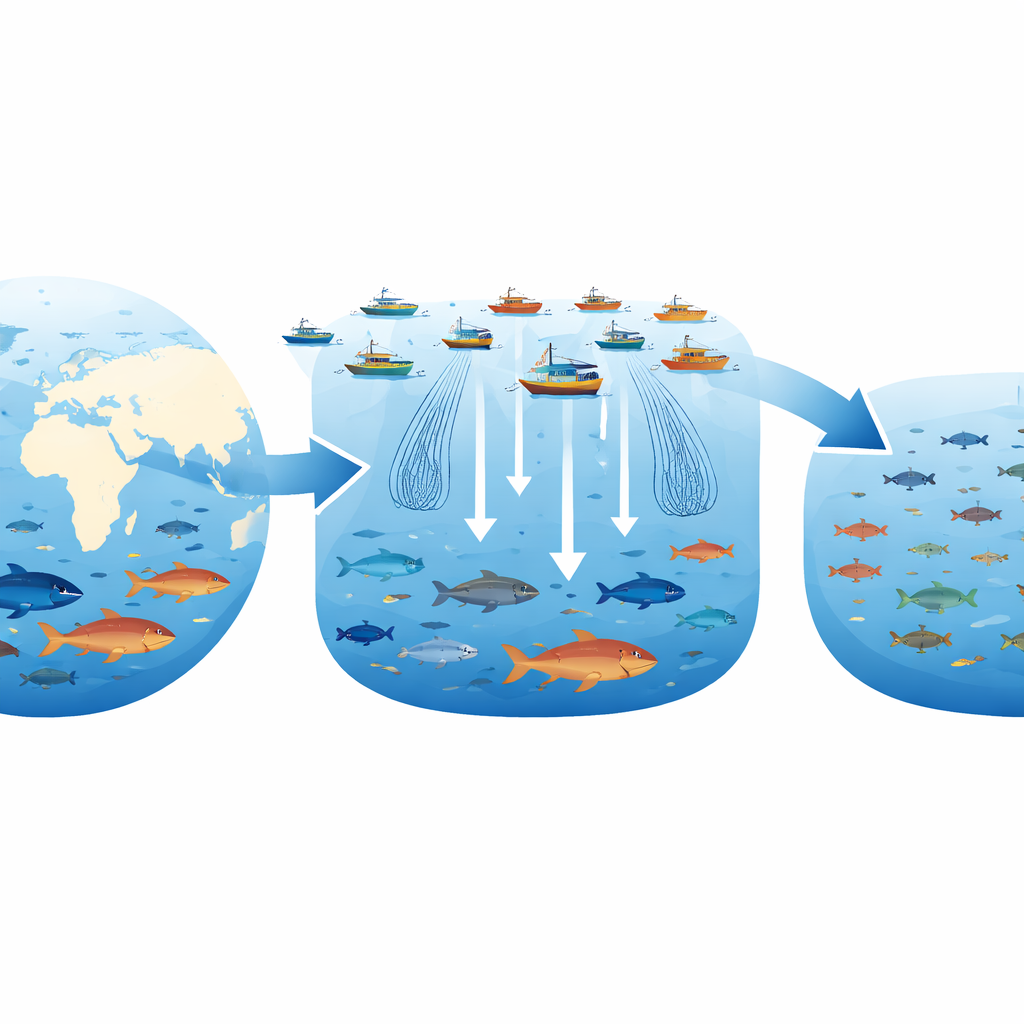
A worldwide slowdown in fish growth
The global picture is clear: average growth performance has fallen by about 8% over the last century. Translated into more intuitive terms, this drop could mean that, on average, fish either reach roughly one-quarter smaller maximum sizes, grow nearly half as fast, or experience some mix of both. Importantly, this pattern is not simply the result of scientists studying different species at different times. The same or closely related species appear repeatedly through the record, and the analyses suggest that within-species changes—fish of a given kind now growing more slowly or staying smaller—are the main driver of the decline.
The heavy hand of fishing
When the authors separated fish into three groups—those from intensively managed commercial fisheries, from fished but unmanaged groups, and from species not considered fished at all—a striking contrast emerged. Fish belonging to formally managed fisheries showed a steady, roughly 9% decline in growth performance since 1908. In practical terms, that could mean up to about a 27% drop in typical adult size, or more than a 50% decrease in growth rate. In unmanaged fisheries and unfished species, by contrast, growth performance remained broadly stable over time. These trends reflect the legacy of size-selective fishing, where fleets preferentially catch the largest and oldest individuals. Removing big, fast-growing fish truncates populations toward younger, smaller individuals and can leave behind slower-growing survivors. Over generations, this pressure can push populations toward smaller bodies and altered life cycles, even if overall numbers partially recover. 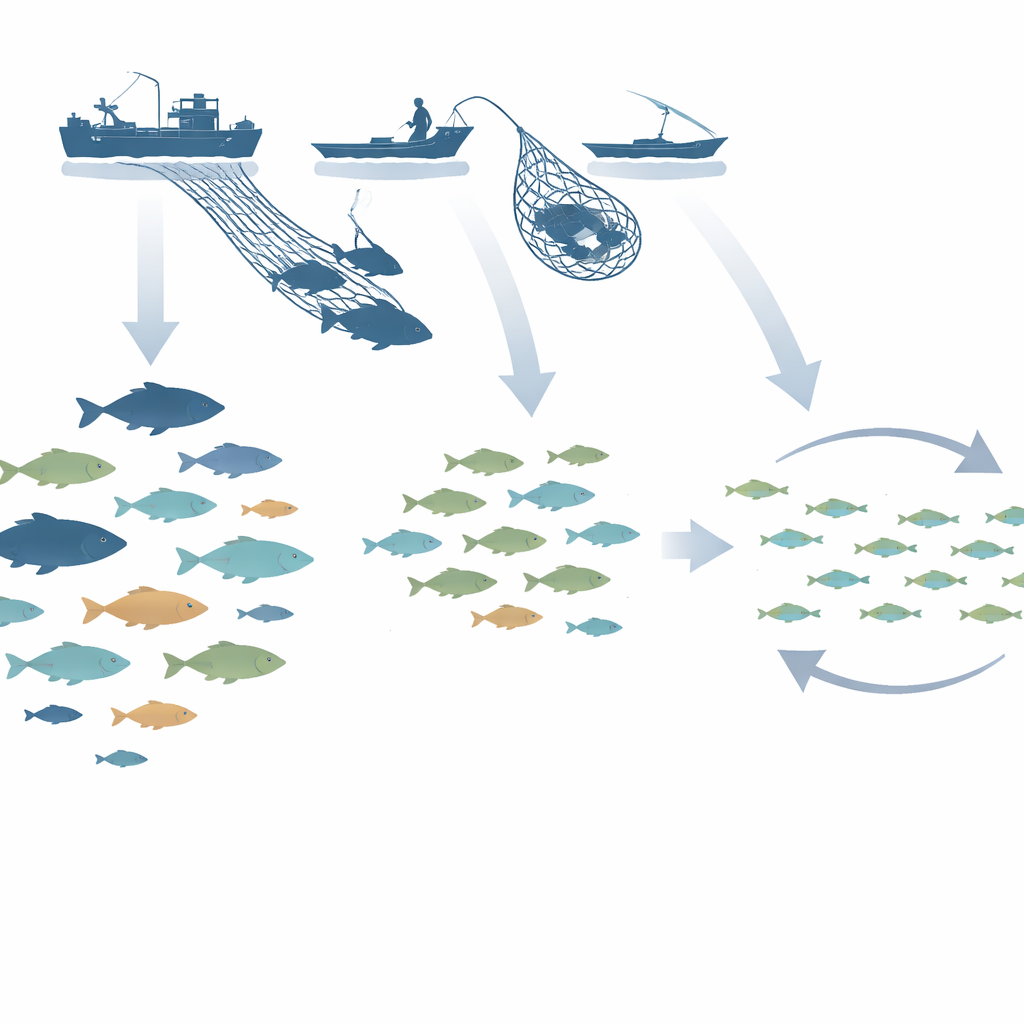
Climate warming versus overfishing
Because the oceans have warmed by about 1 °C over the study period, the team also asked whether rising temperatures were responsible for shrinking fish. They compared growth performance in temperate, subtropical and tropical regions and linked each observation to local sea-surface temperature. Growth performance declined only in temperate regions, where most intensively managed, commercially valuable fisheries are located. Subtropical and tropical fishes, which have warmed even more in many places, showed no clear long-term change. When the authors explicitly modelled temperature effects while accounting for shared ancestry among species, they found that warming tended to boost growth performance in unfished and unmanaged fishes, but had essentially no detectable effect on managed, heavily exploited stocks. In other words, the biological fingerprints of overfishing appear to overwhelm the more subtle effects of gradual warming.
What this means for the future
The study concludes that a century of size-focused fishing has left a lasting mark on the world’s marine fishes, driving a global decline in how well many species grow. This matters because smaller, faster-turnover populations can be less stable and may produce less biomass over time, threatening both marine food webs and human food security. The authors argue that smarter fishing rules—such as protecting both the smallest and largest individuals using “harvest slots”—could help rebuild healthier size structures and make fish populations more resilient to ongoing climate change. For readers, the key message is that today’s oceans still hold abundant life, but the fish within them are, on average, growing less impressively than they once did—and better management choices now will shape whether that trend continues.
Citation: Yan, H.F., Watkins, H.V., Siqueira, A.C. et al. Over a century of global decline in the growth performance of marine fishes. Nat Commun 17, 2612 (2026). https://doi.org/10.1038/s41467-026-69416-x
Keywords: overfishing, fish growth, marine ecology, climate change, fisheries management