Clear Sky Science · en
Colloidal synthesis of large near-bulk InAs quantum dots through seeded and seedless growth using cluster precursors
Why bigger quantum dots matter
From night-vision cameras in cars to face recognition on smartphones, many emerging technologies rely on detecting invisible infrared light. Today this often requires expensive, power-hungry semiconductor chips. This study presents a more affordable and environmentally friendlier alternative: tiny crystals of indium arsenide, called quantum dots, grown in liquid solution and made so large that they begin to behave almost like ordinary bulk material while still retaining some quantum advantages.
Building tiny crystals for invisible light
Quantum dots are semiconductor particles so small that their color and infrared response are controlled by their size. For devices that must see deep into the infrared, such as long-range imaging or chemical sensing, the dots must be comparatively large. That has been difficult for indium arsenide, a material attractive because it is compatible with European rules limiting toxic elements like lead and mercury. The chemical bond between indium and arsenic is strong and fussy, so most earlier recipes produced only small particles, required hazardous ingredients, or gave poor control over size and uniformity.
Starting from stable nano “seeds”
The researchers solved this by first making very small, stable indium arsenide clusters in a liquid containing indium(I) chloride and a relatively safe arsenic compound known as amino-arsine. These clusters are just a couple of nanometers across and absorb visible light. By adjusting temperature and reaction time, the team could tune their size and optical fingerprint, and they found that the clusters remained chemically stable for years when stored in an oxygen-free environment. Heating these clusters further transformed them into slightly larger, well-defined “seed” quantum dots, whose size and crystal structure could be measured precisely using electron microscopes and X-ray diffraction.
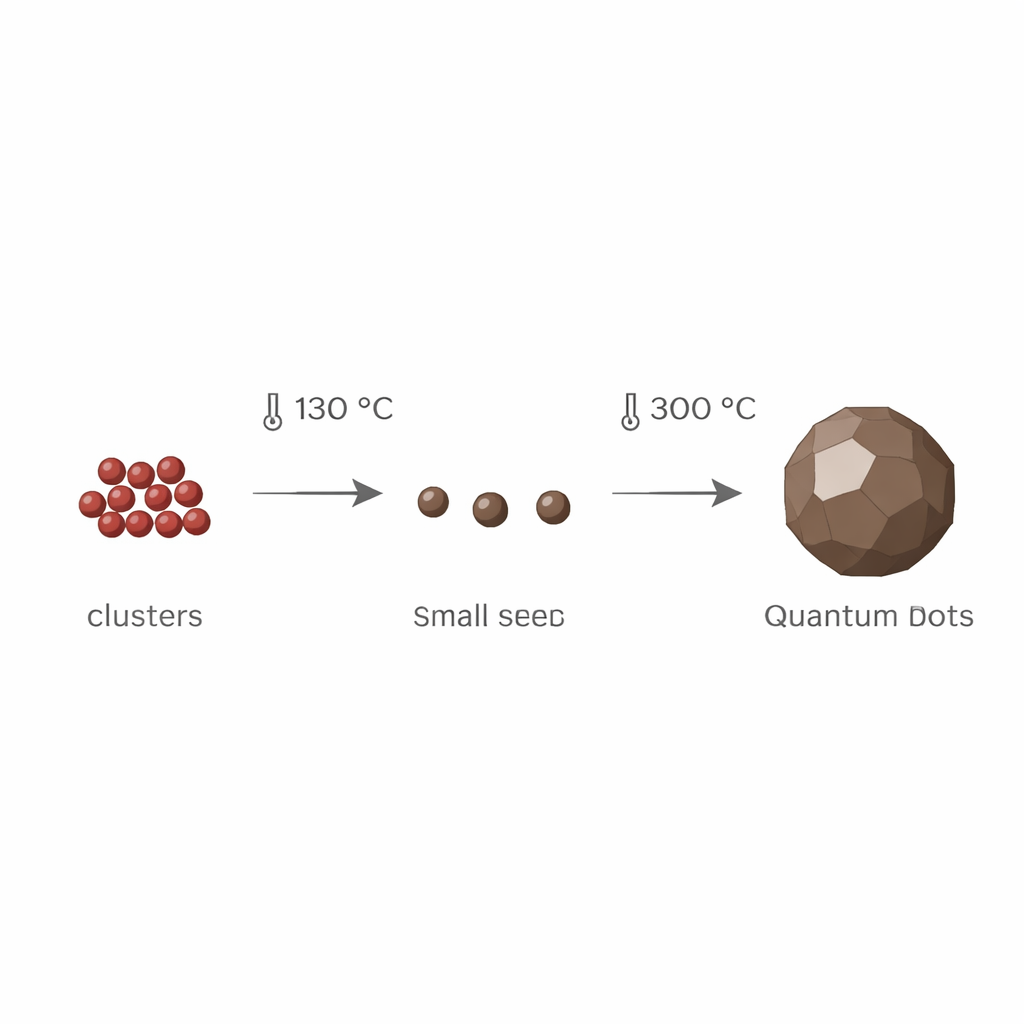
Growing quantum dots step by step
With these seeds in hand, the team developed two growth strategies. In the seeded approach, pre-made seeds were suspended in hot solvent while fresh cluster solution was slowly injected. After each injection, the mixture was held at high temperature (an annealing step), allowing atoms released from the clusters to attach to the existing seeds rather than forming new particles. Repeating these injection–annealing cycles gradually increased the dot size. By fine-tuning injection rate, concentration, and the time spent annealing, the researchers produced smooth, non-elongated indium arsenide quantum dots up to about 18 nanometers across, with their absorption edge shifting far into the short-wave infrared.
Reaching near-bulk particle sizes
To push sizes even further, the scientists diluted the number of seeds so that each growing dot had more material available. This led to particles around 36 nanometers but with a broader spread of sizes and varied shapes such as octahedra and icosahedra. In a second, even more striking method, they skipped seeds entirely. Instead, they injected clusters into hot solvent and let a small number of “natural” seeds form on their own before continuing growth. Because fewer seeds shared the available material, the resulting particles reached average diameters of about 40 nanometers, with some exceeding 60 nanometers. At these dimensions the particles approach or exceed the so-called exciton Bohr radius of indium arsenide, the scale where quantum effects begin to weaken and properties resemble bulk material.
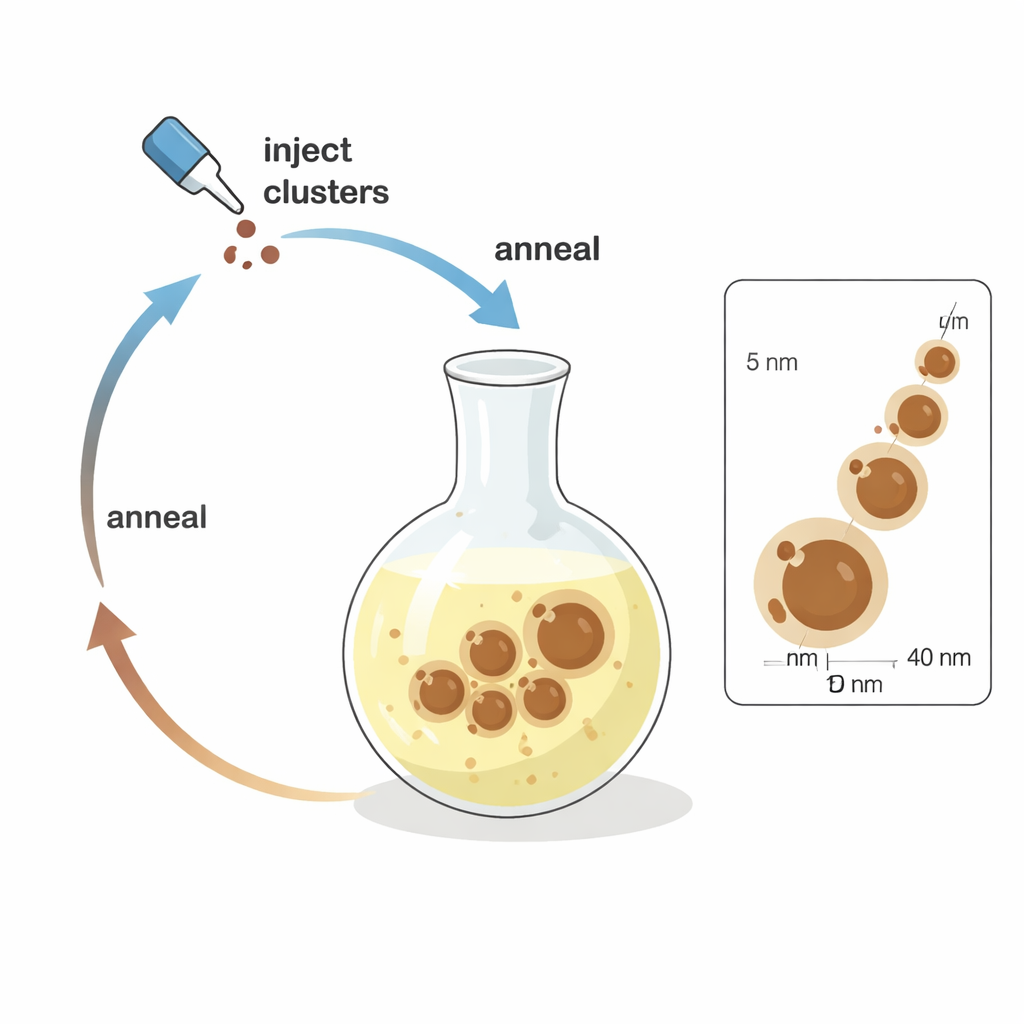
What this means for future infrared devices
Although such large particles no longer show sharp absorption peaks, measurements confirm that they absorb strongly well into the mid-infrared. Importantly, all steps use commercially available precursors and avoid notoriously dangerous arsenic reagents, making the process more sustainable and easier to scale. The authors argue that their cluster-based, stepwise growth toolbox opens the door to industrial production of lead- and mercury-free infrared-active quantum dots. These near-bulk indium arsenide particles could underpin next-generation detectors, cameras, and communication devices that see further into the dark while remaining safer, cheaper, and more flexible to manufacture.
Citation: Salikhova, E., Mews, A., Schlicke, H. et al. Colloidal synthesis of large near-bulk InAs quantum dots through seeded and seedless growth using cluster precursors. Nat Commun 17, 1700 (2026). https://doi.org/10.1038/s41467-026-69409-w
Keywords: indium arsenide quantum dots, infrared imaging, colloidal nanocrystals, seeded growth, nanomaterials synthesis