Clear Sky Science · en
Rising Air-Conditioning Use Intensifies Global Warming
Staying Cool in a Hotter World
As heatwaves become more frequent and cities grow, billions of people are turning to air-conditioning to stay safe and comfortable. But the very machines that protect us from extreme heat are quietly adding more heat to the planet. This study asks a troubling question: how much extra global warming will come from our expanding use of air-conditioners, and who will be able to afford this cooling in the first place?
Why Cooling Demand Is Surging
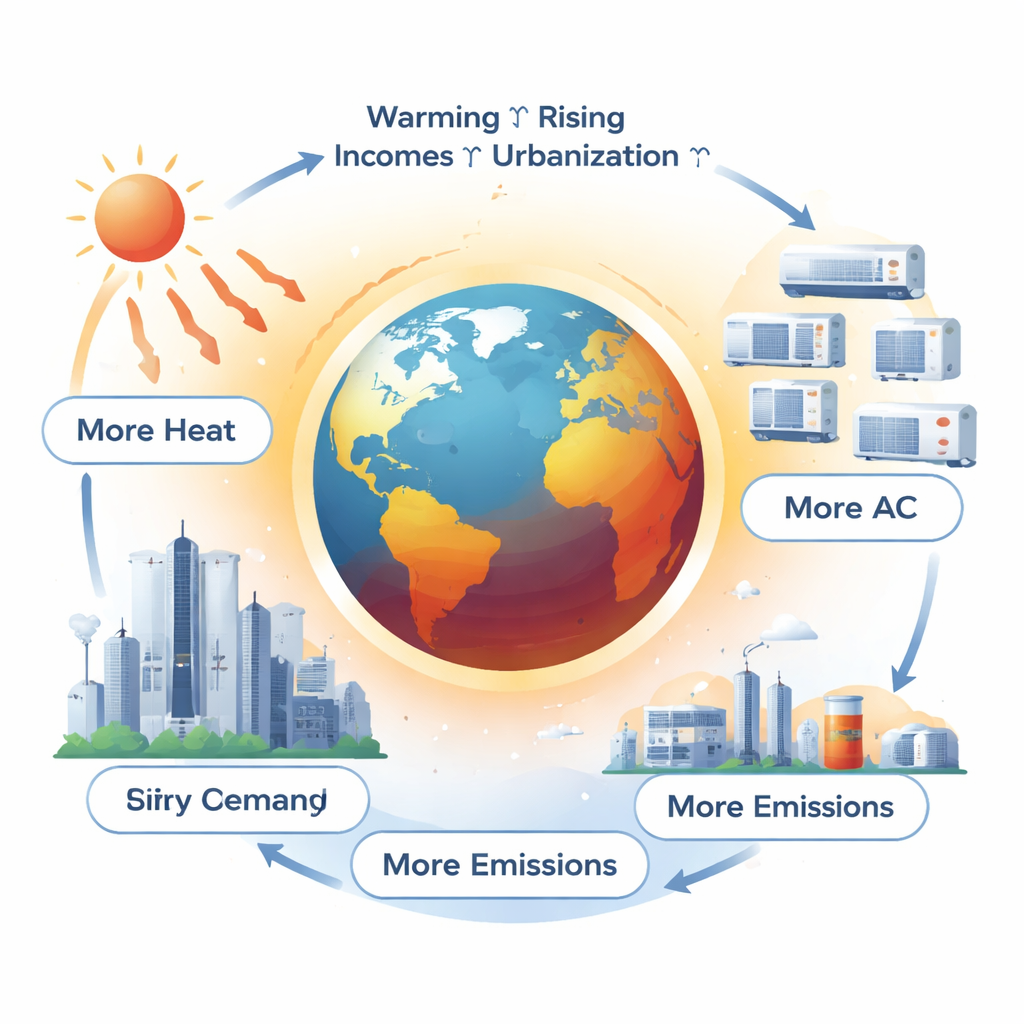
Two big forces are driving a rapid rise in air-conditioning: a warming climate and rising incomes. As global temperatures increase, many regions experience more days that feel dangerously hot, especially once humidity is taken into account. At the same time, economic growth, urbanization, and cheaper appliances are making AC units more common. Using detailed climate models and population data, the researchers estimate how much “cooling demand” will grow this century, measured by how often and how far temperatures rise above a comfortable baseline. Across a range of future climate pathways, the world’s need for cooling increases substantially, especially in already hot, humid regions near the equator.
More Air-Conditioners, More Power, More Emissions
Translating this rising need into actual machines, the team projects global air-conditioning stock to reach roughly 2 to 3 billion units by 2050 in a middle-of-the-road scenario, with even higher totals if the world develops quickly while relying heavily on fossil fuels. Powering this equipment will require thousands of terawatt-hours of electricity each year, a large share of all power used in buildings. Because electricity in many countries still comes mainly from coal, oil, and gas, this extra demand leads to substantial greenhouse gas emissions. On top of that, common refrigerants used inside AC units are themselves powerful warming gases if they leak, and by mid-century those leaks could account for most emissions from cooling systems.
How Much Extra Warming ACs Create
The researchers then feed these AC-related emissions into a climate model to estimate how much they add to global temperature. Between 2010 and 2050, air-conditioning alone is projected to increase the global average temperature by about 0.03 to 0.07 degrees Celsius, depending on how strongly the world curbs overall emissions. That may sound small, but at today’s high level of warming, every tenth of a degree matters for heatwaves, crop losses, and extreme weather. Most of this added warming comes from economic growth—more people with higher incomes buying and running more ACs—rather than from the direct effect of a hotter climate increasing AC use. If electricity systems rapidly switch to low-carbon energy and refrigerants with much lower warming power, the cooling we rely on could have a far smaller climate penalty.
Who Gets to Stay Cool?
The study also reveals a striking fairness problem. Regions with the greatest need for cooling—such as parts of South Asia, West Africa, and other low-latitude areas—are often among the poorest. Even as incomes rise, many households in these places still cannot afford to buy or run air-conditioners. By comparing income levels, cooling needs, and projected AC ownership, the researchers show that by 2050 the richest 10 percent of the global population will enjoy far more cooling per unit of heat exposure than the poorest 10 percent. If everyone in low- and middle-income regions had the same income and AC access as people in wealthy regions, hundreds of millions of additional units would be installed, raising global temperatures even further.
Balancing Comfort, Fairness, and the Climate
In simple terms, the paper concludes that the world faces a double challenge: we must expand access to safe indoor temperatures for billions of people without supercharging global warming. The authors argue that this requires a rapid shift to clean electricity, much stronger rules to phase in climate-friendly refrigerants, more efficient buildings and cooling equipment, and policies that help low-income households afford safe cooling. Without such a low-carbon cooling transition, the effort to protect people from dangerous heat will itself push the planet closer to temperature limits that make life hotter and more hazardous for everyone.
Citation: Zhang, H., Shan, Y., Li, R. et al. Rising Air-Conditioning Use Intensifies Global Warming. Nat Commun 17, 1961 (2026). https://doi.org/10.1038/s41467-026-69393-1
Keywords: air conditioning, global warming, cooling demand, energy inequality, clean cooling