Clear Sky Science · en
Efficient pheromone navigation via antagonistic detectors in Caenorhabditis elegans male
How Tiny Worms Solve a Big Search Problem
Finding a partner is a life-or-death mission for many animals, and even tiny soil-dwelling worms face a surprisingly hard version of this task. Male Caenorhabditis elegans must track down females by following a faint, short-lived scent that drifts through air and porous material like rotting fruit. This study reveals that males solve this problem not with a simple “follow-the-scent” rule, but with a clever comparison between two opposite ends of their body, using a pair of cooperating and competing sensors in the head and tail.
Two Noses on One Body
At the heart of the story is a still-unknown volatile sex pheromone released by females that no longer produce sperm. Males recognize this signal with a receptor called SRD-1, but in an unusual twist, the same receptor appears in very different nerve cells. In male worms, SRD-1 is found in AWA sensory neurons in the head and in a male-specific pair of tail neurons called PHD. Using genetic markers and high-resolution imaging, the researchers confirmed that PHD indeed carries this receptor and lights up when exposed to female scent. When SRD-1 is disabled, both head and tail neurons stop responding, showing that they truly detect the same chemical cue even though they sit far apart.
Head Drives the Chase, Tail Fixes the Mistakes
Why does a tiny creature that is barely a millimeter long need detectors at both ends, when the concentration difference across its body is minuscule? Behavioral tests provide the answer. When navigation is easy—short distances on flat agar and strong pheromone—males that have had their PHD tail neurons shut down perform almost as well as normal animals. But when the task becomes realistic and hard—longer distances, weaker scent, or movement in a soft three-dimensional gel that mimics soil—males without working PHD neurons falter. They wander, miss weak sources, and rarely reach the target. This suggests the head sensor is enough for simple chemotaxis, but the tail sensor becomes crucial when the signal is patchy, faint, or distorted.
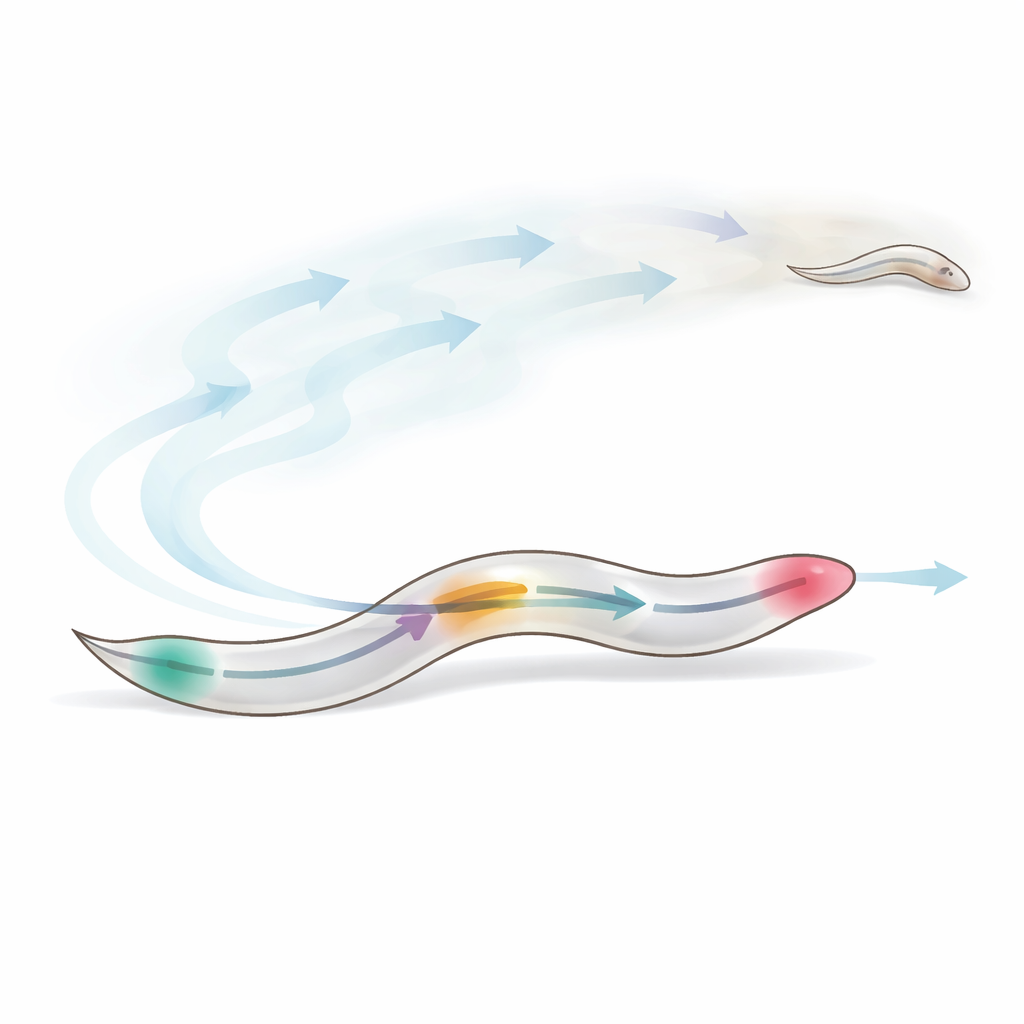
To probe what each sensor does in real time, the team used optogenetics, turning neurons on with flashes of red light. Activating all SRD-1-positive neurons at once drove males into persistent forward motion: they sped straight ahead and suppressed turns. Isolating the tail PHD neurons told a different story. When only PHD was activated, worms slowed down and tended to reverse more, especially when the tail region was selectively illuminated. In contrast, stimulating the head region suppressed direction changes during the light and triggered bursts of turning and “self-exploration” afterward, as males probed their own body with their tail. Together, these experiments show that head circuits push the animal forward, while tail circuits act as a brake and steering correction.
Inside the Worm’s Decision Hub
Calcium imaging across the entire nervous system revealed how these opposing signals converge. Head neurons AWA and ASI respond quickly to rising pheromone, then adapt and quiet down even if the scent remains. Tail neurons PHD, by contrast, respond more slowly but can stay active for many minutes, especially at moderate concentrations. A key command neuron, AVA, which helps trigger reversals, is strongly inhibited when head neurons are active and modestly excited when tail neurons fire. In other words, the brain’s “reverse” center listens mostly to the head saying “keep going” and a little to the tail saying “back up.” Microfluidic devices that deliver controlled scents just to the head, just to the tail, or to both ends confirmed this antagonism: head-only stimuli suppress AVA, tail-only stimuli at certain low doses excite it, and combined stimuli can be predicted by a weighted mix of the two.
A Simple Algorithm for a Messy World
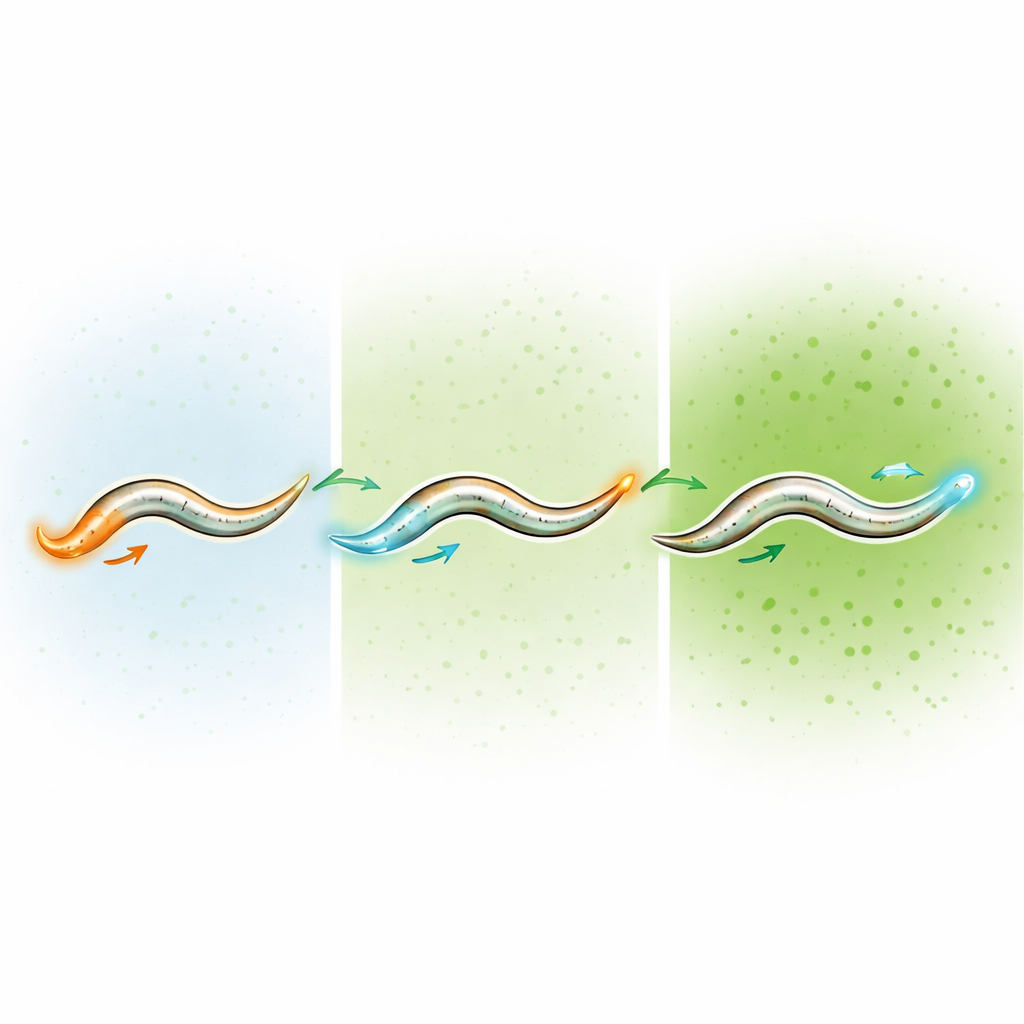
Real pheromone plumes do not form neat gradients. Simulations of scent spreading through air and agar showed swirling, non-Gaussian fields in which a worm often experiences low overall concentration and misleading changes over time. Using these fields, the researchers built a minimalist navigation model. In it, head and tail inputs are turned into separate “confidence” signals about whether the worm is heading the right way. The difference between head and tail confidence then sets both speed and the chance of turning. Head input, which reacts to improvements in the gradient, encourages long forward runs and fast “sprinting” near the source. Tail input, tuned to absolute level, becomes most influential at moderate concentrations, raising the probability of reversals when the worm drifts off course. Simulated worms with only head input frequently become overconfident and veer away; adding the tail input doubles success in tough searches and produces trajectories that resemble real behavior.
What This Means Beyond Worms
This work shows that even a tiny nervous system can solve a complex search problem using a surprisingly elegant strategy. Rather than depend on the small physical distance between head and tail, C. elegans males compare two kinds of information about the same smell: rapid change detection in the head and slower threshold sensing in the tail. The head drives pursuit when the signal clearly improves; the tail reins in mistakes when the signal is weak or deceptive. The result is a robust, sex-specific navigation algorithm that lets males track fleeting pheromones in cluttered, changing environments. Similar “antagonistic detector” designs—where different sensors for the same cue push behavior in opposing directions—may be a common way that brains, large and small, turn noisy chemical landscapes into reliable paths toward a mate.
Citation: Wan, X., Zhou, T., Susoy, V. et al. Efficient pheromone navigation via antagonistic detectors in Caenorhabditis elegans male. Nat Commun 17, 2738 (2026). https://doi.org/10.1038/s41467-026-69392-2
Keywords: pheromone navigation, Caenorhabditis elegans, chemotaxis, neural circuits, mate searching