Clear Sky Science · en
Spin-exciton coupling modified by interfacial magnetic interactions in a van der Waals heterostructure
Light and magnetism working together
Imagine a light-emitting material whose color you can dial up or down just by changing how its tiny internal magnets line up—no bulky magnets or complex wiring required. This study shows how stacking two ultra-thin crystals lets scientists tune the color of the light-carrying particles inside, called excitons, in both directions. Such fine control could underpin future low‑power data links, quantum devices, and new kinds of optical memory, where information is written and read using both light and magnetism.
Stacking two tiny crystals
The researchers build a "van der Waals heterostructure"—a sandwich made from two different atomically thin materials that gently stick together. The top layer, CrSBr, is a semiconductor whose atoms behave like tiny magnets pointing in alternating directions, a pattern known as antiferromagnetism. The bottom layer, Fe3GaTe2 (FGT), is a ferromagnet, where the mini-magnets all point the same way and stay ordered even above room temperature. When these two are stacked, they interact across their shared interface without the need for chemical bonding, letting the team probe how magnetism in one layer can reshape the light‑emitting behavior of the other. 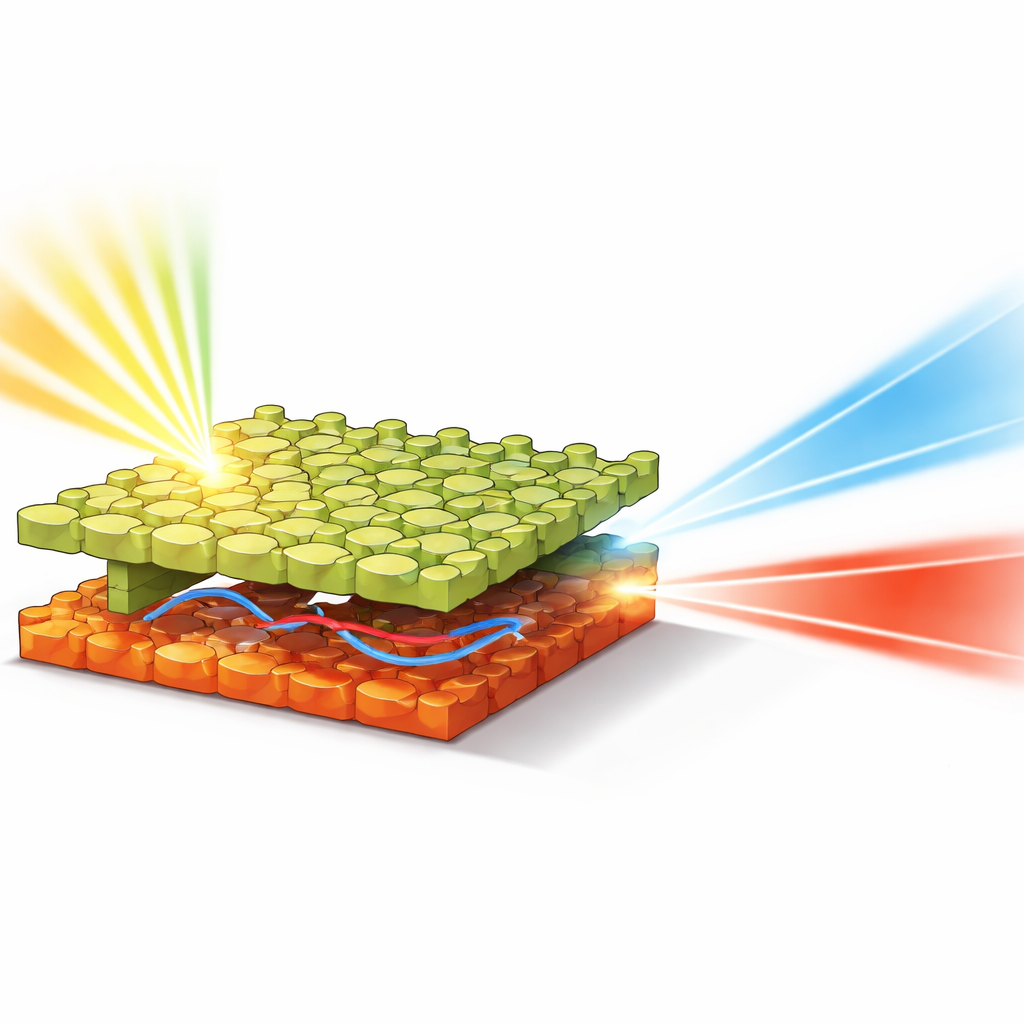
Color shifts that follow hidden magnetism
Inside CrSBr, light creates excitons—bound pairs of electrons and holes—that later release their energy as new light. The energy, and therefore color, of this light is extremely sensitive to the magnetic arrangement of the atoms. By comparing plain CrSBr with the stacked CrSBr/FGT structure across a wide temperature range, the team tracks how the glow from excitons shifts. They find that around CrSBr’s magnetic transition temperature, the exciton emission in the stack jumps to higher energy (a “blueshift”) compared with the bare crystal, and at other temperatures it shifts to lower energy (a “redshift”). In total, the emission can be tuned by more than 6–8 percent of its full bandwidth in either direction—an unusually large and reversible range for such materials.
Invisible charges and strengthened order
Why does simply adding a magnetic underlayer so strongly reshape the light coming from CrSBr? Using a suite of microscopy and spectroscopy tools, the authors show that electrons leak slightly from FGT into CrSBr at the interface. This subtle charge transfer changes how the unpaired electrons in both materials occupy their atomic orbitals, reducing their individual magnetic moments but strengthening how their spins prefer to align. Simulations and magnetic transport measurements reveal that, as a result, CrSBr’s antiferromagnetic pattern becomes more robust: it is harder to flip, domain walls are stiffer, and the material behaves more like a single magnetic region. These magnetic changes are tightly mirrored in the exciton energy shifts, confirming that light emission is being steered by interfacial spin order rather than by charge transfer alone. 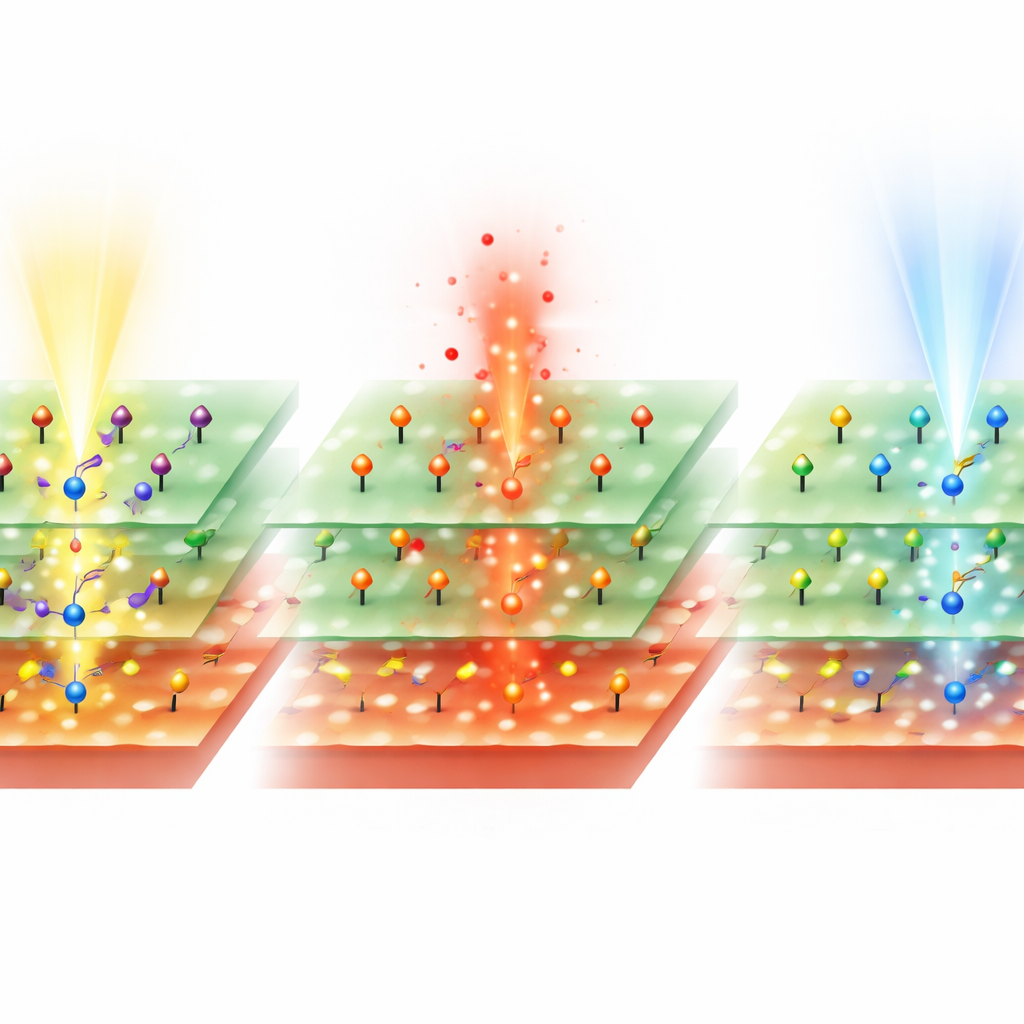
Blocking and opening recombination paths
On the microscopic level, excitons in layered CrSBr can either stay within a single sheet or stretch across neighboring sheets. When spins in adjacent layers are opposite, as in strong antiferromagnetic order, interlayer recombination is suppressed and excitons behave more like confined particles, tending to emit higher‑energy light. When spins are forced toward a ferromagnetic arrangement, interlayer mixing becomes easier, lowering the emission energy. In the CrSBr/FGT stack, the interfacial magnetic interaction tips this balance: at low temperatures it reinforces antiferromagnetism in CrSBr and blocks interlayer recombination, producing the observed blueshift. At higher temperatures, where CrSBr’s own order weakens but FGT remains magnetic, the proximity to FGT can locally favor more ferromagnetic‑like regions, reopening interlayer paths and causing a redshift.
Toward tunable light‑based devices
These findings show that by carefully engineering the interface between a magnetic semiconductor and a ferromagnet, it is possible to push exciton energies up or down at will, without sacrificing the speed and robustness that come with antiferromagnetic order. In practical terms, that means a new design knob for setting the color and timing of light in ultra‑thin devices—useful for wavelength‑selectable lasers, spin‑logic components, and quantum technologies that need precise control of excitonic states. The work demonstrates that spin and light can be coherently linked in two‑dimensional materials, opening a path toward compact, energy‑efficient components where magnetism quietly reconfigures how matter glows.
Citation: Lan, W., Liu, C., Feng, Y. et al. Spin-exciton coupling modified by interfacial magnetic interactions in a van der Waals heterostructure. Nat Commun 17, 2551 (2026). https://doi.org/10.1038/s41467-026-69389-x
Keywords: excitons, antiferromagnets, van der Waals heterostructures, spintronics, optoelectronics